
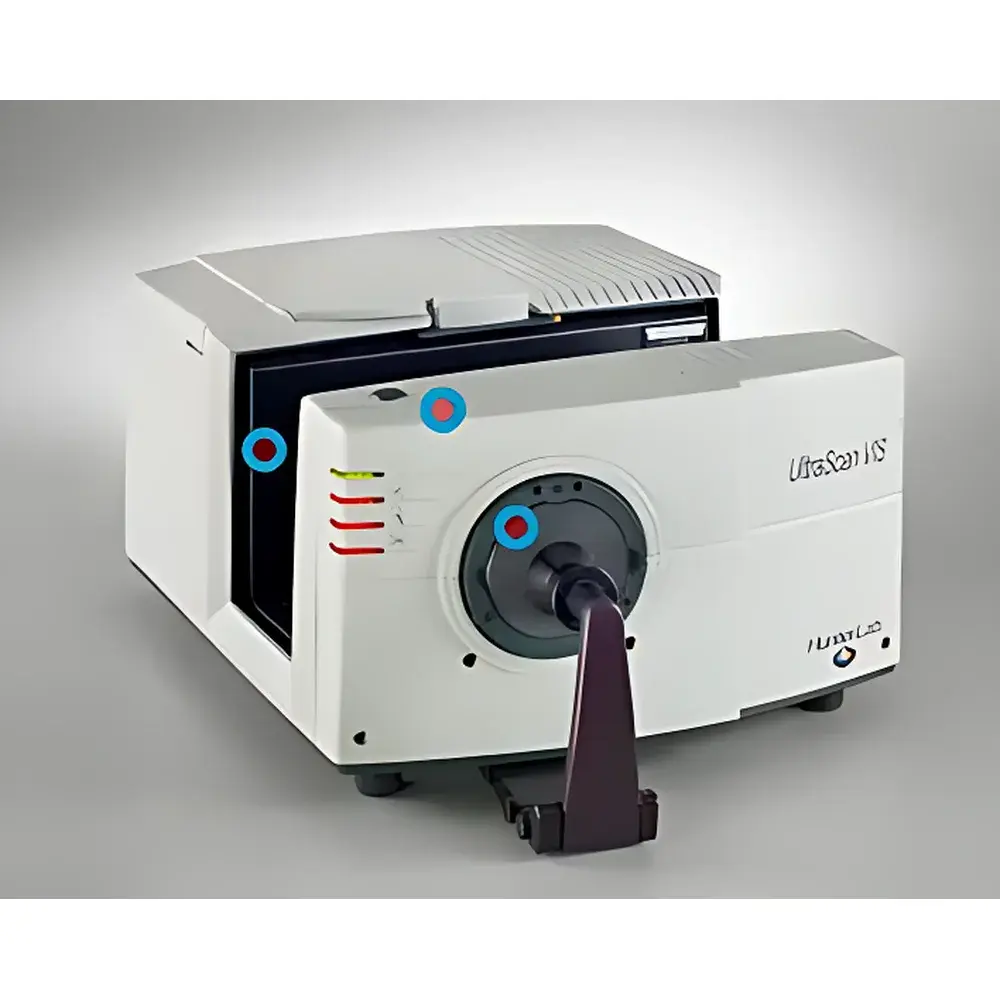
HunterLab UltraScan VIS Spectrophotometer
| Brand | HunterLab |
|---|---|
| Origin | USA |
| Model | UltraScan VIS |
| Product Type | Colorimeter |
| Instrument Type | Benchtop (not online) |
| Optical Geometry | d/0° (Diffuse Illumination / 0° Viewing) with Integrated Sphere |
| Spectral Range | 360–780 nm |
| Spectral Bandwidth | 10 nm |
| Reporting Interval | 10 nm |
| UV Calibration | Automatic |
| Measurement Modes | Reflectance (Specular Included/Excluded), Transmittance (Regular & Haze), Fluorescent Sample Support (D65 + UV) |
| Aperture Sizes | 25 mm and 9.5 mm |
| Compliance | ASTM E308, ASTM D2244, ISO 11664, CIE No. 15:2018, USP <1061>, FDA 21 CFR Part 11 (via EasyMatch QC) |
Overview
The HunterLab UltraScan VIS Spectrophotometer is a high-precision, benchtop color measurement instrument engineered for rigorous color quality control and research applications across industrial and laboratory environments. It operates on the principle of diffuse illumination/0° viewing (d/0°) geometry using an integrated 150 mm diameter sphere, conforming to CIE-recommended spectral evaluation conditions. Designed to quantify colorimetric data in full compliance with CIE 15:2018, the instrument captures spectral reflectance and transmittance across the complete human-visible spectrum—from 360 nm to 780 nm—with a fixed 10 nm optical bandwidth and 10 nm data reporting interval. Its dual-beam silicon photodiode array architecture enables real-time reference correction, minimizing drift and ensuring high inter-instrument agreement (<0.15 ΔE*ab for tile standards). The system incorporates a long-life xenon flash lamp calibrated to simulate the CIE Standard Illuminant D65, including controlled UV component output for accurate assessment of fluorescent and optically brightened materials.
Key Features
- Integrated 150 mm diameter sphere with matte barium sulfate coating for uniform diffuse illumination and minimal stray light
- Automatic specular component compensation (SCI/ SCE switching) via motorized baffle—enabling consistent measurement of textured, glossy, or structured surfaces
- Dual aperture options (25 mm and 9.5 mm) for flexible sample coverage, supporting both large-area homogeneity checks and small-part analysis
- Transmittance compartment with three-sided open configuration—accommodating oversized bottles, cuvettes, and irregularly shaped transparent or translucent specimens up to 100 mm in height
- Real-time UV energy monitoring and auto-compensated UV calibration routine—critical for repeatable fluorescence quantification per ASTM E308 Annex A5
- Robust mechanical construction: stainless-steel fasteners, vibration-damped optical platform, and sealed electronics for long-term thermal and mechanical stability
- Front-panel status indicators and ergonomic sample stage with adjustable tilt—supporting solids, powders, pastes, liquids, films, and fibrous substrates without reconfiguration
Sample Compatibility & Compliance
The UltraScan VIS accommodates a broad spectrum of physical forms—including opaque solids (paint chips, plastic pellets, ceramic tiles), translucent media (milk, fruit juices, gels), transparent objects (glass, PET bottles, optical lenses), and semi-crystalline matrices (textiles, carpet fibers, paper). Its d/0° geometry ensures metrologically sound measurements of scattering samples, while its haze-capable transmittance mode complies with ASTM D1003 for total and diffuse transmittance, as well as ASTM D5629 for wide-angle haze quantification. All color calculations adhere to CIE 116:1995 and ISO/CIE 11664 series standards, with tristimulus integration performed over the full 360–780 nm range. Instrument validation is supported by NIST-traceable calibration tiles and certified interference filters; routine performance verification meets GLP/GMP audit requirements when paired with EasyMatch QC’s electronic signature and 21 CFR Part 11-compliant audit trail.
Software & Data Management
The UltraScan VIS operates exclusively with HunterLab’s EasyMatch QC software—a validated, scalable platform for method development, statistical process control (SPC), and regulatory reporting. EasyMatch QC supports multi-instrument network synchronization, custom pass/fail tolerancing (ΔL*a*b*, ΔE00, CMC, DIN99), and automated report generation compliant with ISO/IEC 17025 documentation frameworks. Raw spectral data (360–780 nm @ 10 nm intervals) is exportable in CSV, XML, and CxF/XRGA formats for third-party spectral analysis or integration into LIMS and MES systems. The software enforces role-based access control, full electronic audit trails, and secure user authentication—meeting FDA 21 CFR Part 11 requirements for electronic records and signatures in regulated manufacturing environments.
Applications
The UltraScan VIS serves as a primary color measurement platform in quality assurance laboratories across paint & coatings, food & beverage, pharmaceuticals, plastics, textiles, automotive glass, and cosmetics industries. Typical use cases include: incoming raw material verification (e.g., pigment batches, resin pellets); in-process color consistency monitoring of extruded profiles or injection-molded parts; final product release testing of bottled beverages, lipstick formulations, or medical device housings; development of color-matching algorithms for OEM supply chains; and regulatory submission support for USP appearance testing of injectables or ophthalmic solutions. Its ability to simultaneously quantify color, luminous transmittance, and haze makes it indispensable for optical clarity validation in packaging and display technologies.
FAQ
Does the UltraScan VIS support measurement of fluorescent samples?
Yes—its xenon flash source includes a tunable UV component, and the instrument performs automatic UV calibration prior to each fluorescent measurement cycle, ensuring traceable compliance with CIE 15:2018 Annex E.
Is the d/0° geometry suitable for measuring metallic or pearlescent coatings?
While d/0° provides excellent repeatability for flat, non-directional finishes, gonio-apparent effects in effect pigments require a multi-angle spectrophotometer (e.g., MiniScan EZ or AE series); UltraScan VIS remains optimal for base-color formulation and batch-to-batch consistency checks.
Can spectral data be exported for external analysis?
Yes—EasyMatch QC exports full 360–780 nm spectral curves in ASCII-compatible formats, enabling advanced modeling in MATLAB, Python, or proprietary spectral prediction engines.
What maintenance is required to maintain long-term accuracy?
Annual verification using HunterLab’s Certified Reference Standards (CRS) and optional factory recalibration are recommended; no user-serviceable optics or lamps are present—the xenon flash lamp is rated for >2 million flashes.
Does the instrument meet international regulatory requirements for pharmaceutical color testing?
Yes—when operated with validated EasyMatch QC methods and documented calibration history, it satisfies USP , EP 2.2.58, and ICH Q5E color stability testing requirements.





