
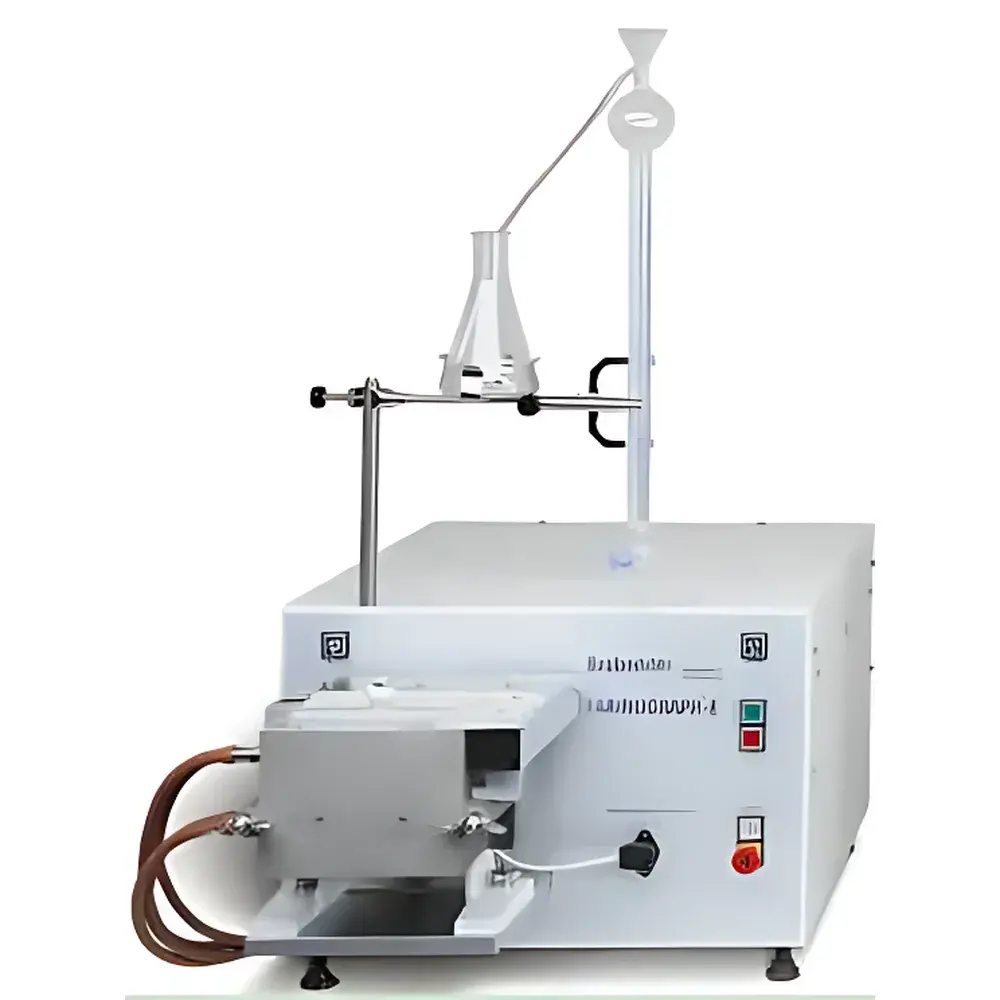
Brabender Farinograph-E Electronic Farinograph
| Brand | Brabender |
|---|---|
| Origin | Germany |
| Model | Farinograph-E |
| Bowl Options | 10 g, 50 g, and 300 g dough bowls |
| Control System | Fully computer-controlled with digital torque sensing |
| Data Interface | RS-232 or USB serial communication |
| Compliance | Designed to meet ISO 5530-1 and AACC Method 54-21 requirements |
Overview
The Brabender Farinograph-E Electronic Farinograph is an advanced, microprocessor-controlled instrument engineered for precise rheological characterization of wheat flour and dough systems. It operates on the principle of controlled mechanical mixing under standardized hydration and temperature conditions, measuring torque resistance as a function of time to generate the farinogram — a fundamental curve used to assess dough consistency, water absorption, dough development time, stability, and degree of softening. Unlike legacy mechanical farinographs relying on analog levers and damped pendulums, the Farinograph-E employs high-resolution digital torque transducers and real-time motor speed regulation, eliminating mechanical hysteresis and drift. Its compact, modular architecture integrates seamlessly into modern QC laboratories where space efficiency, data traceability, and method reproducibility are critical. The instrument conforms to internationally recognized standard test protocols, including ISO 5530-1 (Cereal and cereal products — Determination of rheological properties using the farinograph — Part 1: Method using 50 g flour) and AACC International Method 54-21 (Farinograph Method), ensuring compatibility with regulatory and contractual specifications across milling, baking, and ingredient supply chains.
Key Features
- Digital torque measurement system with ±0.5% full-scale accuracy, replacing traditional mechanical lever assemblies to improve long-term calibration stability and reduce maintenance intervals.
- Computer-integrated control interface allowing full parameter definition (water addition rate, mixing speed profile, target temperature, test duration) via keyboard input prior to run initiation.
- Real-time graphical display of the farinogram during operation, enabling immediate visual assessment of dough development onset, peak viscosity, breakdown behavior, and end-point determination.
- Multi-bowl compatibility supporting standardized 10 g (micro-farinograph), 50 g (standard), and 300 g (industrial-scale) dough bowls — all interchangeable without hardware modification.
- Programmable temperature control (typically 30 °C ± 0.2 °C) with active cooling/heating jacket integration, ensuring strict thermal compliance per ISO and AACC methodologies.
- Embedded data logging with timestamped raw torque vs. time datasets exported in ASCII or CSV format for external statistical analysis or LIMS integration.
Sample Compatibility & Compliance
The Farinograph-E accepts milled cereal flours (primarily wheat, but also rye, spelt, and composite blends) with typical protein content ranging from 8–15%. It accommodates variations in particle size distribution and starch damage levels commonly encountered in commercial milling environments. All operational parameters align with ISO 5530-1 Annex A (instrument performance verification), ASTM D6796 (Standard Practice for Farinograph Testing), and AACC 54-21. The system supports GLP-compliant workflows through user-accessible audit trails, electronic signatures (when paired with validated laboratory software), and configurable report templates meeting FDA 21 CFR Part 11 requirements for electronic records and signatures.
Software & Data Management
Data acquisition and analysis are managed via Brabender’s proprietary WinFARIN software (Windows-based), which provides automated farinogram interpretation algorithms for key indices: water absorption (%), dough development time (min), dough stability (min), and mixing tolerance index (MTI, BU). Raw datasets are stored with metadata including operator ID, sample ID, environmental conditions (ambient temperature/humidity), and instrument calibration status. Export functions support direct integration with enterprise quality management systems (QMS) and statistical process control (SPC) platforms. Software validation documentation (IQ/OQ/PQ protocols) is available upon request to support GMP or ISO 17025 accreditation efforts.
Applications
- Flour mill quality assurance: routine monitoring of batch-to-batch consistency, blending optimization, and supplier qualification.
- Bakery R&D: formulation development for pan bread, flatbreads, noodles, and extruded products requiring specific dough handling characteristics.
- Grain breeding programs: phenotypic screening of wheat lines for end-use suitability based on farinographic profiles.
- Regulatory testing: generation of certified test reports for export documentation, contract compliance, and third-party certification (e.g., ISO 22000, BRCGS).
- Educational laboratories: hands-on instruction in cereal science, food rheology, and analytical method validation principles.
FAQ
Does the Farinograph-E require recalibration between tests?
No — the digital torque sensor maintains baseline stability across sequential runs; however, daily verification using reference flour standards is recommended per ISO 5530-1 Section 7.2.
Can historical data from older Brabender farinographs be imported into WinFARIN?
Yes, provided legacy files are in Brabender’s native .FAR format or ASCII-delimited time-series structure; conversion utilities are included in WinFARIN v4.2 and later.
Is the 10 g micro-bowl suitable for research applications with limited sample availability?
Yes — the 10 g configuration delivers metrologically equivalent results to the 50 g method when operated under identical thermal and shear conditions, as verified in peer-reviewed interlaboratory studies (Cereal Chemistry, 2018;95:422–430).
What environmental conditions must be maintained in the testing room?
Ambient temperature should be controlled between 20–25 °C with relative humidity ≤65% to prevent flour moisture equilibration artifacts prior to testing.
Does the system support automated water dosing?
The Farinograph-E relies on manual volumetric water addition per standard methods; however, optional Brabender AutoDose modules (sold separately) enable programmable, gravimetric water delivery with ±0.1 mL precision.





