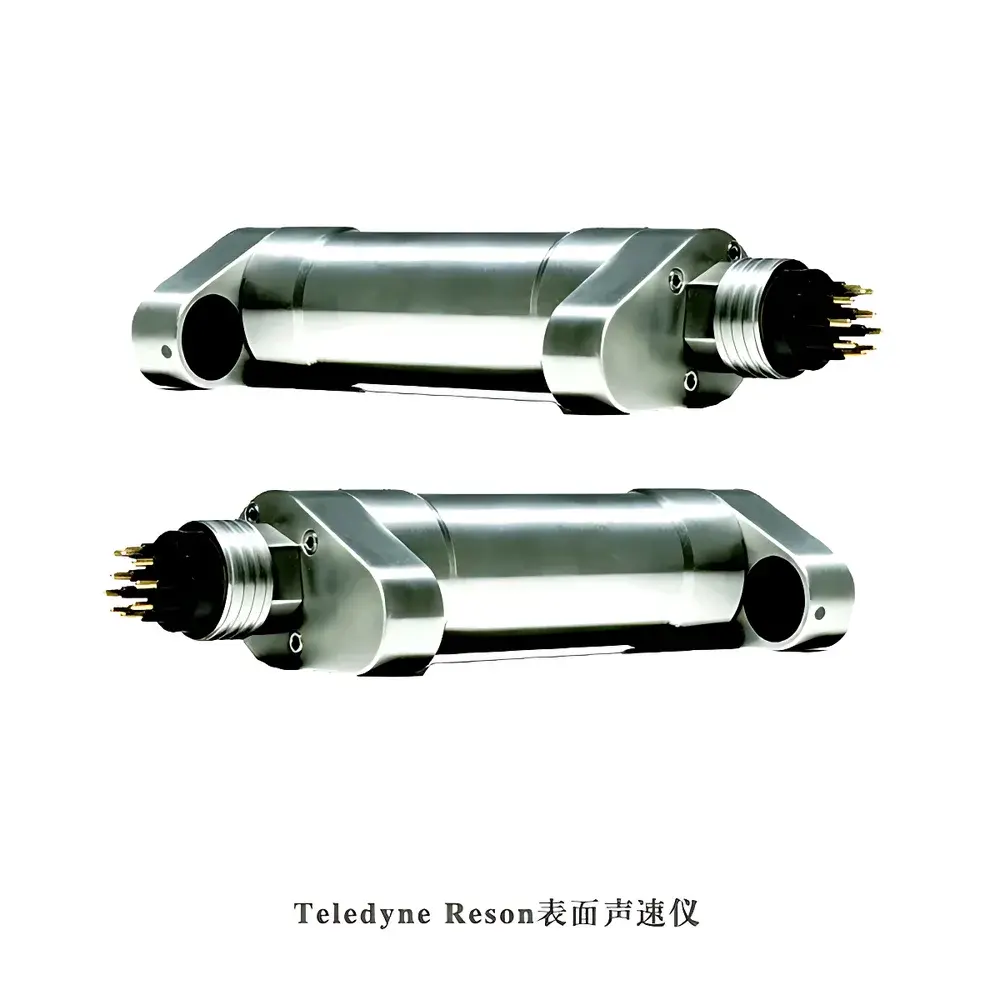
Teledyne Reson SVP9000 Surface Sound Velocity Profiler (Danish-Made)
| Key | Origin: Denmark |
|---|---|
| Brand | Teledyne Reson |
| Measurement Range | 1350–1800 m/s |
| Accuracy | ±0.05 m/s (0–50 m depth), ±0.25 m/s (2000 m & 6000 m depth) |
| Sampling Rate | 20 Hz |
| Operating Voltage | 9–55 VDC |
| Pressure Rating | 6000 m |
| Resolution | 0.01 m/s |
| Transducer Frequency | 2 MHz |
| Output Interfaces | Galvanically Isolated RS-232, RS-422, Ethernet, and Analog (0–5 V) |
Overview
The Teledyne Reson SVP9000 Surface Sound Velocity Profiler is a high-precision, Danish-engineered instrument designed for real-time, in-situ measurement of sound speed in seawater across the full oceanic depth range—from surface deployment to 6000 meters. It employs direct time-of-flight ultrasonic echo detection using a 2 MHz transducer pair, enabling deterministic calculation of acoustic velocity based on precise transit-time measurements between fixed separation distances. This principle—grounded in fundamental acoustics—ensures minimal drift and high reproducibility under varying thermal and hydrostatic conditions. Unlike analog or phase-based systems, the SVP9000’s digital time-of-flight architecture eliminates ambiguity in signal interpretation and supports robust operation in turbid, sediment-laden, or biologically active water columns. Its primary function is to deliver calibrated, pressure- and temperature-compensated sound speed profiles essential for multibeam echosounder (MBES) beamforming, sidescan sonar correction, and underwater navigation modeling.
Key Features
- Titanium alloy pressure housing (Grade 5 Ti-6Al-4V) certified to 6000 m depth, offering exceptional corrosion resistance in saline, sulfide-rich, and low-oxygen environments.
- Integrated high-stability thermistor and quartz-based pressure sensor with factory traceable calibration against NIST-traceable standards.
- Galvanically isolated communication interfaces—including RS-232, RS-422, 10/100BASE-T Ethernet, and analog voltage output—support seamless integration into shipboard networks, AUVs, ROVs, and moored observatories.
- Digital signal processing firmware enables real-time temperature and pressure compensation per IAPSO TEOS-10 equation of state, ensuring compliance with modern oceanographic data standards.
- Compact, streamlined hydrodynamic form factor minimizes flow noise and vortex shedding during towed or free-fall deployments.
- 20 Hz sampling rate supports high-resolution vertical profiling at descent velocities up to 1.5 m/s without aliasing or interpolation artifacts.
Sample Compatibility & Compliance
The SVP9000 is optimized for natural seawater across salinity ranges of 28–42 PSU and temperatures from −2 °C to +35 °C. It does not require sample extraction or conditioning—measurements are performed in situ via direct contact with ambient water. All sensor calibrations conform to ISO/IEC 17025 requirements through Teledyne Reson’s accredited metrology laboratory in Slagelse, Denmark. The instrument meets IEC 60529 IP68 ingress protection, MIL-STD-810G environmental stress screening (vibration, shock, thermal cycling), and complies with IMO Resolution A.817(19) for hydrographic survey instrumentation. Data output formats adhere to NMEA 0183 v4.10 and SeaDataNet BODC conventions, facilitating ingestion into ERDDAP, MATLAB, QGIS, and CARIS HIPS & SIPS workflows.
Software & Data Management
The SVP9000 operates natively with Teledyne Reson’s SIS (Seafloor Information System) and PDS2000 software suites, supporting automated profile stitching, real-time MBES latency compensation, and two-way communication for remote configuration and diagnostics. Raw binary data streams include embedded timestamps synchronized to GPS PPS (pulse-per-second) input, enabling post-mission alignment with vessel motion sensors. Firmware updates are delivered via signed .hex packages with SHA-256 verification. Audit trails, user access logs, and parameter change histories are retained onboard for GLP-compliant operations. Optional integration with OceanServer’s OASIS platform provides cloud-based telemetry, alerting, and long-term metadata archiving compliant with FAIR (Findable, Accessible, Interoperable, Reusable) principles.
Applications
- Real-time sound speed correction for multibeam bathymetric surveys (e.g., EM2040, EM712, Kongsberg MBES systems).
- Vertical profiling during CTD casts, autonomous glider missions, and deep-sea mooring arrays.
- Calibration reference for inverted echo sounders and acoustic Doppler current profilers (ADCPs).
- Supporting hydroacoustic modeling in naval mine countermeasures (MCM) and anti-submarine warfare (ASW) training environments.
- Long-term monitoring of thermohaline structure in continental slope canyons and hydrothermal vent fields.
FAQ
What is the maximum operational depth of the SVP9000?
The SVP9000 is rated for continuous operation to 6000 meters water depth, validated by full-scale pressure chamber testing per ISO 13628-6 Annex D.
Does the instrument support synchronization with external GNSS timing sources?
Yes—it accepts 1PPS input and embeds UTC timestamps with microsecond resolution aligned to GPS or GLONASS receivers.
Is factory recalibration required annually?
Teledyne Reson recommends recalibration every 24 months under typical operational use; extended intervals may be justified with documented in-field verification using traceable reference standards.
Can the SVP9000 operate from a battery-powered platform?
Yes—the 9–55 VDC input range accommodates lithium-thionyl chloride, LiFePO₄, and lead-acid batteries common in AUVs and buoys.
How is data integrity ensured during high-latency telemetry links?
All transmitted frames include CRC-32 checksums and sequence numbering; missing packets trigger automatic retransmission requests in TCP/IP mode.