
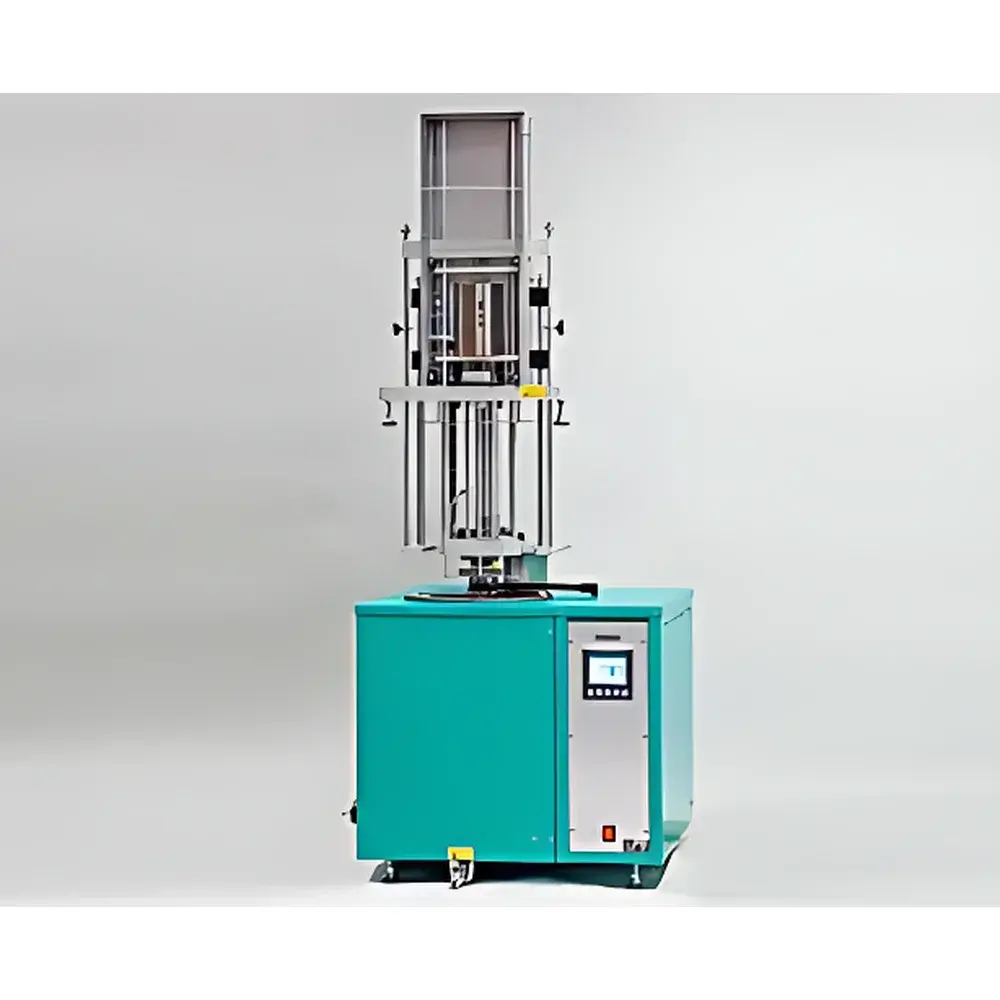
Elastocon ET 05-II Low-Temperature Brittleness Tester
| Brand | Elastocon |
|---|---|
| Origin | Sweden |
| Model | ET 05-II |
| Temperature Range | −80 to +30 °C |
| Temperature Accuracy | ±0.5 °C |
| Temperature Resolution | 0.1 °C |
| Temperature Sensor | PT100, 1/3 DIN |
| Hammer Velocity Measurement | Digital encoder |
| Velocity Resolution | 0.01 m/s |
| Test Stations | 6 |
| Sample Types | ISO 812 Type A and Type B specimens |
| Cooling Medium Volume | ~8 L |
| Power Supply | 220–240 VAC, 50/60 Hz (optional 110–120 VAC) |
| Power Consumption | 600 W |
| Compressed Air Requirement | 6 bar |
| Interface | RS232C (COM port) |
| External Dimensions (W × H × D) | 630 × 1100 (1420) × 710 mm |
| Weight | ~40 kg |
Overview
The Elastocon ET 05-II Low-Temperature Brittleness Tester is an automated, six-station instrument engineered for precise determination of the brittle temperature of vulcanized or thermoplastic elastomers under controlled cryogenic conditions. It operates on the principle of impact-induced fracture initiation, where standardized test specimens are cooled incrementally in a liquid bath until subjected to a calibrated hammer impact. The brittle temperature is defined as the lowest temperature at which no brittle fracture occurs upon impact — a critical parameter for material selection in automotive sealing, aerospace gasketing, cable jacketing, and cold-climate industrial applications. Designed in accordance with ISO 812, ASTM D2137, and ASTM D746 Method A, the ET 05-II integrates thermal control, pneumatic actuation, high-resolution velocity sensing, and digital data acquisition into a single robust architecture optimized for reproducible, auditable testing in QC laboratories and R&D environments.
Key Features
- Six independent test stations enable parallel evaluation of multiple specimens or replicate measurements at identical or staggered temperatures — significantly improving throughput without compromising inter-test consistency.
- Programmable temperature ramping from −80 °C to +30 °C with ±0.5 °C accuracy and 0.1 °C resolution, maintained via a closed-loop PID-controlled cooling system using environmentally compatible cryogenic fluid (e.g., ethanol or methanol-based mixtures).
- Pneumatically driven hammer mechanism (6 bar supply required) with adjustable drop height and interchangeable weights, ensuring compliance with force-energy requirements specified in ISO 812 and ASTM standards.
- Digital optical encoder for real-time hammer velocity measurement before and after impact; velocity loss analysis provides insight into energy absorption characteristics and supports failure mode interpretation.
- Stainless steel and aluminum alloy construction ensures long-term dimensional stability, corrosion resistance, and compatibility with aggressive cooling media.
- Integrated RS232C serial interface enables direct communication with Windows-based host software for automated test sequencing, real-time monitoring, and raw data export in CSV or XML formats.
Sample Compatibility & Compliance
The ET 05-II accommodates ISO 812 Type A (dumbbell-shaped, 25 mm × 6 mm × 2 mm) and Type B (rectangular, 25 mm × 6 mm × 2.5 mm) test specimens. Specimen clamping fixtures are precision-machined to prevent lateral displacement during impact and ensure consistent strike geometry. All operational parameters — including cooling rate, dwell time at target temperature, hammer release timing, and post-impact verification — are programmable and fully traceable. The system supports GLP-compliant workflows through timestamped audit logs, user-access controls, and configurable electronic signatures. Validation documentation aligns with IQ/OQ protocols per ISO/IEC 17025 and supports regulatory submissions requiring adherence to ASTM, ISO, and USP physical testing guidelines.
Software & Data Management
The dedicated Elastocon Control Software provides a validated Windows application for instrument configuration, method development, and result visualization. Users define multi-step temperature profiles, assign specimen IDs, and configure pass/fail criteria based on visual inspection or optional image-assisted fracture detection (via external USB camera integration). Each test cycle records ambient temperature, bath temperature, hammer pre-impact velocity, post-impact velocity, calculated energy loss, and operator-confirmed fracture status. Exported datasets include full temperature-vs.-time curves, impact event metadata, and summary statistics (e.g., mean brittle point, standard deviation across replicates). Data files comply with FDA 21 CFR Part 11 requirements when deployed with appropriate IT infrastructure, including electronic signature validation, audit trail generation, and role-based access management.
Applications
- Quality control of rubber compounds used in automotive door seals, brake hoses, and engine mounts operating below −40 °C.
- Formulation screening of thermoplastic elastomers (TPEs) for medical tubing and low-temperature packaging films.
- Validation of polymer aging effects — e.g., ozone exposure or thermal oxidation — on low-temperature resilience.
- Supporting ISO 22859-compliant testing of elastomeric seismic isolation bearings for civil infrastructure projects in subarctic regions.
- Research into bio-based elastomers and recycled rubber blends where brittle transition behavior directly correlates with service life expectancy.
FAQ
What cooling media are compatible with the ET 05-II?
Ethanol, methanol, or commercial cryogenic mixtures with freezing points below −80 °C are recommended. Avoid aqueous solutions due to ice formation risk and potential sensor contamination.
Is calibration certification included with delivery?
Yes — each unit ships with a factory-issued calibration certificate covering temperature uniformity across all six stations and hammer velocity linearity, traceable to national metrology institutes (e.g., SP Technical Research Institute of Sweden).
Can the ET 05-II be integrated into a LIMS environment?
Via its RS232C interface and structured ASCII data output, the instrument supports middleware-driven LIMS ingestion; Elastocon also offers optional OPC UA server modules for modern industrial network integration.
What maintenance intervals are recommended?
Cooling fluid should be replaced every 6 months or after 200 test cycles; pneumatic filter elements require quarterly inspection; PT100 sensors are verified annually using certified dry-block calibrators.
Does the system support ASTM D746 Method B (bending test)?
No — the ET 05-II implements only Method A (impact test) per ASTM D746. For bending-based brittle temperature assessment, Elastocon’s ET 03 series is recommended.






