
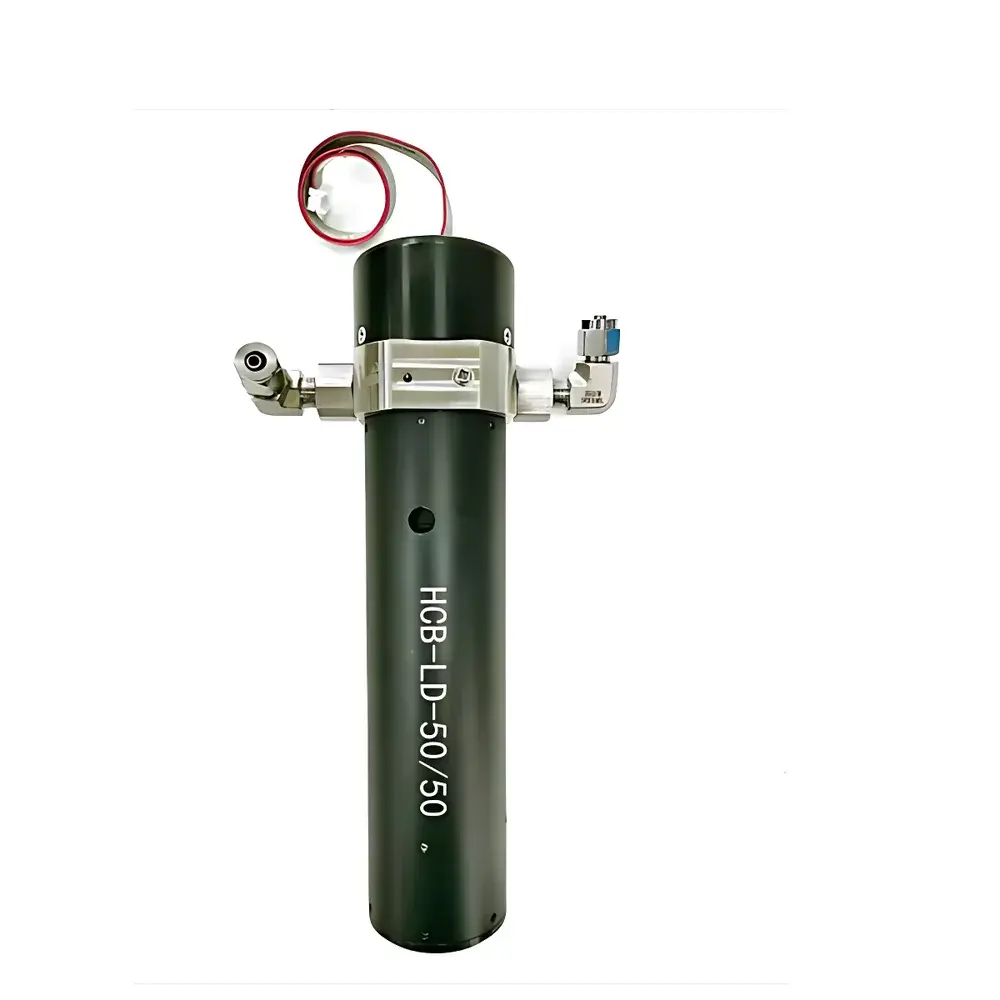
SOOHOW INSTRUMENT HCB-LD-50/50 Optical Blockage Particle Counter
| Brand | SOOHOW INSTRUMENT |
|---|---|
| Origin | Jiangsu, China |
| Manufacturer Type | Manufacturer |
| Product Category | Domestic |
| Model | HCB-LD-50/50 |
| Instrument Type | Resistive Pulse (Optical Blockage) Particle Counter |
| Light Source | Semiconductor Laser |
| Sample Temperature Range | 0–80 °C |
| Particle Size Range | 1–500 µm |
| Flow Rate (Detection) | 5–60 mL/min (Default: 25 mL/min) |
| Flow Rate (Rinse) | 5–60 mL/min |
| Coincidence Limit | 12,000–40,000 particles/mL |
| Counting Repeatability | RSD < 2% |
| Sensitivity | 1 µm (per ISO 4402) or 4 µm (c) (per ISO 11171 and GB/T 18854) |
| Dimensions (L × H) | 214 × 115 mm |
| Sensor Head Diameter | 52 mm |
| Sensor Tail Diameter | 46 mm |
| Mounting | Adjustable Fixation with M4 Screws |
Overview
The SOOHOW INSTRUMENT HCB-LD-50/50 Optical Blockage Particle Counter is a precision-engineered instrument designed for quantitative analysis of suspended particulate matter in liquid media using the light extinction (optical blockage) principle. This method relies on the transient reduction in laser beam intensity as individual particles pass through a focused optical detection zone—generating pulse signals proportional to particle cross-sectional area. Unlike resistive pulse (Coulter) systems, the HCB-LD-50/50 employs a semiconductor laser source operating at a stable wavelength optimized for high signal-to-noise ratio and minimal thermal drift. Its measurement range spans 1 µm to 500 µm, supporting calibration traceability to internationally recognized standards including ISO 4402 (for hydraulic fluid cleanliness) and ISO 11171 (for calibration of particle counters using NIST-traceable reference materials). The device is engineered for integration into laboratory-based quality control workflows, in-line process monitoring setups, and R&D environments requiring reproducible, statistically robust particle count data under variable temperature conditions (0–80 °C).
Key Features
- High-fidelity optical detection architecture featuring a collimated semiconductor laser and low-noise photodetector array for stable baseline and minimal pulse distortion
- Programmable flow control system enabling precise adjustment of sample throughput between 5 and 60 mL/min—critical for balancing counting statistics and sample volume constraints
- Dynamic coincidence error compensation validated across concentrations from 12,000 to 40,000 particles/mL, ensuring accuracy in high-load samples without manual dilution
- Thermally stabilized sensor housing allowing continuous operation across the full 0–80 °C sample temperature range without recalibration
- Modular mechanical design: sensor head (52 mm diameter) and tail (46 mm diameter) accommodate standard tubing interfaces; adjustable M4-mounting fixture enables rigid alignment in benchtop or OEM-integrated configurations
- Compliance-ready firmware architecture supporting audit trail logging and user-access controls aligned with GLP and GMP documentation requirements
Sample Compatibility & Compliance
The HCB-LD-50/50 is compatible with a broad spectrum of transparent or semi-transparent liquids, including mineral oils, synthetic lubricants, aqueous coolants, pharmaceutical suspensions, and microfluidic carrier fluids. It excludes opaque or highly scattering media where optical transmission falls below operational thresholds. Calibration verification follows ISO 21501-4 for light extinction particle counters, while sensitivity validation adheres to ISO 4402 (1 µm threshold) and ISO 11171 (4 µm(c) threshold), with domestic equivalence confirmed per GB/T 18854. The instrument meets electromagnetic compatibility (EMC) requirements per IEC 61326-1 and safety standards per IEC 61010-1. No internal radioactive sources or hazardous consumables are employed.
Software & Data Management
The counter operates via PC-hosted software supporting real-time visualization of differential and cumulative particle size distributions (PSD), customizable reporting templates (PDF/CSV), and configurable alarm thresholds per ISO 4406 or NAS 1638 codes. Raw pulse data—including amplitude, width, and timestamp—is stored with metadata (flow rate, temperature, operator ID) to satisfy FDA 21 CFR Part 11 requirements for electronic records and signatures when deployed in regulated environments. Batch export supports statistical post-processing in third-party tools (e.g., MATLAB, JMP), and optional OPC UA integration enables seamless connection to SCADA or MES platforms.
Applications
- Hydraulic and lubricant fluid cleanliness verification per ISO 4406 classification
- Pharmaceutical parenteral solution particulate testing in accordance with USP and
- Quality assurance of battery electrolytes and electrode slurries in energy storage R&D
- In-process monitoring of filtration efficiency in bioprocessing and ultra-pure water systems
- Validation of cleaning-in-place (CIP) rinse cycles in food & beverage manufacturing
- Research-grade characterization of micronized APIs, ceramic suspensions, and nanocomposite dispersions
FAQ
What calibration standards are supported for this instrument?
The HCB-LD-50/50 is calibrated using ISO 11171-compliant latex sphere suspensions traceable to NIST SRM 2806, with secondary verification against ISO 4402 reference materials.
Can the sensor be installed in pressurized lines?
Yes—the sensor body is rated for continuous operation up to 1 MPa (10 bar) at ambient temperatures; optional high-pressure fittings are available upon request.
Is temperature compensation applied automatically during measurement?
Yes—integrated PT100 sensor provides real-time temperature feedback to the signal processing unit, correcting for refractive index shifts in the sample medium.
Does the system support multi-channel particle counting?
The base configuration is single-channel; dual-sensor synchronization and time-aligned multi-zone analysis require custom firmware and hardware integration.
How is data integrity ensured during power interruption?
Non-volatile memory retains all active method parameters, calibration history, and last 72 hours of raw pulse logs—even during unexpected shutdowns.



