
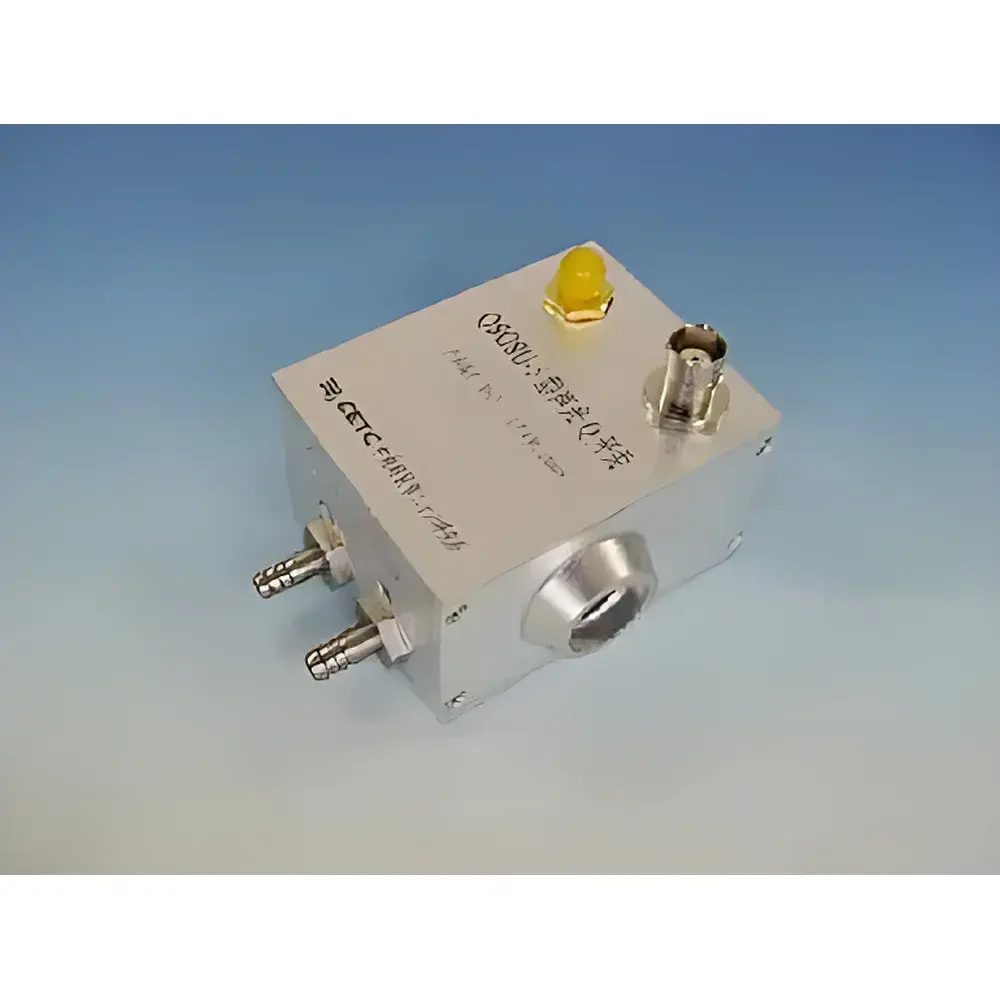
Acousto-Optic Q-Switch QSGSU-5
| Origin | Shanghai |
|---|---|
| Manufacturer Type | Distributor |
| Origin Category | Domestic (China) |
| Model | QSGSU-5 |
| Price | Upon Request |
| Interaction Material | Fused Silica |
| Wavelength | 1064 nm |
| RF Frequency | 27.0 ± 0.1 MHz |
| Anti-Reflection Coating | < 0.2% per surface |
| Single-Pass Transmission | > 99.6% |
| Optical Damage Threshold | > 500 MW/cm² |
| VSWR | ≤ 1.2 (50 Ω input impedance) |
| Active Aperture | 3–5 mm |
| Thermal Protection | Integrated overtemperature auto-shutdown |
Overview
The Acousto-Optic Q-Switch QSGSU-5 is a high-reliability, water-cooled acousto-optic modulator engineered for active Q-switching of continuous-wave-pumped Nd:YAG lasers operating at 1064 nm. It operates on the principle of Bragg diffraction, where an RF-driven acoustic wave propagates through fused silica to generate a transient periodic refractive index grating. This grating selectively diffracts the intracavity laser beam, enabling precise temporal control of pulse build-up and extraction. Designed specifically for YAG laser systems delivering 30–50 W average output power, the QSGSU-5 ensures stable, high-fidelity pulse generation with minimal thermal lensing and negligible beam distortion under sustained duty cycles. Its robust mechanical packaging and integrated thermal management system support uninterrupted operation in industrial OEM laser platforms.
Key Features
- High optical damage threshold (>500 MW/cm²) validated under nanosecond-scale pulsed irradiation at 1064 nm, ensuring long-term reliability in high-peak-power laser cavities.
- Low insertion loss: single-pass transmission exceeds 99.6%, minimizing cavity round-trip loss and preserving laser efficiency.
- Precision RF excitation at 27.0 ± 0.1 MHz with VSWR ≤ 1.2 into a 50 Ω system, enabling efficient RF power coupling and stable diffraction efficiency across operating temperature ranges.
- Anti-reflection coating optimized for 1064 nm (< 0.2% reflectance per surface), reducing parasitic etalon effects and back-reflection-induced instability.
- Active aperture dimensioned between 3 mm and 5 mm, accommodating common beam diameters in medium-power solid-state laser resonators while maintaining uniform acoustic field distribution.
- Integrated thermal protection circuitry that monitors transducer temperature in real time and initiates automatic shutdown upon exceeding safe operational limits—critical for unattended or embedded integration scenarios.
- First-pulse suppression functionality mitigates initial spiking behavior during Q-switch activation, improving pulse-to-pulse amplitude stability and reducing risk of target damage in precision marking or micromachining applications.
Sample Compatibility & Compliance
The QSGSU-5 is compatible with standard plano-plano or Brewster-angle Nd:YAG rod configurations and integrates seamlessly with commercial and custom-built laser cavities using standard flange-mounting interfaces. Its fused silica interaction medium exhibits excellent UV–NIR transmission and low thermo-optic coefficient, supporting stable performance across ambient temperatures from 15 °C to 35 °C when operated with regulated water cooling (recommended flow rate: ≥ 1.5 L/min, ΔT < 3 °C). While not certified to a specific international standard as a standalone component, the device conforms to general safety and electromagnetic compatibility expectations outlined in IEC 61000-6-3 (EMI emission) and IEC 61000-6-2 (immunity), and its optical specifications align with common requirements in ISO 11146 (laser beam parameters) and ISO 13694 (laser-induced damage threshold testing methodology). Integration into final laser systems intended for medical, aerospace, or semiconductor manufacturing use should follow applicable regional regulatory frameworks including FDA 21 CFR Part 11 (if used in GMP-controlled environments) and CE marking directives for machinery safety.
Software & Data Management
As a hardware-level electro-optic actuator, the QSGSU-5 does not include embedded firmware or onboard data logging capabilities. It is driven by external RF drivers (e.g., A020 series or equivalent) providing TTL/CMOS-compatible trigger inputs and analog modulation ports. Pulse timing, repetition rate, and burst mode sequencing are managed externally via programmable digital delay generators or laser controller platforms such as those compliant with NI LabVIEW, MATLAB Instrument Control Toolbox, or Beckhoff TwinCAT interfaces. For traceability in regulated environments, users may implement audit trails through host-system software that records driver command timestamps, RF power levels, and thermal sensor feedback—supporting GLP/GMP-aligned documentation workflows where required.
Applications
- Laser marking and engraving systems requiring consistent pulse energy and narrow pulse width (typically 100–200 ns) for high-contrast metal, ceramic, and polymer marking.
- PCB micromachining and semiconductor scribing, where first-pulse suppression prevents substrate cracking during initial ablation.
- Thin-film removal and selective layer ablation in display manufacturing, leveraging high modulation speed (>100 kHz achievable) and low jitter (<5 ns RMS).
- OEM integration into compact fiber- or diode-pumped solid-state laser modules used in analytical instrumentation, LIBS sources, or time-resolved fluorescence excitation.
- Research-grade Nd:YAG oscillators requiring reproducible Q-switched output for pump-probe spectroscopy or nonlinear frequency conversion experiments.
FAQ
What is the maximum recommended average RF drive power for the QSGSU-5?
The unit is rated for continuous RF input up to 25 W; operation beyond this level without enhanced thermal management may accelerate transducer aging and reduce diffraction efficiency stability.
Is the QSGSU-5 compatible with 532 nm second-harmonic output?
No—it is optimized exclusively for 1064 nm fundamental wavelength; use at harmonic wavelengths requires recalibration of acoustic velocity and Bragg angle, and is not supported without manufacturer validation.
Does it support analog modulation of diffraction efficiency?
Yes, when paired with a compatible RF driver offering amplitude modulation input (0–5 V or 0–10 V), enabling variable pulse energy control within a fixed repetition rate.
Can it be operated in air-cooled mode?
Water cooling is mandatory; air cooling cannot dissipate the thermal load generated during sustained operation at 30–50 W laser power levels.
What is the typical rise/fall time for optical switching?
Measured at full width half maximum (FWHM), the optical switching response is ≤ 12 ns, limited primarily by acoustic transit time across the active aperture.




