
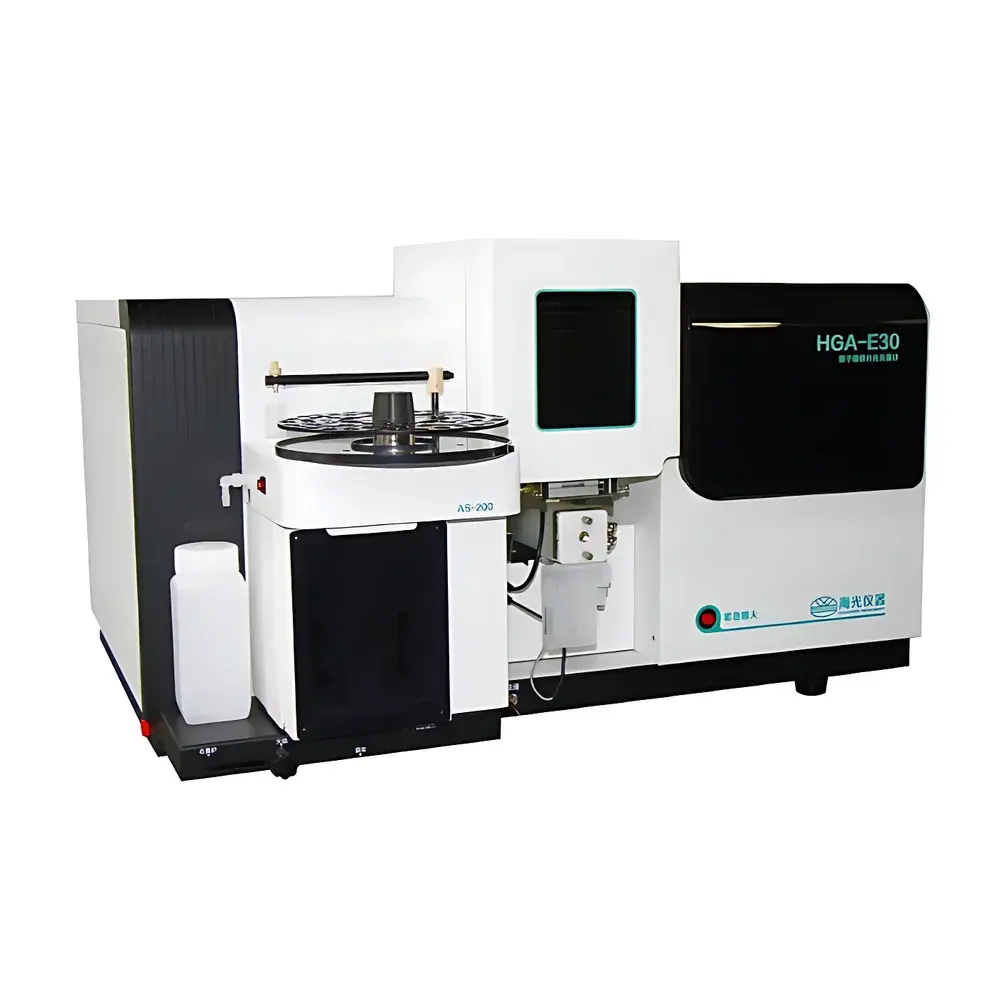
Haiguang HGA-E30 Flame and Graphite Furnace Atomic Absorption Spectrometer
| Brand | Haiguang Instrument |
|---|---|
| Origin | Beijing, China |
| Model | HGA-E30 |
| Instrument Type | Flame and Graphite Furnace AAS |
| Optical Design | Czerny-Turner with 270 mm focal length and 1800 lines/mm grating |
| Slit Widths | 6 auto-switchable positions |
| Light Source | 8-lamp rotating turret with simultaneous preheating |
| Lamp Recognition | Automatic identification of hollow cathode lamps (HCL), self-reversal lamps, and high-performance lamps |
| Background Correction | D₂ lamp and self-absorption methods across full wavelength range (190–900 nm) |
| Atomization Modes | Flame (triple-gas flow control with safety interlock) and electrothermal graphite furnace (integrated power supply) |
| Autosampler | 84-position sliding-type flame/graphite furnace integrated autosampler |
| Software Functions | Auto-alignment, auto-peak search, auto-slit selection, startup diagnostics, and analytical condition recommendation |
| Optional Accessories | Hydride generation system for As, Hg, Se, Sb, Bi, etc. |
| Compliance | Fully supports GB, HJ, and ISO 8288, ISO 11170, ASTM D5059, USP <730>, FDA 21 CFR Part 11 (audit trail enabled) |
Overview
The Haiguang HGA-E30 Flame and Graphite Furnace Atomic Absorption Spectrometer is a dual-mode analytical instrument engineered for trace metal quantification in complex matrices using atomic absorption spectroscopy (AAS). It operates on the fundamental principle that ground-state free atoms in a gaseous state absorb light at element-specific wavelengths—typically within the ultraviolet and visible spectrum (190–900 nm). The HGA-E30 integrates flame atomization for higher-concentration samples (e.g., water, digested food extracts) and graphite furnace electrothermal atomization for sub-ppt level detection (e.g., Cd in soil leachates or Pb in biological fluids). Its monolithic optical platform employs a robust Czerny-Turner monochromator with a 270 mm focal length and 1800 lines/mm holographic grating, delivering high spectral resolution and long-term optical stability under variable ambient conditions. Vibration-damping mechanical design and temperature-compensated optics ensure reproducible baseline performance across extended operational cycles—critical for GLP-compliant laboratories performing routine regulatory testing.
Key Features
- Integrated flame–graphite furnace architecture with fully automated mode switching—no manual reconfiguration or component relocation required.
- Eight-lamp rotary turret with simultaneous preheating capability and intelligent lamp recognition: distinguishes standard HCLs, self-reversal lamps, and high-intensity lamps to optimize spectral line selection and energy throughput.
- Six programmable slit widths (0.1, 0.2, 0.4, 0.7, 1.0, 2.0 nm) automatically selected based on elemental line width and matrix interference requirements.
- Dual-background correction: deuterium (D₂) continuum source correction for broadband absorption and self-absorption correction for narrow-line interference—enabling accurate quantitation in high-salt or organic-rich samples.
- Triple-gas flame system (oxidant/fuel/support gas) with mass-flow-controlled regulation and hardware-enforced safety interlocks—including flame-out detection, gas leak monitoring, and automatic shutdown protocols.
- Internal graphite furnace power supply eliminates external cabling clutter and improves thermal coupling efficiency; furnace temperature ramping profiles support up to 30-step programmable heating sequences.
- 84-position integrated autosampler compatible with both flame nebulizer and graphite furnace sample introduction—sliding carriage design enables seamless transition without disassembly or realignment.
- Flame emission capability for alkali and alkaline earth metals (e.g., K, Na, Ca) where ionization interference limits absorption sensitivity.
Sample Compatibility & Compliance
The HGA-E30 meets methodological requirements for over 30 Chinese national standards (GB) and environmental monitoring standards (HJ), including GB 5009.12–2017 (Pb in food), GB 5009.15–2014 (Cd in food), HJ 491–2019 (Cu, Zn, Pb, Ni, Cr in soils), and HJ 757–2015 (Cr in water). Its analytical workflow supports solid, liquid, and semi-solid sample types following standardized digestion protocols (e.g., EPA 3050B, GB/T 5009.17–2021). The system complies with ISO/IEC 17025 documentation requirements for calibration traceability, measurement uncertainty estimation, and quality control implementation. When operated with validated SOPs and configured with audit-trail-enabled software, it satisfies data integrity expectations under FDA 21 CFR Part 11 and EU Annex 11 for regulated environments.
Software & Data Management
The embedded AAS control software provides full instrument automation—from startup diagnostics and wavelength calibration to peak integration and multi-point calibration curve generation. All analytical parameters (lamp current, slit width, burner height, furnace temperature program, background correction mode) are stored with timestamped metadata. Raw absorbance/time and absorbance/wavelength data are exportable in CSV and ASCII formats for third-party statistical analysis. Audit trail functionality logs all user actions—including method edits, result deletions, and calibration updates—with operator ID, timestamp, and reason-for-change fields. Data backups are supported via USB storage or network file transfer, ensuring alignment with laboratory data retention policies.
Applications
The HGA-E30 serves as a primary elemental analyzer in food safety laboratories verifying heavy metal contamination in raw materials and finished products; in environmental testing labs quantifying trace metals in wastewater, sediments, and agricultural soils per HJ-series methods; in pharmaceutical QC labs assessing catalyst residues (e.g., Pd, Pt) in active pharmaceutical ingredients; and in academic research settings studying bioaccumulation kinetics or speciation behavior following hydride generation coupling. Its dual-atomization flexibility allows method developers to validate both flame-based screening assays and furnace-based confirmatory analyses within a single platform—reducing cross-instrument variability and improving inter-laboratory comparability.
FAQ
Does the HGA-E30 support hydride generation analysis?
Yes—when coupled with an optional hydride generation accessory module, the system enables sensitive determination of As, Hg, Se, Sb, Bi, and Te at sub-ng/mL levels using cold vapor or quartz cell atomization.
Is the graphite furnace power supply internal or external?
The graphite furnace power supply is fully integrated into the main instrument chassis, eliminating external power units and simplifying installation, maintenance, and electromagnetic compatibility management.
Can the software generate reports compliant with GLP requirements?
Yes—the software includes customizable report templates with embedded calibration curves, QC check results, sample IDs, analyst names, instrument serial numbers, and electronic signatures—all traceable via the built-in audit trail.
What safety certifications does the flame system include?
The flame subsystem incorporates redundant safety mechanisms: flame sensor feedback loop, gas pressure monitoring, automatic fuel cutoff upon flame extinction, and interlocked access doors that disable ignition when open.
How is wavelength calibration performed?
Wavelength calibration uses a sealed hollow cathode lamp (e.g., Fe or Cu) with known emission lines; the system performs automated peak search and fine-tunes grating position to align measured peaks with NIST-traceable reference values.
Related Products






