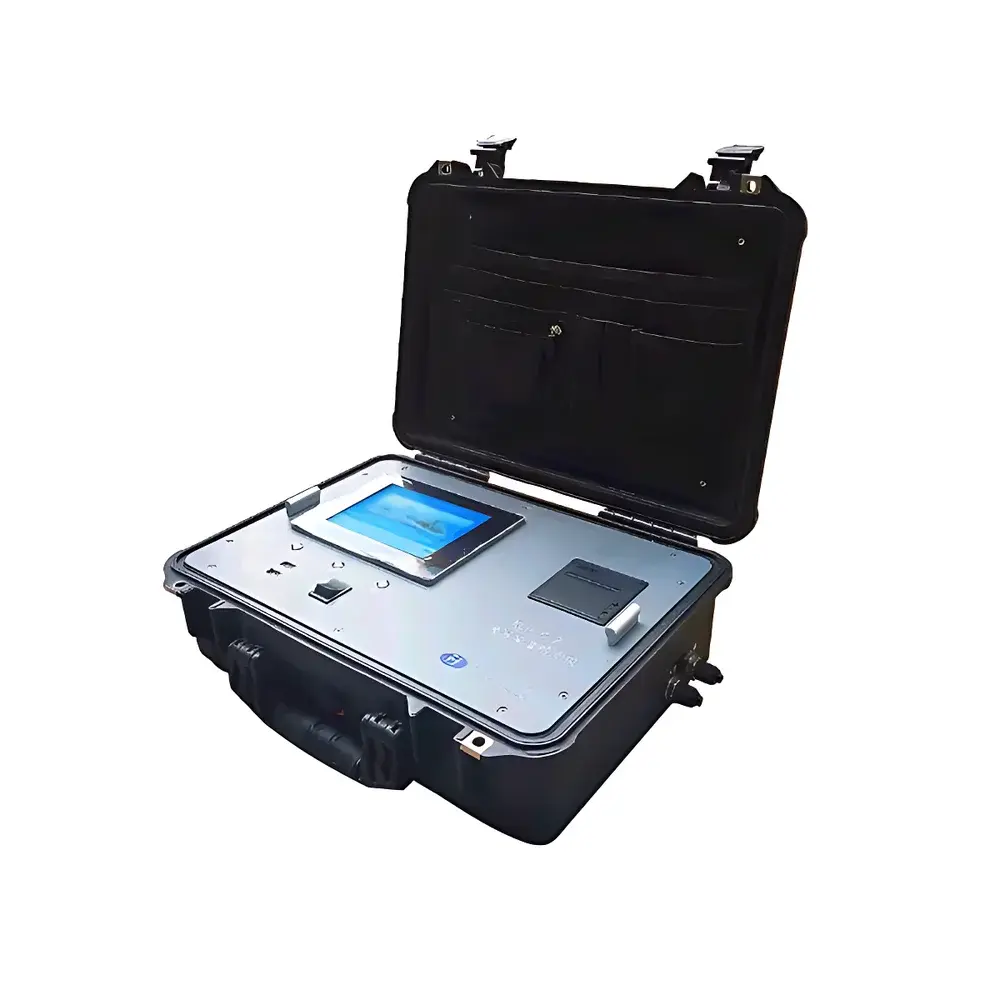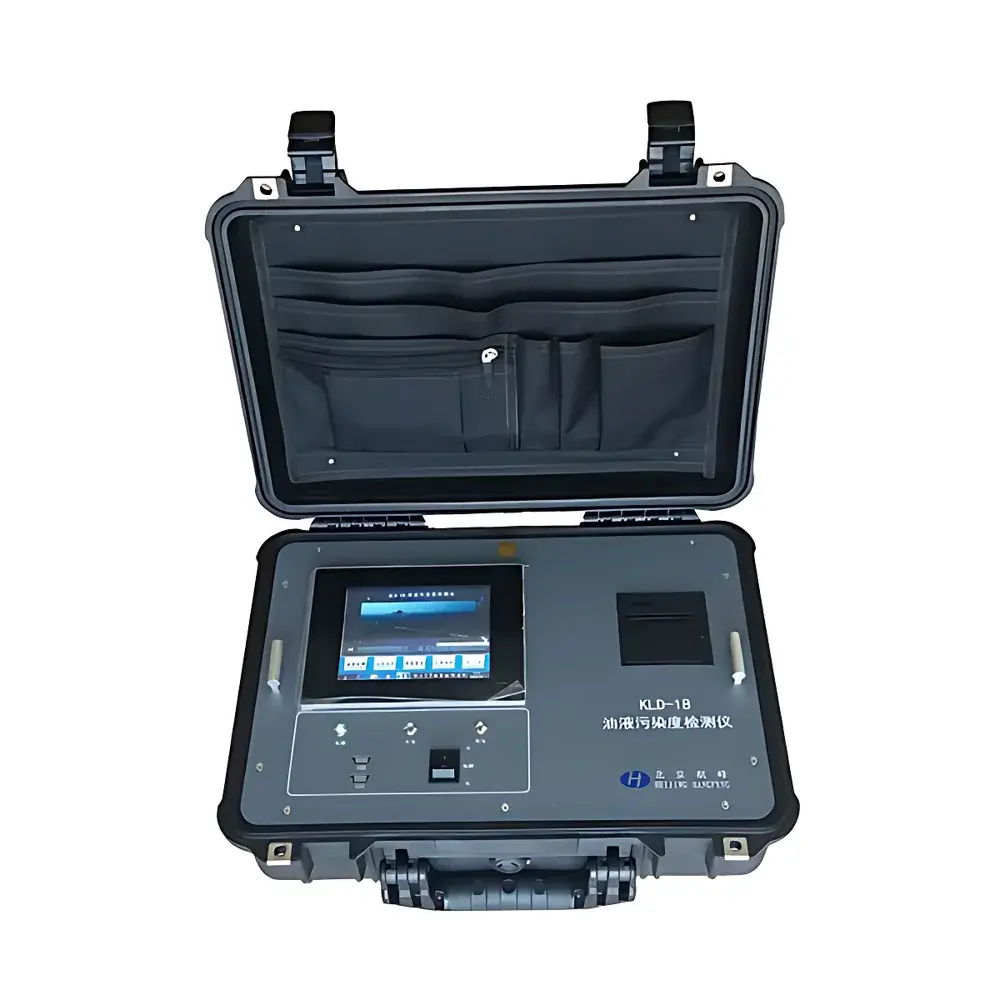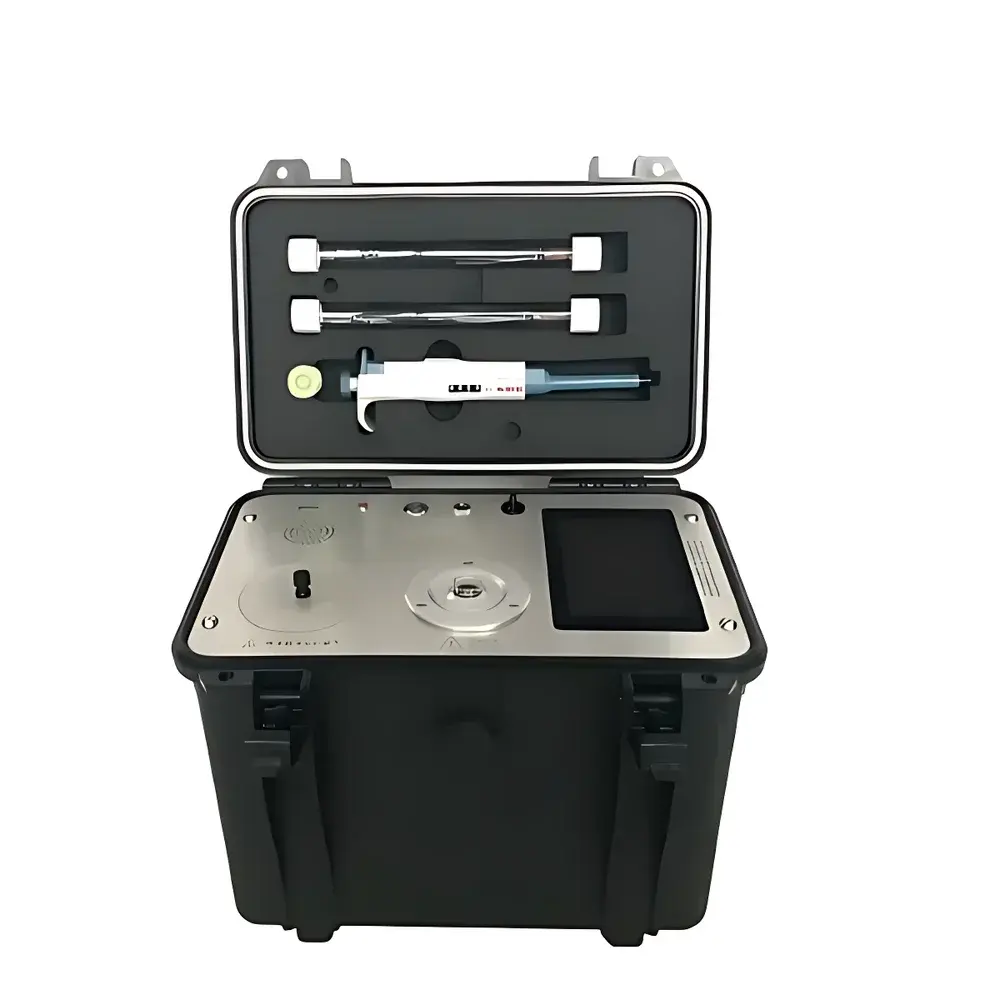
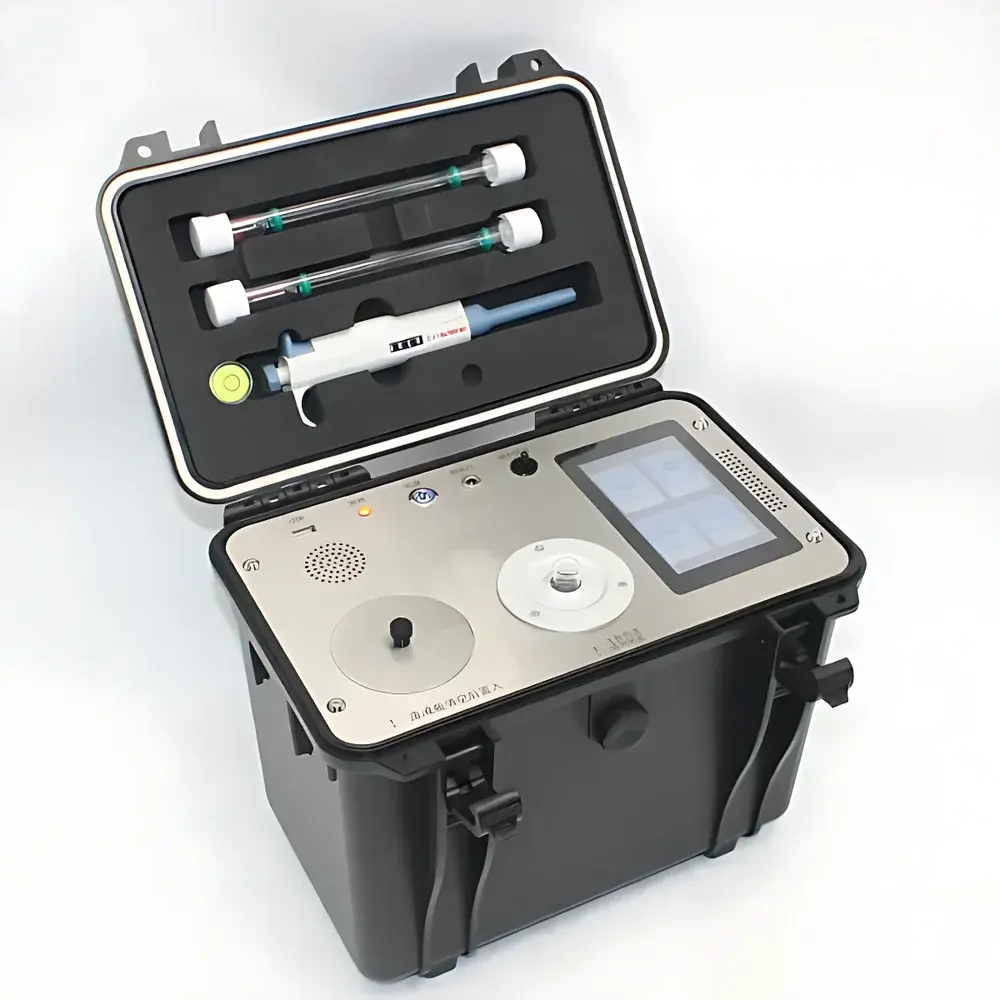
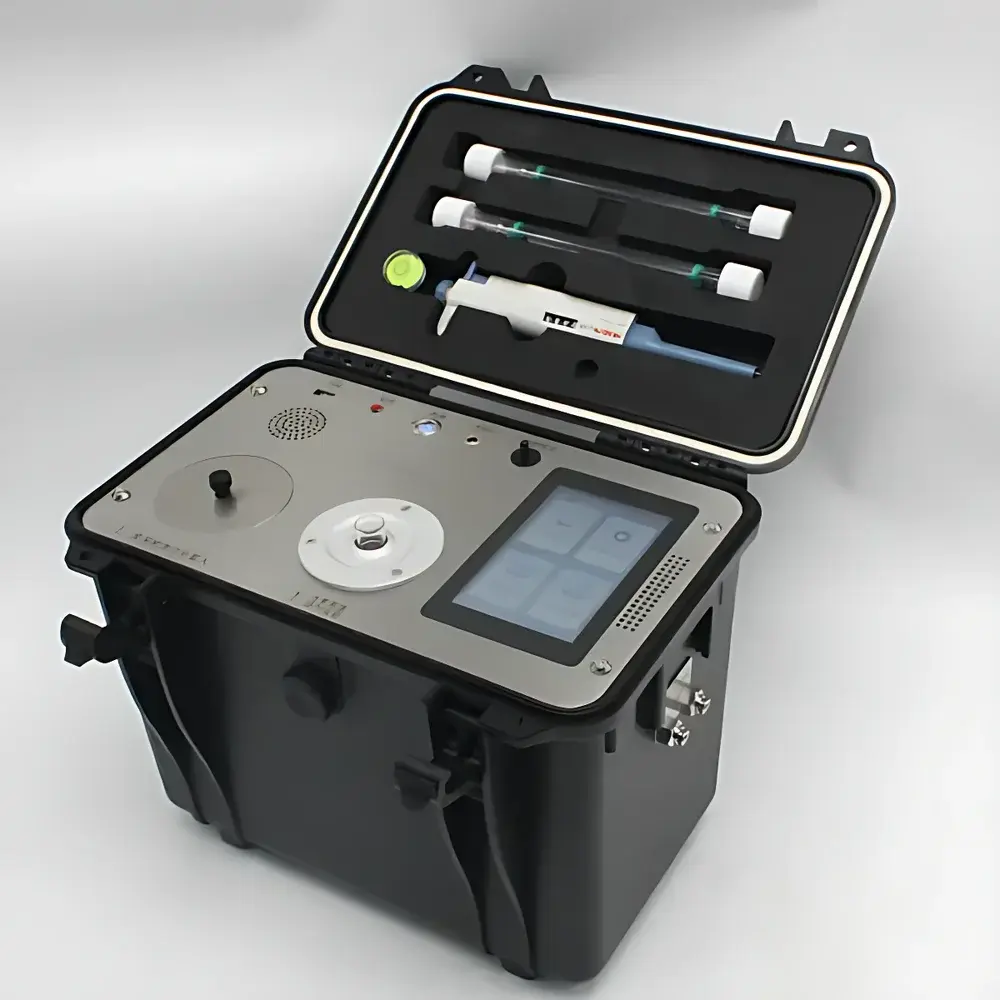
SOOHOW INSTRUMENT VS600 Portable Kinematic Viscosity Analyzer
| Brand | SOOHOW INSTRUMENT |
|---|---|
| Origin | Jiangsu, China |
| Manufacturer Type | Direct Manufacturer |
| Country of Origin | China |
| Model | VS600 |
| Price Range | USD 8,500 – 14,200 |
| Measurement Principle | Capillary Flow Time-Based Kinematic Viscosity Determination (ASTM D445 / ISO 3104 Compliant) |
| Temperature Range | 20–100 °C (±0.02 °C stability) |
| Sample Volume | 1.5–3.0 mL |
| Cycle Time (Full Auto) | ≤5 min (including aspiration, measurement, cleaning, drying, calculation) |
| Cleaning Solvent Consumption | ≤10 mL per cycle |
| Power Supply | Integrated Li-ion Battery (10 h @ 100 °C), AC Adapter Optional |
| Data Export | USB 2.0 (CSV, PDF report) |
| Viscosity Range | 0.2–100,000 mm²/s (cSt) |
| Display | 7-inch TFT LCD, Chinese UI with guided workflow |
| Capillary Exchange | Plug-and-play modular viscometer cartridge (<10 s swap) |
| Compliance | ASTM D445, ISO 3104, GB/T 265, IP 71 |
Overview
The SOOHOW INSTRUMENT VS600 Portable Kinematic Viscosity Analyzer is an engineered solution for field-deployable, high-reproducibility kinematic viscosity measurement in petroleum and industrial lubrication environments. It operates on the capillary flow time principle—measuring the time required for a fixed volume of liquid to flow under gravity through a calibrated glass capillary tube at precisely controlled temperatures. This method conforms to internationally recognized standards including ASTM D445, ISO 3104, and GB/T 265. Unlike benchtop capillary viscometers requiring manual timing and temperature baths, the VS600 integrates thermostatic control, automated fluid handling, real-time flow detection, and embedded calculation algorithms into a single ruggedized platform. Its design prioritizes operational robustness in non-laboratory settings: from refinery perimeters and offshore platforms to mobile service trucks and remote storage depots. The instrument delivers traceable kinematic viscosity values (in mm²/s, equivalent to cSt) across a broad dynamic range—from light hydrocarbons (e.g., gasoline, kerosene) to highly viscous used engine oils and thermal transfer fluids—without requiring sample dilution or pre-filtration in most cases.
Key Features
- Fully automated measurement cycle: sample aspiration, temperature equilibration, capillary flow timing, solvent rinse, hot-air drying, and viscosity calculation—all executed without user intervention.
- Ultra-fast throughput: typical measurement completion within 3 minutes; full cycle (including cleaning and drying) completed in ≤5 minutes.
- Integrated lithium-ion battery system enabling continuous operation for up to 10 hours at 100 °C—critical for extended field use where AC power is unavailable.
- Ruggedized portable architecture: custom-engineered IP67-rated tri-proof carrying case (shock-, dust-, and water-resistant), total mass <8.2 kg, footprint <280 × 220 × 190 mm.
- Modular capillary viscometer cartridges: tool-free, plug-and-play replacement in under 10 seconds; supports multiple capillary constants for optimized range coverage.
- Low-consumption cleaning protocol: uses ≤10 mL of solvent per full cleaning cycle—reducing hazardous waste generation and operational cost.
- Onboard calibration suite: independent verification of capillary constant and bath temperature accuracy using certified reference standards.
- Thermal safety architecture: dual-stage overtemperature protection, redundant thermal fuses, and real-time PID-controlled heating with ±0.02 °C stability.
Sample Compatibility & Compliance
The VS600 accommodates Newtonian liquids across transparency classes—both optically clear (e.g., base oils, jet fuel) and opaque (e.g., soot-laden diesel engine oil, dark residual fuels). Its optical flow detection system employs infrared beam interruption sensing, eliminating dependence on visual clarity. Compatible sample types include but are not limited to: gasoline, diesel, aviation turbine fuel (Jet A-1), lubricating oils (new and in-service), heat transfer fluids, hydraulic fluids, cutting fluids, and additive packages. All measurements adhere to the procedural rigor mandated by ASTM D445 (Standard Test Method for Kinematic Viscosity of Transparent and Opaque Liquids) and ISO 3104 (Petroleum Products — Determination of Kinematic Viscosity and Calculation of Dynamic Viscosity). The device supports GLP-aligned documentation: each result includes timestamp, operator ID (optional), temperature setpoint, measured flow time, capillary constant, and environmental ambient log—exportable for audit trails.
Software & Data Management
The embedded firmware provides a guided, icon-driven Chinese interface with contextual help prompts at every workflow stage. Measurement data—including raw flow times, calculated kinematic viscosity, temperature logs, and QC flags—are stored internally (≥10,000 test records) and exportable via USB 2.0 to standard CSV or PDF formats. No proprietary software installation is required on host PCs. For integration into enterprise LIMS or CMMS platforms, the VS600 supports configurable metadata tagging (e.g., sample ID, batch number, location code) during test initiation. While not natively 21 CFR Part 11 compliant, the system supports ALCOA+ principles: attributable, legible, contemporaneous, original, accurate, complete, consistent, enduring, and available data—enabling validation by end-user QA departments under GMP or ISO/IEC 17025 frameworks.
Applications
- On-site condition monitoring of in-service lubricants in wind turbines, marine engines, and mining equipment.
- Field verification of fuel specification compliance (e.g., ASTM D975 for diesel, ASTM D1655 for jet fuel) prior to acceptance.
- Quality assurance of new oil batches at distribution terminals or OEM receiving docks.
- Rapid screening of thermal degradation in heat transfer systems during routine maintenance rounds.
- Supporting predictive maintenance programs by trending kinematic viscosity drift against OEM baselines.
- Regulatory sampling in remote locations where transport of samples to central labs introduces delay and risk of thermal or oxidative alteration.
FAQ
Does the VS600 require external calibration fluids for daily operation?
No—routine verification uses built-in reference checks for temperature and capillary constant. Certified calibration oils (e.g., NIST-traceable SRMs) are recommended annually or after major maintenance.
Can the instrument measure non-Newtonian fluids such as greases or polymer-thickened oils?
No—the VS600 is validated exclusively for Newtonian behavior per ASTM D445. Non-Newtonian samples require rotational rheometry (e.g., Brookfield or Anton Paar systems).
Is the cleaning solvent compatible with chlorinated solvents like trichloroethylene?
Yes—system wetted materials (316 stainless steel, PTFE, borosilicate glass) are chemically resistant to common hydrocarbon and chlorinated cleaning agents; solvent compatibility must be verified per SDS.
What is the minimum sample volume required for reliable measurement?
1.5 mL is sufficient for full-range operation; 3.0 mL is recommended for high-viscosity samples (>50,000 mm²/s) to ensure complete capillary fill and stable flow profile.
How is temperature uniformity maintained across the capillary during measurement?
The bath employs a precision-machined copper block with distributed heating elements and dual Pt100 RTD sensors—one immersed in thermal fluid, one adjacent to the capillary outlet—ensuring axial temperature deviation <±0.03 °C over the active length.