
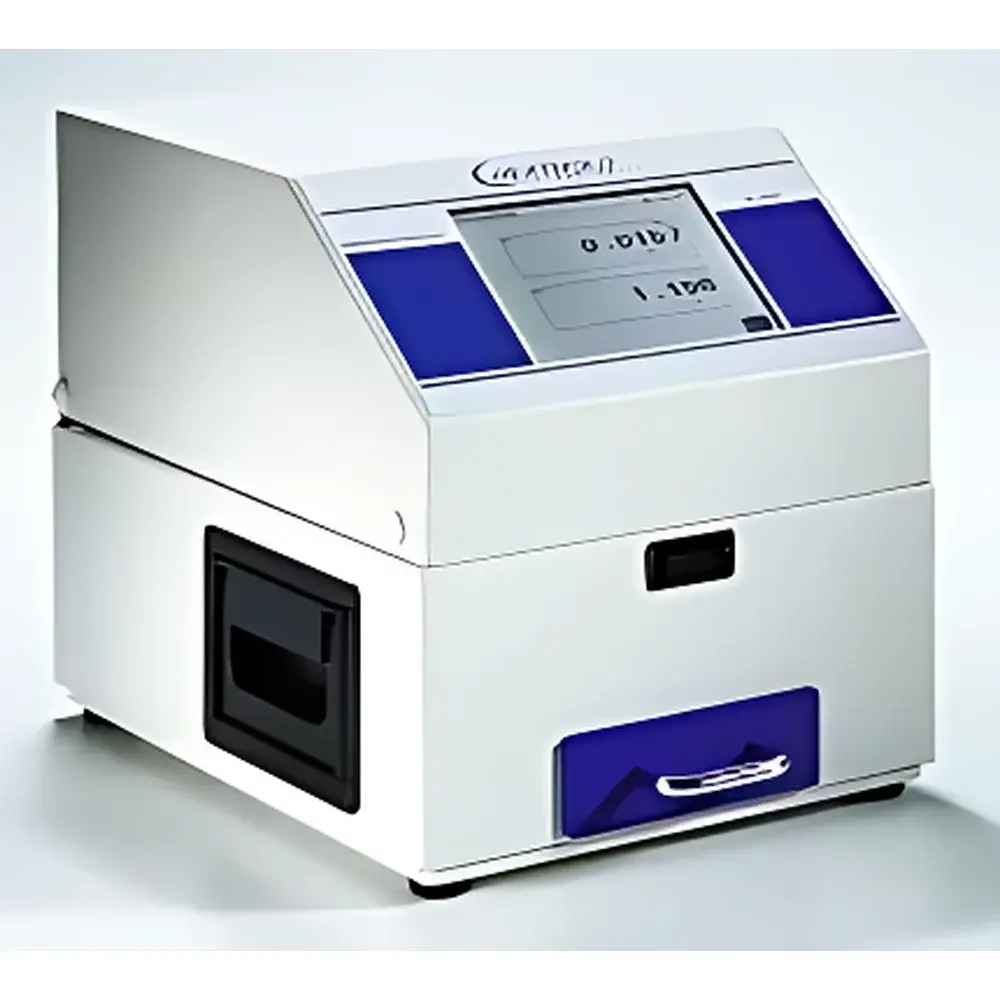
Berthold LB2046 Portable Alpha/Beta Scintillation Counter
| Brand | Berthold |
|---|---|
| Origin | Germany |
| Model | LB2046 |
| Detector | Ø60 mm ZnS(Ag)-coated scintillator |
| Foil window | 0.4 mg/cm² aluminum |
| Alpha efficiency (²⁴¹Am) | 22% |
| Beta efficiency (³⁶Cl) | 41% |
| Beta efficiency (¹⁴C) | 8% |
| Counting range | α: 0–5000 cps |
| β | 0–50000 cps |
| Detection limit (1 h) | 0.03 Bq (²⁴¹Am) |
| Background | α: 0.02 cps |
| β | 0.3 cps |
| Cross-talk | α→β <10% |
| Dimensions | 33 × 24.5 × 27 cm |
| Weight | 15 kg |
Overview
The Berthold LB2046 Portable Alpha/Beta Scintillation Counter is a field-deployable, dual-channel radiation measurement instrument engineered for rapid, quantitative assessment of alpha- and beta-emitting radionuclides on filter papers, smear samples, and other planar solid matrices. It operates on the principle of pulse-shape discrimination (PSD) coupled with ZnS(Ag) scintillation detection—where alpha particles produce high-light-yield, short-decay flashes, while beta particles generate lower-intensity, longer-decay signals. This enables reliable spectral separation without requiring high-resolution spectroscopy hardware. Designed specifically for environmental monitoring, nuclear facility routine surveillance, and radiological emergency response, the LB2046 delivers laboratory-grade sensitivity in a compact, battery-operable form factor. Its real-time background subtraction, energy-dependent efficiency correction, and integrated nuclide library ensure traceable, reproducible activity calculations per ISO 7503-1 and ASTM D3648 standards.
Key Features
- Integrated Ø60 mm ZnS(Ag) scintillation detector with ultra-thin 0.4 mg/cm² aluminum entrance foil—optimized for high alpha transmission while maintaining mechanical integrity and low beta absorption.
- Dual independent counting channels with automatic cross-talk compensation: α→β leakage <10%, β→α leakage <0.002%, verified per IEC 61577-2 test protocols.
- Onboard nuclide library containing preconfigured calibration parameters for common emitters including ²⁴¹Am, ³⁶Cl, ¹⁴C, ⁹⁰Sr/⁹⁰Y, ²³⁸Pu, and ²¹⁰Po—supporting both absolute activity calculation and comparative screening modes.
- High-contrast, capacitive touchscreen interface with intuitive icon-driven workflow—designed for glove-compatible operation in controlled or contaminated environments.
- Embedded background auto-subtraction algorithm that continuously monitors ambient count rates during idle periods and dynamically corrects live measurements over user-defined integration times (1 min to 24 h).
- Ruggedized housing rated IP54 for dust and splash resistance; operational temperature range: −10 °C to +45 °C; powered via internal rechargeable Li-ion battery (≥8 h continuous use) or external 12 V DC input.
Sample Compatibility & Compliance
The LB2046 accepts standard 47 mm and 55 mm circular filter papers (e.g., cellulose ester, glass fiber), stainless-steel smear discs, and petri dishes up to 60 mm diameter. Sample geometry is standardized via fixed detector-to-sample distance (5 mm) and collimated field-of-view, minimizing geometric uncertainty. Instrument compliance aligns with key regulatory frameworks: measurements satisfy ALARA-based reporting requirements under IAEA Safety Standards Series No. RS-G-1.8; software data handling supports audit trails required by ISO/IEC 17025:2017 Clause 7.7; firmware versioning and calibration logs are timestamped and non-erasable, facilitating GLP-compliant record retention. The device is CE-marked per EU Directive 2014/30/EU (EMC) and 2014/53/EU (Radio Equipment), and meets German Strahlenschutzverordnung (StrlSchV) Annex VIII criteria for portable contamination monitors.
Software & Data Management
Data acquisition, analysis, and reporting are managed through LB-Soft v4.x—Berthold’s dedicated PC application compatible with Windows 10/11. Raw spectra, count rates, net activities, and statistical uncertainties are exported in CSV and XML formats compliant with NIST SP 800-53 Rev. 5 logging requirements. Each measurement file embeds metadata: operator ID, sample ID, geometry configuration, calibration certificate ID, and firmware revision. Optional FDA 21 CFR Part 11 compliance package provides electronic signature capability, role-based access control, and immutable audit trail generation—including all parameter modifications, calibration updates, and result approvals. Remote diagnostics and firmware updates are supported via encrypted USB or Ethernet connection.
Applications
- Routine swipe testing at nuclear power plant access points, glovebox exits, and hot cell maintenance zones.
- Post-decontamination verification following radiological incidents or decommissioning activities (per IAEA TECDOC-1611 guidance).
- Environmental monitoring of airborne particulate filters from stack emissions or ambient air samplers.
- Waste characterization in low-level radioactive waste (LLW) sorting facilities—particularly for mixed alpha/beta waste streams.
- Field validation of liquid scintillation counting (LSC) results where rapid triage is required prior to lab submission.
- Educational use in health physics laboratories for hands-on training in alpha/beta discrimination principles and detection statistics.
FAQ
What sample types can be measured directly on the LB2046?
Filter papers (47 mm or 55 mm), stainless-steel smear discs, and flat-bottom petri dishes up to 60 mm diameter. Liquid samples require evaporation onto suitable substrates prior to counting.
Is the LB2046 suitable for regulatory reporting?
Yes—when used with certified calibration sources and documented procedures, its measurements meet ISO 7503-1 and ANSI N42.22 requirements for surface contamination monitoring and are accepted in national regulatory submissions across EU member states and Canada.
How is detector efficiency calibrated for different radionuclides?
Efficiency values are stored in the onboard nuclide library and applied automatically based on selected isotope and sample matrix. Primary calibrations trace to PTB (Physikalisch-Technische Bundesanstalt) reference standards; users may perform secondary validations using traceable check sources.
Does the instrument support networked data transfer?
Yes—via optional Ethernet module or USB host interface; LB-Soft enables centralized database synchronization and automated report generation for multi-instrument deployments.
What maintenance is required to ensure long-term accuracy?
Annual verification of background stability, efficiency consistency, and PSD threshold performance is recommended. Detector window inspection and cleaning with isopropyl alcohol should occur after each high-activity sample series.
Related Products







