
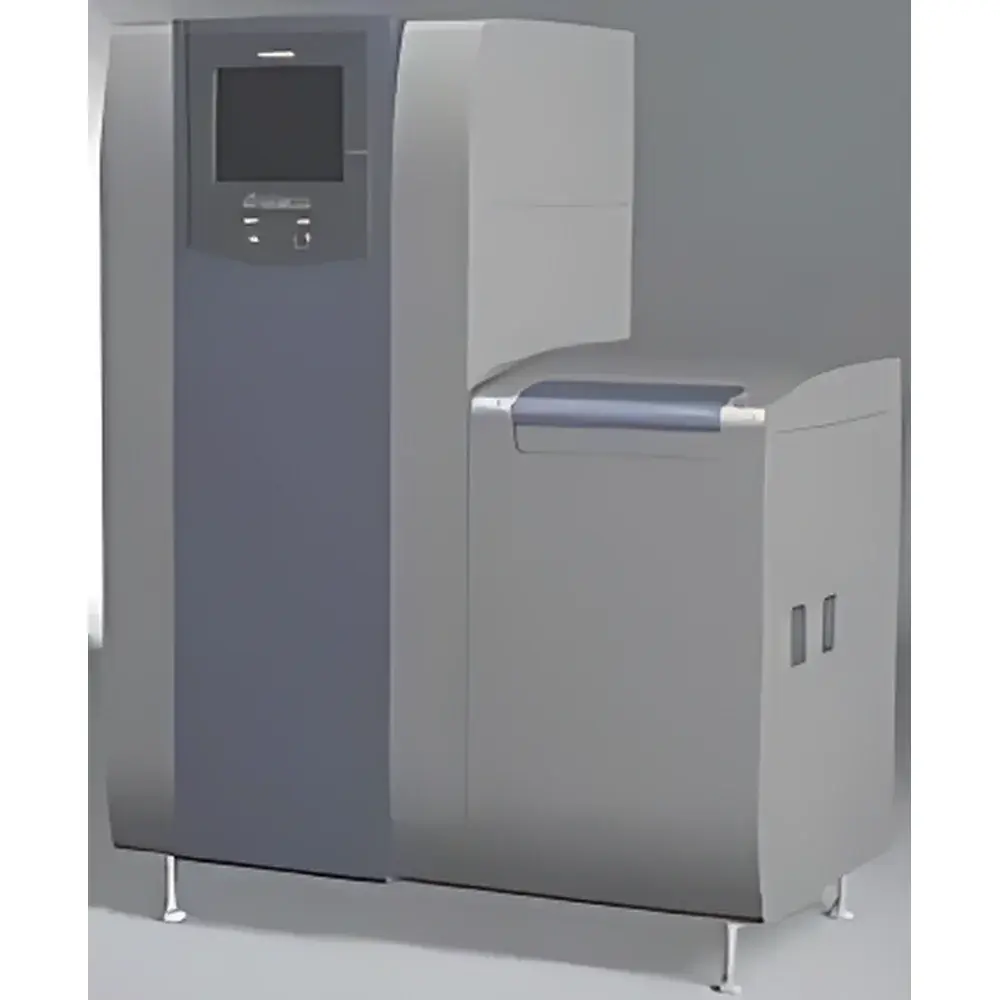
ALOKA LB7 Liquid Scintillation Counter
| Origin | Japan |
|---|---|
| Manufacturer Type | Authorized Distributor |
| Origin Category | Imported Instrument |
| Model | LB7 |
| Instrument Type | Liquid Scintillation Counter (LSC) for Beta Radiation Quantification |
| Detection Range | H-3 (³H): ≥60% efficiency (1–18 keV) |
| C-14 (¹⁴C) | ≥90% efficiency (3–156 keV) |
| Background Count Rate | ³H: ≤3.5 cpm |
| ¹⁴C | ≤20 cpm |
| Figure of Merit (FOM) | ≥285,000 |
| Sample Vial Compatibility | 20 mL, 100 mL, and 145 mL standard scintillation vials |
| Automated Sample Handling | Robotic carousel with priority insertion capability |
| HV & ESCR Auto-Calibration | Real-time high-voltage and electronic stability control regulation |
| Gain Optimization & Spectrum Correction | On-the-fly digital gain adjustment and spectral curve normalization |
| Quench Correction | Dual-mode correction (color quench and chemiluminescence quench) |
| Electrostatic Discharge (ESD) Mitigation | Integrated ionizing air blower pre-measurement |
| Display | 12-inch full-color capacitive touchscreen LCD |
Overview
The ALOKA LB7 Liquid Scintillation Counter is a high-performance, fully automated benchtop instrument engineered for precise quantification of low-energy beta-emitting radionuclides—including tritium (³H) and carbon-14 (¹⁴C)—in environmental, pharmaceutical, clinical, and nuclear research laboratories. Operating on the principle of liquid scintillation counting, the LB7 detects photons generated when beta particles interact with scintillation cocktail molecules in solution. Its optimized photomultiplier tube (PMT) geometry, low-noise electronics, and advanced pulse-shape discrimination enable exceptional sensitivity and reproducibility at ultra-low activity levels. Designed and manufactured in Japan under stringent quality control standards, the LB7 meets the metrological requirements for routine compliance with ISO/IEC 17025-accredited testing, EPA Method 900 series, and IAEA Safety Standards RS-G-1.7 for environmental radioactivity monitoring.
Key Features
- High-efficiency dual-PMT detection system optimized for low-energy beta emitters, delivering ≥60% counting efficiency for ³H and ≥90% for ¹⁴C across defined energy windows.
- Figure of Merit (FOM) exceeding 285,000—calculated as (efficiency² / background)—ensuring superior signal-to-noise ratio and detection limit performance.
- Automated sample handling platform supporting up to 100 vials (20 mL, 100 mL, or 145 mL formats), with real-time priority insertion for urgent samples without interrupting ongoing runs.
- Integrated electrostatic discharge (ESD) suppression via regulated ionized air flow, eliminating static-induced artifacts prior to each measurement cycle.
- Intelligent auto-calibration suite: continuous high-voltage (HV) stabilization, electronic stability control regulation (ESCR), dynamic gain optimization, and real-time spectral curve correction.
- Dual quench correction algorithms—color quench index (CQI) and chemiluminescence quench index (CLQI)—for accurate activity recovery across diverse sample matrices (e.g., soil extracts, biological fluids, urine, and combustion ash leachates).
Sample Compatibility & Compliance
The LB7 accommodates standard polyethylene and glass scintillation vials (20 mL, 100 mL, and 145 mL), enabling flexible throughput for both high-sensitivity environmental screening (e.g., groundwater ³H analysis per ASTM D5792) and high-volume regulatory bioassay workflows. Its hardware and firmware architecture support audit-ready operation in GLP- and GMP-regulated environments. Full compliance with FDA 21 CFR Part 11 is achieved through user-authenticated access control, electronic signature capture, and immutable audit trails for all calibration events, sample logs, and result exports. Data integrity is reinforced by automatic timestamping, operator ID logging, and tamper-evident file encryption.
Software & Data Management
The LB7 operates under ALOKA’s proprietary LSC-Manager™ software—a Windows-based application offering intuitive touchscreen navigation, customizable protocol templates, and multi-level user permission management. Raw spectra, decay-corrected net counts, and quench-corrected DPM values are stored in vendor-neutral CSV and XML formats. Built-in statistical tools include chi-square goodness-of-fit assessment, error propagation modeling, and uncertainty budgeting per ISO/IEC Guide 98-3 (GUM). Data export supports direct integration with LIMS platforms via HL7 and ASTM E1384 interfaces. All software updates undergo rigorous validation per ICH Q5A and are documented in a traceable change-control record.
Applications
- Environmental monitoring: Routine quantification of ³H and ¹⁴C in surface water, precipitation, soil pore water, and nuclear facility effluents per EPA 900.0 and ISO 11704.
- Radiopharmaceutical QC: Stability testing and specific activity verification of labeled compounds (e.g., [³H]-thymidine, [¹⁴C]-glucose) during preclinical development.
- Bioaccumulation studies: Measurement of radionuclide uptake in aquatic organisms and terrestrial biota under OECD 305 and ASTM D6081 protocols.
- Decommissioning and waste characterization: Alpha/beta separation capability (via pulse-shape analysis) supports classification of LLW and VLLW per IAEA RS-G-1.7 Annex II.
- Archaeological and geological dating: High-precision ¹⁴C measurements in charcoal, bone collagen, and sediment organics—when coupled with acid-base-acid pretreatment modules.
FAQ
What radionuclides is the LB7 specifically optimized for?
The LB7 is calibrated and validated for quantitative analysis of low-energy beta emitters—primarily tritium (³H) and carbon-14 (¹⁴C)—with optional configuration support for sulfur-35 (³⁵S) and phosphorus-33 (³³P) upon request.
Does the LB7 comply with 21 CFR Part 11 for electronic records?
Yes—the system includes role-based authentication, electronic signatures, audit trail generation, and data immutability features fully aligned with FDA 21 CFR Part 11 Subpart B requirements.
Can the LB7 handle heterogeneous or colored environmental samples?
Yes—its dual quench correction engine compensates for optical and chemical interference from humic substances, iron oxides, and organic dyes commonly found in soil leachates and wastewater matrices.
Is remote monitoring or network integration supported?
The LB7 supports Ethernet-based remote diagnostics and can be integrated into enterprise networks via secure TLS 1.2–encrypted communication; LIMS connectivity is enabled through configurable ODBC drivers and RESTful API endpoints.
What maintenance intervals are recommended for optimal long-term performance?
Annual PM (Preventive Maintenance) is recommended, including PMT gain verification, HV supply calibration, ESD system validation, and touchscreen calibration—per ALOKA Service Bulletin LB7-SB-2023-01.







