
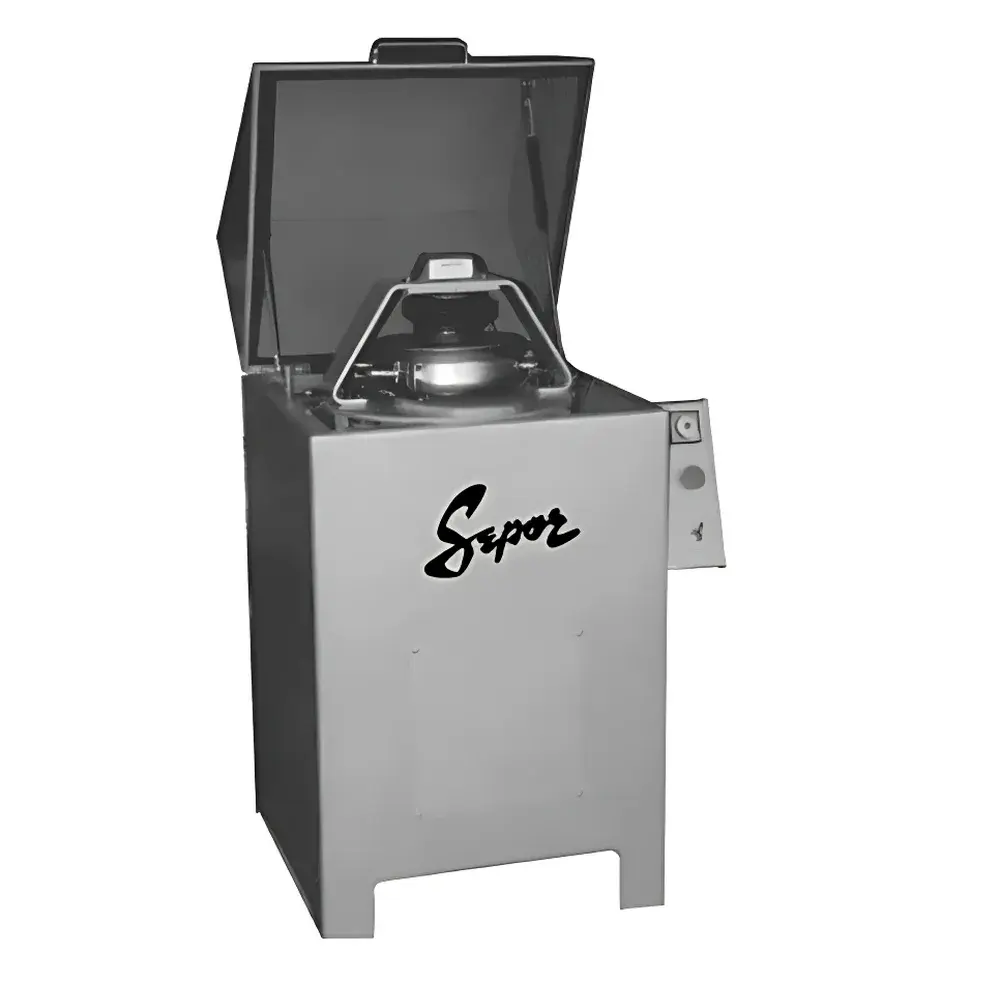
Thor Mill Rotational-Vibratory Laboratory Grinder
| Origin | USA |
|---|---|
| Manufacturer Type | Authorized Distributor |
| Origin Category | Imported |
| Model | 010G-150 |
| Pricing | Upon Request |
| Power | 1.5 HP |
| Voltage/Frequency | 230 V / 3-phase / 60 Hz or 380 V / 3-phase / 50 Hz |
| Max Feed Capacity | 1.2 kg |
| Final Particle Size | ≤ 45 µm (−325 mesh) |
| Grinding Chamber Material | Chromium Alloy Steel, Rockwell Hardness C70 |
| Compliance | ISO 9001-certified manufacturing |
| Acoustic Enclosure | Integrated sound-dampening cabinet |
Overview
The Thor Mill Rotational-Vibratory Laboratory Grinder is an engineered solution for high-efficiency size reduction and homogenization of brittle, friable, and moderately hard solid materials in analytical, quality control, and R&D laboratories. Operating on the principle of combined rotational and high-frequency vibrational energy transfer, the Thor Mill subjects samples to controlled impact, shear, and compression forces within a rigid, dynamically balanced grinding chamber. Unlike conventional jaw or disk mills, this dual-mode motion ensures rapid, uniform particle size reduction without excessive heat generation or preferential attrition—critical for preserving sample integrity in downstream analyses such as XRF, ICP-OES, SEM-EDS, or geochemical assay. Designed for reproducible batch processing, the unit accommodates feed masses ranging from 600 g to 1.2 kg per cycle, delivering consistent sub-45 µm output (−325 mesh) in under five minutes—enabling statistically robust sampling for heterogeneous materials including ores, ceramics, slag, coal, pharmaceutical excipients, and geological cores.
Key Features
- Rotational-vibratory dual-action mechanism ensures rapid, uniform comminution with minimal thermal load and low contamination risk.
- Pneumatically actuated clamping system guarantees secure, repeatable chamber sealing and eliminates manual torque variability.
- Grinding chamber fabricated from chromium alloy steel (Rockwell C70 hardness) provides exceptional wear resistance and long service life—even with abrasive mineral matrices.
- Integrated acoustic enclosure reduces operational noise to <72 dB(A) at 1 m, meeting occupational safety requirements for routine lab deployment.
- Modular design supports quick interchange of grinding kits (600 g and 1.2 kg configurations) without tooling or recalibration.
- Compliant with ISO 9001:2015 quality management standards throughout design, assembly, and factory testing.
Sample Compatibility & Compliance
The Thor Mill is validated for use with non-fibrous, non-ductile, and thermally stable materials—including silicates, carbonates, oxides, sulfides, polymers, and dried botanicals. It is not recommended for ductile metals, elastomers, or hygroscopic substances without pre-conditioning. All units are supplied with full traceability documentation, including material certifications for chamber components and electrical safety compliance (UL/CSA recognized power supply modules). While the mill itself does not carry CE marking, its voltage-configurable motor and control architecture meet IEC 61000-6-2 (immunity) and IEC 61000-6-4 (emission) specifications when installed per manufacturer guidelines. For regulated environments, optional audit-trail-enabled operation logs can be integrated via third-party LIMS interfaces.
Software & Data Management
The Thor Mill operates as a standalone electromechanical instrument with no embedded firmware or proprietary software stack. Process parameters—including cycle duration, start/stop timestamps, and chamber identification—are manually recorded or captured via external lab notebooks or ELN systems. Optional digital integration is supported through dry-contact relay outputs (NO/NC) for PLC or SCADA synchronization, enabling automated batch logging in GLP- or GMP-aligned workflows. Raw grinding time and feed mass entries may be linked to sample IDs in compliant data systems supporting 21 CFR Part 11 audit trails when paired with validated electronic signature protocols.
Applications
- Preparation of representative subsamples for bulk ore grade analysis (e.g., Au, Cu, Fe assays).
- Homogenization of cementitious materials prior to Blaine surface area or XRD phase quantification.
- Routine pulverization of ASTM D3174 coal ash samples for proximate and ultimate analysis.
- Size reduction of ceramic green bodies for SEM cross-sectioning and microstructural evaluation.
- Production of fine, dispersion-stable powders for laser diffraction particle size distribution (PSD) calibration standards.
- Support of ISO/IEC 17025 accredited testing labs requiring documented, repeatable sample preparation SOPs.
FAQ
What is the maximum allowable feed size for the Thor Mill?
The standard chamber accepts feed particles up to 12 mm in maximum dimension. Oversized fragments must be pre-crushed to avoid mechanical stress on the drive train.
Can the Thor Mill process wet or slurry-based samples?
No—this is a dry-grinding system only. Introduction of moisture compromises chamber sealing, accelerates corrosion, and invalidates particle size specifications.
Is routine maintenance required beyond cleaning?
Yes. Recommended preventive maintenance includes biannual inspection of pneumatic seals, vibration isolator mounts, and chamber bolt torque verification per OEM service bulletin 010G-SV-2023.
Does the unit support custom grinding media or alternative chamber linings?
Not natively. Chamber geometry and dynamic balance are optimized exclusively for the supplied chromium alloy configuration. Third-party modifications void warranty and compromise ISO 9001 conformance.
How is particle size distribution verified post-grinding?
Users must employ independent sieving (ASTM E11), laser diffraction (ISO 13320), or sedimentation analysis—no built-in PSD measurement capability is provided.




