
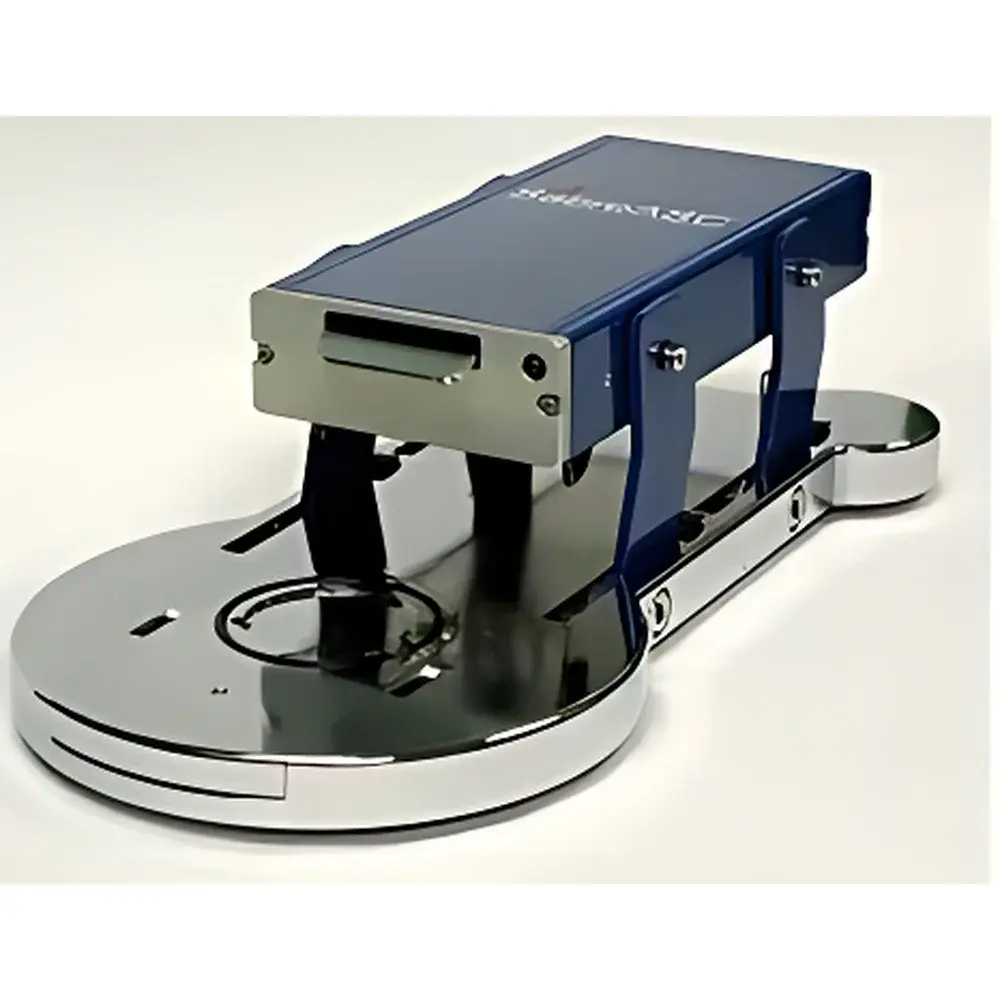
SabreASC Portable Alpha Spectrometer
| Origin | USA |
|---|---|
| Manufacturer Type | Distributor |
| Origin Category | Imported |
| Model | SabreASC |
| Pricing | Upon Request |
Overview
The SabreASC Portable Alpha Spectrometer is a field-deployable, high-sensitivity alpha-particle spectrometry system engineered for rapid, on-site quantification of alpha-emitting radionuclides—including 210Po, 238U, 239Pu, and 241Am—in environmental and health physics applications. Unlike traditional alpha counters requiring multi-day sample storage to allow 222Rn progeny decay, the SabreASC integrates real-time radon decay compensation via embedded algorithmic correction of 218Po and 214Po contributions—enabling accurate net alpha activity determination within minutes of sample collection. Its measurement principle relies on direct detection of alpha particles using a passivated ion-implanted silicon (PIPS) semiconductor detector, operating in vacuum or low-pressure argon atmosphere to minimize energy straggling and maximize spectral resolution.
Key Features
- 450 mm² active-area PIPS detector with optimized dead-layer thickness for high intrinsic efficiency (25% at 5.3 MeV) and excellent peak-to-Compton ratio
- Integrated 1024-channel multichannel analyzer (MCA) with programmable gain, shaping time, and baseline restoration for stable spectral acquisition
- Real-time radon decay compensation firmware that dynamically corrects for 222Rn–218Po–214Po ingrowth during counting—eliminating need for delayed measurement protocols
- Interchangeable dual-sided sample holder accommodating 50.8 mm (2-inch) diameter filters, smear wipes, or cartridge-based air sampling media
- Maximum sustained count rate capability of 600,000 counts per minute (cpm) with pile-up rejection and live-time correction
- Compact, battery-operated design weighing only 4.0 kg; fully functional without external power supply for ≥6 hours (optional extended-life Li-ion pack available)
- Ruggedized aluminum chassis with IP54-rated enclosure for dust and splash resistance in outdoor and industrial environments
Sample Compatibility & Compliance
The SabreASC supports standardized sample geometries defined by ASTM D3648 (Standard Test Methods for Alpha-Particle Emitting Isotopes of Uranium and Thorium in Water), ISO 11704 (Radiological protection — Measurement of radioactivity in foodstuffs — Alpha- and beta-emitting radionuclides), and EPA Method 900.0 (Alpha Spectrometry of Water Samples). It is validated for use with cellulose ester, polycarbonate, and mixed-cellulose ester (MCE) filters; stainless-steel or Teflon-coated smear wipes; and commercially available air sampling cartridges (e.g., Zefluor™, Gelman A/E). All spectral data files comply with ANSI N42.42-2022 (Data Format for Nuclear Spectrometry) for interoperability with third-party analysis software. The instrument meets IEC 61000-6-3 (EMC emissions) and IEC 61000-6-2 (EMC immunity) standards and is designed to support GLP and ISO/IEC 17025-compliant laboratory workflows.
Software & Data Management
The SabreASC is operated via SabreControl v3.x—a Windows-based application supporting both USB and Bluetooth 5.0 connectivity. The software provides real-time spectrum display, automatic peak search with Gaussian fitting, nuclide identification using built-in libraries (IAEA Nuclide Chart, ORTEC GammaVision-compatible alpha library), and customizable ROI definition. All raw spectra are stored in binary .SAB format with embedded metadata (date/time, operator ID, sample ID, atmospheric pressure, temperature, vacuum status). Audit trails record user actions, calibration changes, and firmware updates in accordance with FDA 21 CFR Part 11 requirements. Export options include CSV (energy vs. counts), PDF reports with uncertainty propagation (including statistical, background, and efficiency uncertainties), and N42.42 XML for integration into LIMS or national radiation monitoring networks.
Applications
- In-field screening of uranium mill tailings, phosphate processing residues, and legacy nuclear site soils
- Emergency response monitoring following radiological dispersal device (RDD) incidents or nuclear facility anomalies
- Regulatory compliance testing of drinking water, groundwater, and wastewater for natural and anthropogenic alpha emitters
- Occupational health surveillance—analysis of nasal swabs, lung bioassay filters, and personal air sampling badges
- Research-grade alpha spectroscopy in university nuclear engineering labs and environmental radiochemistry facilities
- Verification of decontamination efficacy following remediation of alpha-contaminated surfaces
FAQ
Does the SabreASC require liquid nitrogen or external cooling?
No. The PIPS detector operates at thermoelectrically stabilized temperatures (−20 °C ± 0.5 °C) using a single-stage Peltier cooler; no cryogens or external chillers are needed.
Can it distinguish between 234Th and 234mPa in the same spectrum?
Yes—the 1024-channel MCA provides sufficient resolution (FWHM ≤ 18 keV at 5.3 MeV) to resolve the 5.32 MeV (234Th) and 5.25 MeV (234mPa) alpha lines under optimal vacuum conditions.
Is vacuum pumping integrated or external?
A compact, oil-free diaphragm vacuum pump is housed internally; typical pump-down time to 10 mTorr is <90 seconds.
What calibration sources are recommended for routine energy and efficiency verification?
NIST-traceable 241Am (5.64 MeV), 239Pu (5.16 MeV), and 230Th (4.69 MeV) point sources mounted on stainless-steel planchets are standard; certified multi-nuclide reference materials (e.g., IAEA RGU-1) are supported for efficiency curve generation.
How is background minimized during field operation?
The detector assembly includes graded shielding (copper + cadmium + lead), active anti-coincidence veto via optional plastic scintillator guard, and pulse-shape discrimination firmware to reject beta/gamma-induced events and microphonic noise.







