Bt Fluid CW Series Continuous-Wave 532 nm Laser System with Customizable Sheet-Forming Optics
| Brand | Bt Fluid |
|---|---|
| Model | CW |
| Wavelength | 532 nm |
| Output Power | 1–20 W (custom higher power available) |
| Operation Mode | CW, TTL-triggered or analog-modulated pulsed output |
| Beam Divergence | <4 mrad |
| Beam Diameter | 4 mm |
| Sheet Thickness | <1 mm |
| Coating | AR-coated for 532 nm |
| Spherical Lens Focal Lengths | 500 mm, 1000 mm, 1500 mm |
| Cylindrical Lens Focal Lengths | −10 mm (37° divergence), −15 mm (24°), −25 mm (15°) |
| Origin | Beijing, China |
| Lead Time | 6 weeks |
Overview
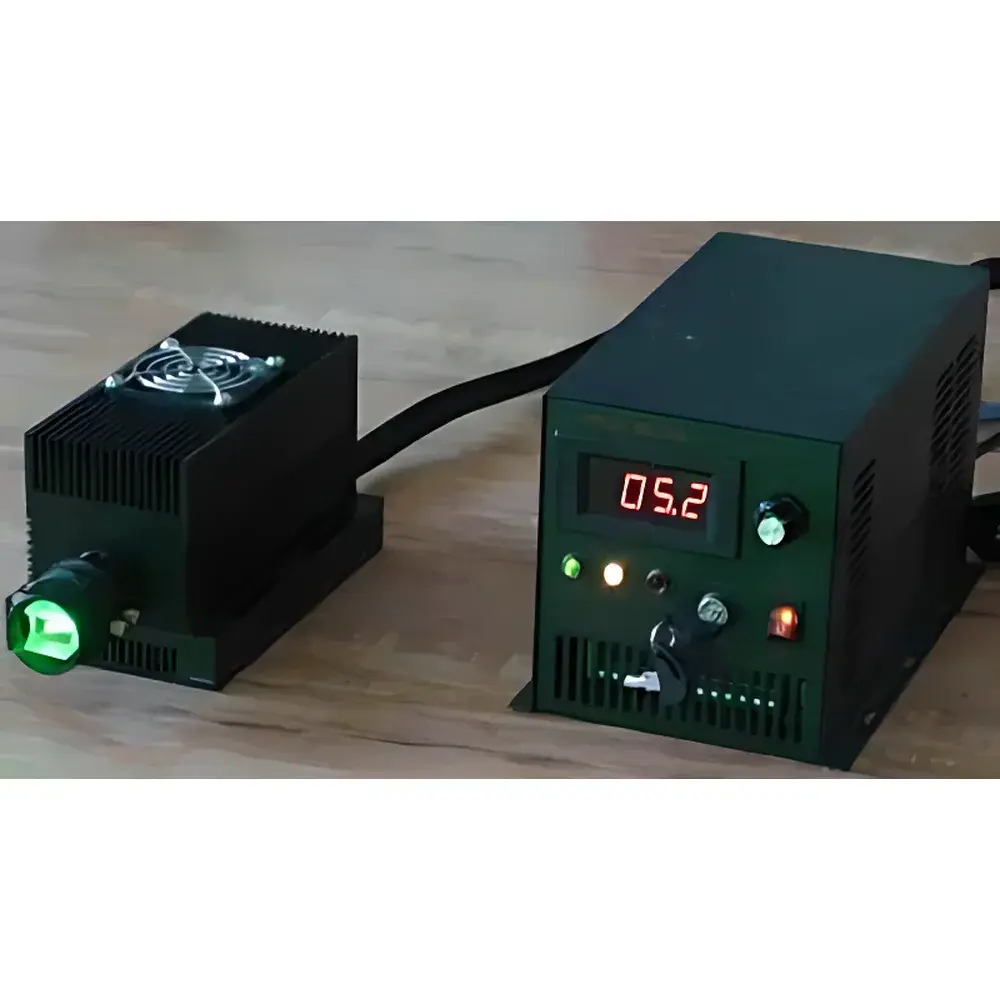
The Bt Fluid CW Series is a high-stability, continuous-wave (CW) diode-pumped solid-state (DPSS) laser system engineered specifically for quantitative fluid dynamics visualization and measurement. Operating at a fundamental wavelength of 532 nm, it delivers collimated, spatially coherent green light ideal for optical seeding-based diagnostics. When coupled with the integrated sheet-forming optical assembly—comprising precision AR-coated spherical and cylindrical lenses—the system generates a planar illumination field with sub-millimeter thickness (<1 mm) and controlled angular extent (15°–37°). This configuration satisfies the stringent geometric and spectral requirements of both qualitative flow visualization and quantitative techniques such as Particle Image Velocimetry (PIV) and Planar Laser-Induced Fluorescence (PLIF). The laser’s narrow spectral bandwidth (<0.1 nm), low pointing instability (<5 µrad/°C), and RMS power stability better than ±1.5% over 8 hours ensure repeatable illumination conditions essential for time-resolved measurements in academic laboratories and industrial R&D environments.
Key Features
- Stable CW output from 1 W to 20 W, scalable via custom OEM configurations for higher-power applications including large-scale wind tunnel illumination or high-speed PIV at kHz frame rates
- TTL and analog modulation inputs support synchronized triggering with high-speed cameras (up to 100 kHz pulse repetition) and external acquisition systems
- Optimized beam profile (M² < 1.3) and low divergence (<4 mrad) enable uniform sheet intensity distribution across working distances up to 1.5 m
- Modular optical head design allows rapid interchange of spherical and cylindrical lens pairs to adjust sheet geometry—focal lengths include 500/1000/1500 mm (spherical) and −10/−15/−25 mm (cylindrical)
- All optical surfaces feature high-efficiency anti-reflection coating centered at 532 nm (R < 0.2% per surface), minimizing ghost reflections and thermal lensing effects
- Integrated mounting interface compatible with standard kinematic mounts (e.g., Thorlabs KM100, Newport UH1) and OEM integration into turnkey Mini-PIV or Mini-PLIF platforms
Sample Compatibility & Compliance
The CW laser system is compatible with common flow tracers—including TiO₂, SiO₂, and fluorescent dye-doped particles (e.g., Rhodamine 6G)—and supports both scattering-based (PIV) and fluorescence-based (PLIF) detection modalities. Its 532 nm output aligns with peak absorption bands of numerous organic fluorophores used in temperature- and concentration-sensitive imaging. The system conforms to IEC 60825-1:2014 Class 4 laser safety standards; full compliance documentation—including hazard analysis, interlock schematics, and labeling guidance—is supplied with each unit. While not certified under FDA 21 CFR Part 11, the system supports audit-ready operation when integrated with validated third-party PIV software (e.g., LaVision DaVis, TSI Insight) that implements electronic signatures, change control, and secure data archiving per GLP/GMP-aligned workflows.
Software & Data Management
The CW laser itself operates as a hardware component within broader experimental ecosystems. It does not include embedded firmware or proprietary control software. Instead, it interfaces directly via industry-standard digital (TTL) and analog (0–5 V) signals with external controllers—including National Instruments DAQ devices, Arduino-based sequencers, or commercial PIV synchronization units (e.g., LaVision PulseMaster, TSI SyncBox). This open architecture ensures compatibility with MATLAB, Python (via PySerial or NI-DAQmx), LabVIEW, and vendor-specific acquisition suites. Users retain full control over pulse timing, duration, and intensity ramping—critical for dual-frame PIV, time-resolved PLIF, or multi-phase illumination strategies. All optical parameters (lens focal lengths, sheet thickness, working distance) are documented in machine-readable format (CSV, JSON) for inclusion in experimental metadata repositories.
Applications
- Laminar and turbulent boundary layer studies in water channels and low-speed wind tunnels
- Educational fluid mechanics demonstrations—including vortex shedding, jet impingement, and wake instability visualization
- Miniaturized PIV (Mini-PIV) setups for microfluidic device characterization (channel heights 50–500 µm)
- Time-resolved thermometry via acetone PLIF in combustion research and HVAC airflow validation
- Concentration mapping in mixing processes using fluorescein or rhodamine-B dyes
- Calibration target illumination for stereo-PIV and tomographic PIV (Tomo-PIV) volume reconstruction
FAQ
Is this laser suitable for use with high-speed cameras operating above 10,000 fps?
Yes—provided appropriate TTL synchronization and sufficient pulse energy per frame; users should verify minimum exposure time compatibility with their specific camera model and tracer concentration.
Can the sheet thickness be reduced below 1 mm?
Standard configurations achieve <1 mm at 500 mm working distance; thinner sheets (<0.5 mm) are attainable using customized cylindrical optics and beam expansion pre-conditioning—contact technical support for feasibility assessment.
Does the system include laser safety interlocks or enclosure options?
The base unit ships without an integrated enclosure; however, mechanical interlock connectors (3-pin LEMO) and OEM-compatible housing templates are available upon request to meet local regulatory requirements.
Are calibration certificates traceable to NIST or CNAS provided?
Power output calibration is performed using a NIST-traceable thermal sensor (Ophir 3A-FS); full calibration reports—including uncertainty budgets per ISO/IEC 17025—are available as optional add-ons.
What is the expected lifetime of the laser diode module?
Rated mean time to failure (MTTF) exceeds 10,000 hours under continuous operation at ≤80% of maximum rated power, assuming active cooling and stable ambient temperature (18–25 °C).