ILA FP 50 Shift Laser Doppler Velocimetry System
| Brand | PIV View |
|---|---|
| Country of Origin | Germany |
| Manufacturer Type | Authorized Distributor |
| Origin Category | Imported |
| Model | FP 50 Shift |
| Laser Source | Semiconductor Diode Laser (75 mW – 2 W output) |
| Focal Length Options | 160 mm, 250 mm, 400 mm, up to 3.5 m |
| Measurement Volume Size | Sub-micrometer scale (µm-level) |
| Velocity Range | 0 to Supersonic (limited by signal processor bandwidth) |
| Dimensionality | 1D, 2D, and 3D vector velocity measurement capability |
| Doppler Frequency Shift Processing | Programmable frequency shifting (e.g., 40 MHz Bragg cell), heterodyne detection, high-resolution FFT analysis |
| Compliance | PTB-traceable calibration, TÜV Rheinland certified for industrial deployment |
Overview
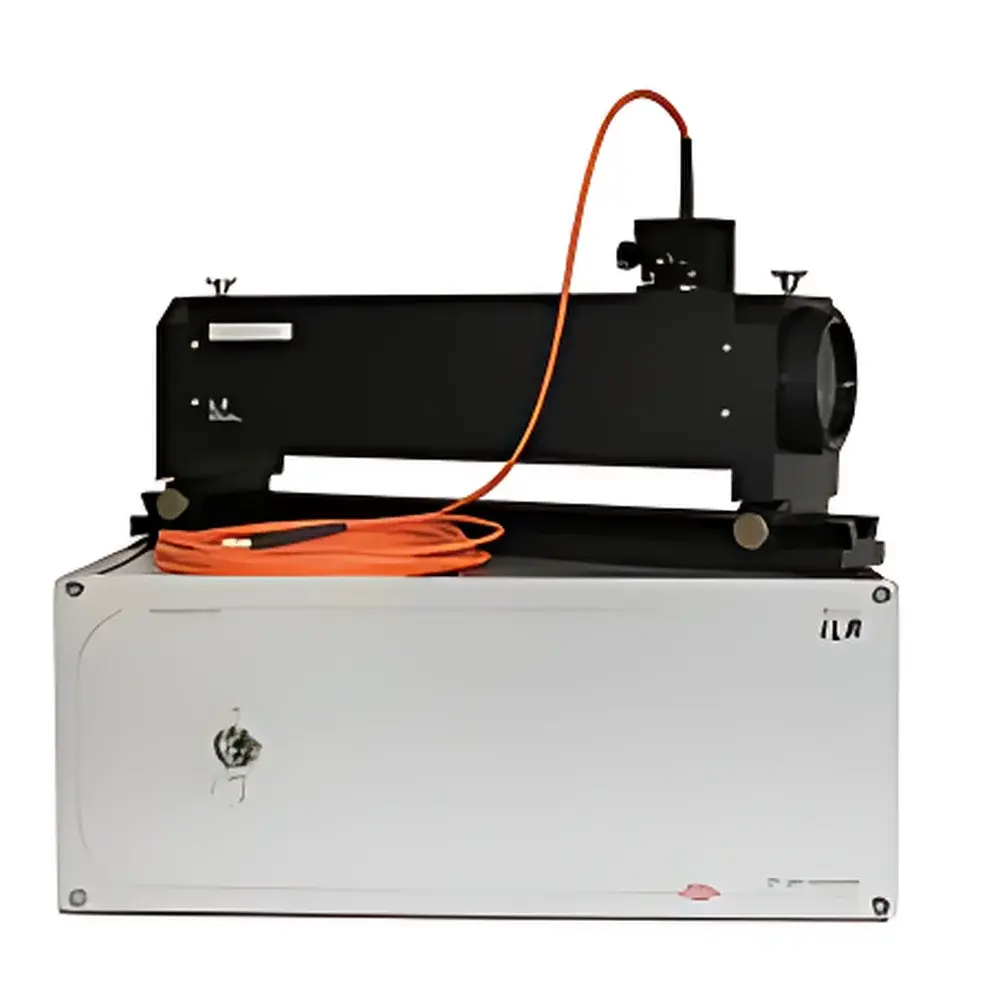
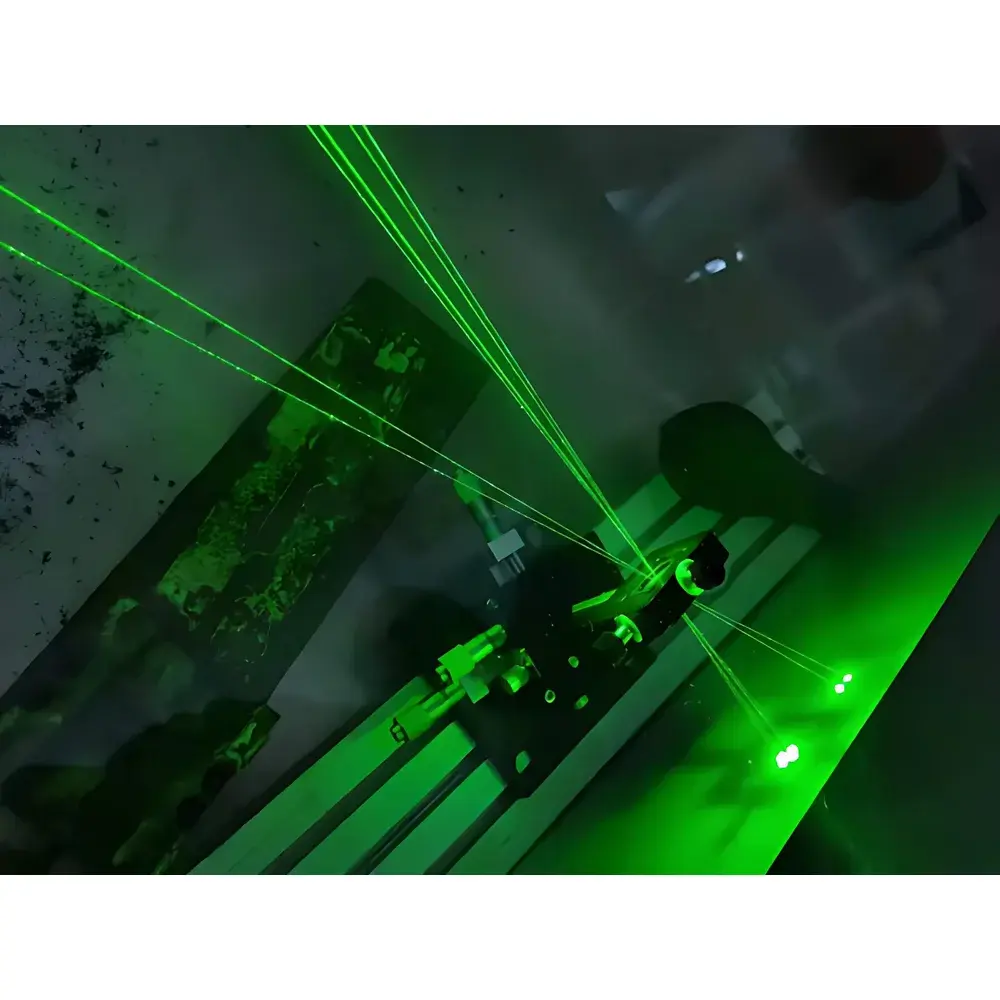
The ILA FP 50 Shift Laser Doppler Velocimetry (LDV) System is the world’s first fully integrated LDV platform featuring a semiconductor diode laser directly embedded within the probe head. Engineered in collaboration between ILA GmbH and the Physikalisch-Technische Bundesanstalt (PTB), Germany’s national metrology institute, this system implements classical heterodyne LDV principles to deliver non-intrusive, point-wise, time-resolved velocity measurements in gaseous and liquid flows. Its operational foundation lies in the interference of two coherent laser beams—intersecting at a precisely defined angle—to generate a stable fringe pattern (measurement volume) with sub-micrometer spatial resolution. When seeding particles traverse this volume, they scatter light modulated at a Doppler-shifted frequency proportional to their instantaneous velocity component along the fringe direction. The FP 50 Shift employs a programmable Bragg cell (e.g., 40 MHz shift) to encode flow direction into the sign of the frequency offset relative to the reference carrier, enabling unambiguous vector resolution without mechanical reorientation. This architecture eliminates conventional optical alignment complexity while maintaining metrological integrity suitable for primary-standard velocity calibration.
Key Features
- Integrated semiconductor laser probe: Compact, thermally stabilized diode source ensures long-term wavelength and beam-pointing stability—critical for drift-free operation over extended laboratory or industrial campaigns.
- True vector-capable design: Supports 1D, 2D, and 3D velocity decomposition via configurable dual- or triple-beam optical setups; directional sensitivity enabled by active frequency shifting (Bragg cell modulation).
- Industrial-grade robustness: Certified by TÜV Rheinland for continuous operation in harsh environments—including vibration, temperature fluctuation, and electromagnetic noise—making it uniquely qualified for on-site validation in power plants, combustion test rigs, and wind tunnel facilities.
- Metrology-grade accuracy: Adopted as a reference standard by national metrology institutes (NMIs) across Europe, including PTB Braunschweig, where the system achieves traceable velocity uncertainty down to ±0.03% (k=2) under controlled calibration conditions.
- Modular optical configuration: Fixed-focus probe options (160 mm, 250 mm, 400 mm) and extended-range optics (up to 3.5 m working distance) maintain µm-scale measurement volume dimensions across diverse experimental geometries.
Sample Compatibility & Compliance
The FP 50 Shift is compatible with any optically scattering fluid medium containing naturally occurring or artificially introduced tracer particles (e.g., DEHS, SiO₂, TiO₂, or oil droplets) sized between 0.1 µm and 10 µm. It requires no physical contact with the flow and imposes zero perturbation to local velocity fields—ensuring fidelity in boundary layer studies, turbulent kinetic energy quantification, and laminar-to-turbulent transition analysis. The system complies with ISO/IEC 17025 requirements for calibration laboratories and supports GLP/GMP-aligned data integrity through audit-trail-enabled software logging. All velocity outputs are traceable to SI units via PTB-certified interferometric path-length calibration and NIST-traceable frequency standards embedded in the signal processor.
Software & Data Management
The included acquisition and analysis software provides real-time spectral processing using adaptive short-time Fourier transform (STFT) algorithms optimized for low-SNR particle bursts. Users configure acquisition parameters—including sampling rate, FFT bin count, gating thresholds, and Bragg cell offset—via an intuitive GUI. Raw voltage signals, power spectra, and validated velocity time series are exported in HDF5 and ASCII formats for post-processing in MATLAB, Python (NumPy/Pandas), or commercial CFD validation suites. The software supports 21 CFR Part 11-compliant electronic signatures, user-access controls, and immutable audit logs—meeting regulatory expectations for pharmaceutical process validation and aerospace R&D documentation.
Applications
- Aerodynamic characterization: Boundary layer profiling, wake dynamics, and vortex shedding analysis in wind tunnels and open-jet facilities.
- Combustion diagnostics: Velocity field mapping in gas turbine combustors, flame stabilization zones, and exhaust aftertreatment systems.
- Calibration traceability: Primary-standard velocity reference for calibrating hot-wire anemometers, Pitot tubes, and industrial flow meters per ISO 17025 and ISO 5167.
- Microfluidics and biomedical flows: Quantification of pulsatile blood analog flows, microchannel laminar profiles, and particle-laden suspension transport.
- Educational instrumentation: Hands-on teaching of laser interferometry, Doppler physics, signal processing fundamentals, and uncertainty propagation in experimental fluid mechanics.
FAQ
What distinguishes the FP 50 Shift from conventional LDV systems?
Its monolithic probe-integrated laser architecture eliminates external beam delivery optics, reducing alignment sensitivity and environmental drift—while retaining full heterodyne capability via programmable Bragg cell frequency shifting.
Can the system measure supersonic flows?
Yes—velocity range is governed by signal processor bandwidth (typically DC to >100 MHz); with appropriate tracer density and optical access, Mach >1 flows have been successfully resolved in propulsion research applications.
Is PTB calibration documentation provided with each unit?
Each FP 50 Shift ships with a factory calibration certificate referencing PTB’s primary LDV standard; optional on-site recalibration services include full uncertainty budget reporting per GUM (JCGM 100:2008).
How is directional ambiguity resolved without moving parts?
By applying a fixed-frequency shift (e.g., +40 MHz) to one beam via acousto-optic modulation, the resulting moving interference fringes convert particle transit direction into a signed Doppler shift—+Δf indicates motion against the fringe drift, −Δf indicates co-directional motion.
Does the system support synchronization with external triggers or PIV illumination?
Yes—the signal processor features TTL-compatible trigger I/O and programmable delay generators, enabling precise phase-locked acquisition with pulsed lasers, pressure transducers, or high-speed cameras in hybrid LDV/PIV experiments.