
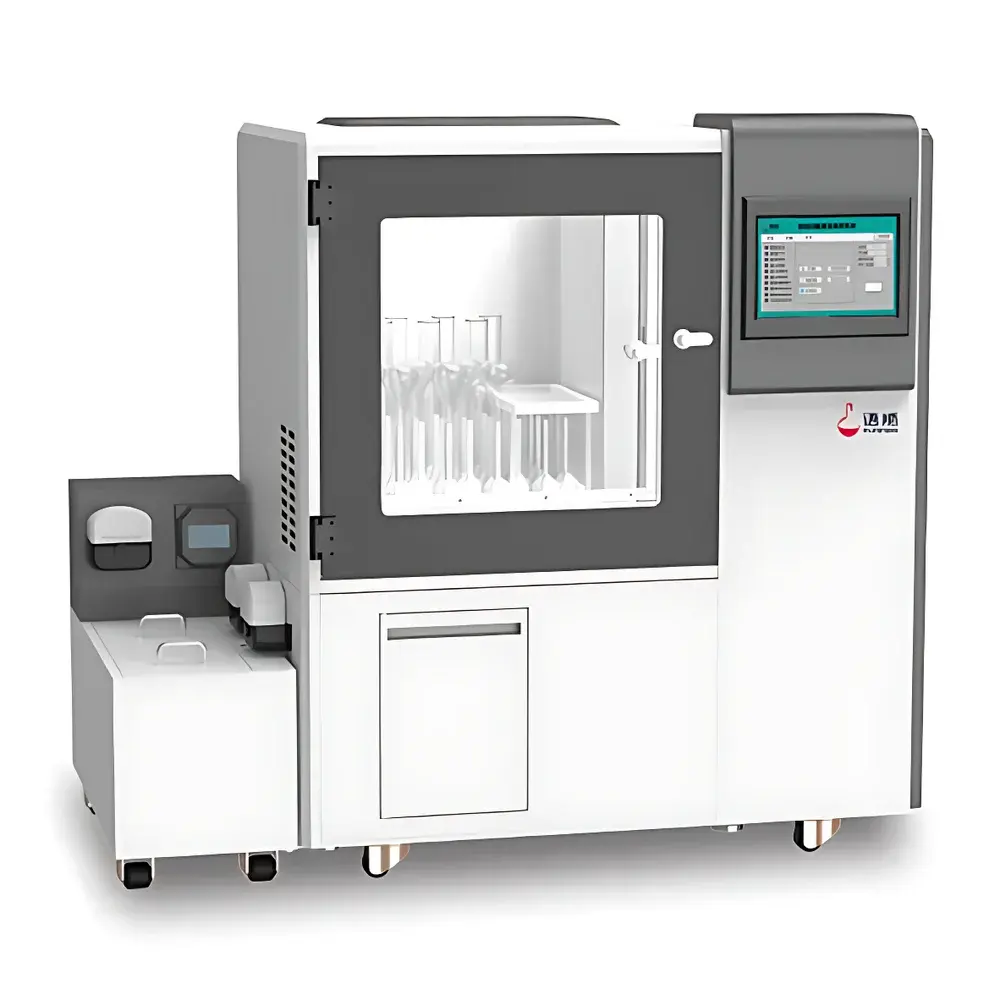
EURPING Acide 3200 Sub-Boiling Acid Vapor Cleaner
| Brand | EURPING |
|---|---|
| Origin | Tianjin, China |
| Manufacturer Type | Direct Manufacturer |
| Model | Acide 3200 |
| Automation Level | Fully Automatic |
| Cleaning Time | 2 Hours |
| Detection Limit Cleanliness | ppt-level residual ion removal |
| Acid Delivery & Drainage | Automated with Liquid-Level Monitoring |
| Exhaust System | Integrated EP Acid Gas Absorption Module |
| Door Design | Dual-Layer Transparent Front-Opening Sealed View Port |
| Waste Effluent pH | Neutral (pH ≈ 7) |
| Rinse Method | Non-recirculating Ultra-Pure Water Spray |
| Heating Profile | Stepwise Ramp (0–90°C in ≤5 min |
| Rinse Duration | 3–6 sec (single-pass) |
| Total Acid Cleaning + Rinse Cycle | 60–90 min |
Overview
The EURPING Acide 3200 Sub-Boiling Acid Vapor Cleaner is an engineered solution for ultra-trace laboratory sample preparation workflows requiring stringent control of elemental background contamination. Designed specifically for analytical laboratories performing ICP-MS, ICP-OES, HR-ICP-MS, and other high-sensitivity elemental analysis techniques, the Acide 3200 employs a controlled sub-boiling acid vapor condensation principle—where high-purity nitric, hydrochloric, or hydrofluoric acid (as compatible with chamber materials) is heated below its atmospheric boiling point to generate saturated, low-velocity vapor. This vapor uniformly condenses on cooler surfaces of labware—including quartz, fused silica, PFA, PTFE, TFM, borosilicate glass, and ICP-MS torch injectors—dissolving adsorbed metal cations and oxide residues via selective ion exchange and chelation. Unlike conventional reflux or ultrasonic acid baths, the Acide 3200’s unidirectional vapor flow prevents re-deposition and cross-contamination, while its non-recirculating architecture eliminates carryover risk from aged or degraded acid solutions.
Key Features
- Fully automated operation with integrated acid dosing, temperature-controlled sub-boiling vapor generation, ultra-pure water spray rinse, and inert-gas-assisted drying—all programmable via touchscreen HMI.
- Stepwise thermal ramping system: achieves 90°C within 5 minutes and stabilizes at 95°C ± 0.5°C within 10 minutes, ensuring consistent sub-boiling conditions without thermal overshoot or localized hot spots.
- Single-pass, non-recirculating ultra-pure water rinse (18.2 MΩ·cm resistivity, <0.005 ppb total metals) delivers 3–6 second targeted spray coverage across all rack-mounted vessels, eliminating rinse water carryover and minimizing post-rinse drying time.
- Dual-layer transparent front-opening door with silicone-sealed gasket enables real-time visual monitoring while maintaining Class 100 cleanroom-compatible sealing integrity during operation.
- Onboard EP (Enhanced Performance) acid gas absorption module actively draws vapors through a caustic scrubber bed (NaOH-based), neutralizing acidic effluents to pH ~7 prior to exhaust—ensuring compliance with OSHA PEL and local emissions regulations.
- Automated acid replenishment and drain cycle with capacitive liquid-level sensing; system alerts operator when acid reservoir falls below operational threshold and initiates full sump evacuation upon cycle completion.
Sample Compatibility & Compliance
The Acide 3200 accommodates standard volumetric and digestion labware up to 1 L capacity, including but not limited to: conical flasks (up to 500 mL), volumetric flasks (10–1000 mL), quartz ICP vials, PFA digestion tubes, TFM microwave vessels, and disassembled ICP-MS nebulizers and spray chambers. All wetted components are constructed from PFA-lined 316L stainless steel and high-purity quartz, certified per ASTM F2217 for fluoropolymer purity and ISO 15195:2019 for reference material traceability. The system supports GLP/GMP-aligned validation protocols—including IQ/OQ/PQ documentation templates—and meets functional requirements for USP /, EPA Method 1638, and ISO/IEC 17025:2017 clause 5.9 regarding measurement uncertainty control in trace element preparation.
Software & Data Management
The embedded control firmware logs timestamped event records—including acid batch ID (via optional RFID tag reader), temperature profiles, rinse duration, exhaust pressure differentials, and door seal integrity checks—for full audit trail generation. Data export is supported via USB 3.0 and Ethernet (Modbus TCP), enabling integration into LIMS platforms compliant with FDA 21 CFR Part 11 (electronic signatures, audit trail retention ≥15 years). Optional software add-ons provide remote monitoring via TLS-secured web interface and automated report generation aligned with ISO/IEC 17025 internal audit checklists.
Applications
- Preparation of calibration standards and blanks for ICP-MS multi-element analysis (e.g., seawater, geological digests, biological matrices).
- Cleaning of high-value quartz and PFA components used in cleanroom semiconductor metrology labs.
- Decontamination of sampling tools and field collection bottles prior to environmental heavy-metal profiling (e.g., Pb, Cd, As, U isotopes).
- Reconditioning of ICP-MS sample introduction systems following high-matrix sample runs to prevent memory effects and polyatomic interferences.
- Supporting ISO 14001-certified laboratories seeking closed-loop acid management and neutral wastewater discharge compliance.
FAQ
What acid types are compatible with the Acide 3200?
Nitric acid (HNO₃), hydrochloric acid (HCl), and hydrofluoric acid (HF) — at concentrations up to 49% w/w — are validated for use. HF requires dedicated PFA fluid path configuration and must be operated under strict safety protocols per ANSI Z9.2.
Does the system support custom cleaning protocols?
Yes. Up to 20 user-defined methods can be stored, each with adjustable acid volume, ramp rate, hold time, rinse duration, and drying temperature setpoints.
How is acid waste handled after a cycle?
All residual acid is fully evacuated into a neutralized waste container; no acid remains in the chamber or lines post-cycle, preventing corrosion and ensuring reproducible performance across consecutive runs.
Is third-party certification available for method validation?
EURPING provides factory-issued IQ/OQ documentation. For PQ validation, certified reference materials (e.g., NIST SRM 3100 series) may be used in conjunction with client-specific SOPs and external auditors.
What maintenance intervals are recommended?
Quarterly inspection of acid delivery tubing, quarterly replacement of EP scrubber media, and annual calibration of temperature sensors against NIST-traceable references per ISO/IEC 17025 requirements.



