
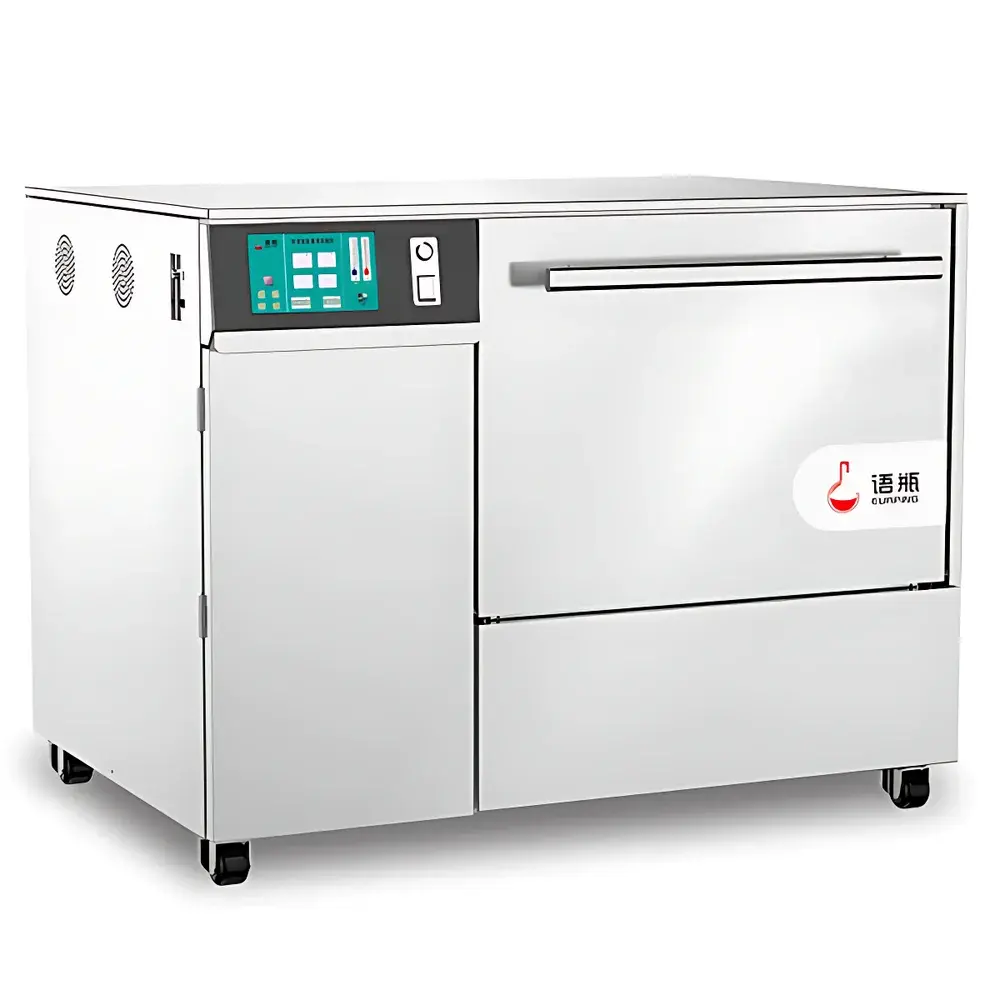
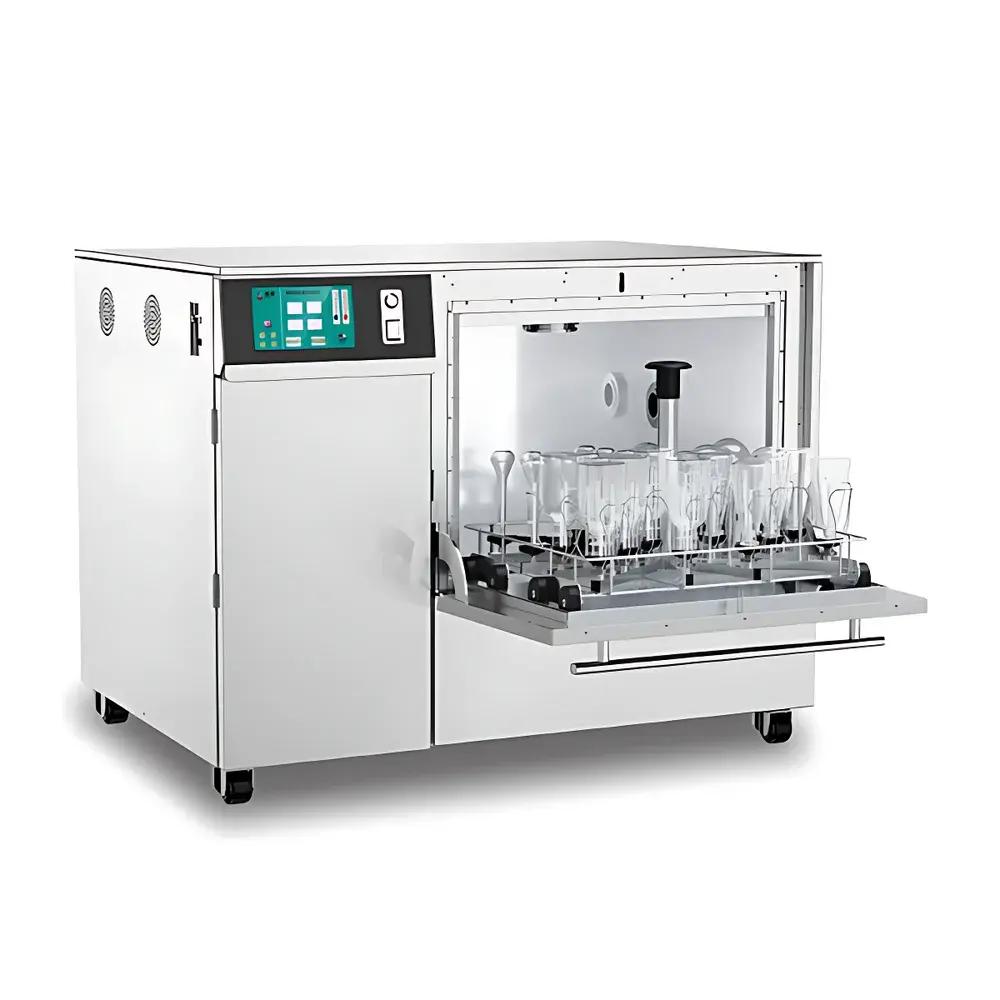
EURPING Q520 Laboratory Bottle Washer
| Brand | EURPING |
|---|---|
| Origin | Tianjin, China |
| Manufacturer Type | Direct Manufacturer |
| Product Category | Domestic |
| Model | Q520 |
| Price Range | USD 7,000 – 14,000 (FOB) |
| Chamber Volume | 150 L |
| Heating Power | 4 kW |
| Temperature Range | Ambient to 93°C (adjustable) |
| Compatible Detergents | Acidic and Alkaline Cleaning Agents |
| External Dimensions (L×W×D) | 1015 × 706 × 796 mm |
Overview
The EURPING Q520 Laboratory Bottle Washer is an engineered cleaning and rinsing system designed for high-integrity reprocessing of glassware and precision labware in regulated environments—including pharmaceutical QC labs, central analytical facilities, and GLP-compliant research institutions. It operates on a closed-loop, multi-stage cycle combining programmable alkaline/acidic detergent injection, high-velocity recirculated spray, controlled temperature ramping, and vacuum-assisted thermal drying. Unlike batch-style ultrasonic cleaners or manual washing stations, the Q520 employs gravity-fed top-down distribution architecture with 12-way symmetrical nozzle manifolds—ensuring uniform hydrodynamic impact across all vessel orientations. Its chamber design eliminates weld seams via seamless 316L stainless steel press-formed construction, minimizing microbial harborage points and enabling full traceability under ISO 15883-1 and ASTM E2852-22 validation frameworks.
Key Features
- Seamless 316L stainless steel wash chamber (150 L volume), fully press-formed with zero internal welds; outer casing in 304 stainless steel for structural integrity and corrosion resistance.
- Top-mounted water distribution manifold with 12 equally spaced (30°) spray arms—eliminating side/back feed lines and ensuring consistent column pressure across all positions.
- Variable-frequency circulation pump (0–400 L/min range) with soft-start control and real-time pipeline pressure monitoring to prevent mechanical stress on fragile glassware.
- Dual independent detergent dosing pumps (alkaline + acidic), each supporting 6 kg canister storage; integrated auto-level detection with on-screen low-detergent alerts.
- 7-inch full-color OLED touchscreen interface with microcontroller-based logic (non-PLC architecture); preloaded with ≥30 standardized cycles and ≥120 user-definable protocols, each permitting granular editing of temperature ramping, dwell time, rinse count, and flow modulation.
- Embedded “black box” event logger recording operational status of all electromechanical components (pumps, heaters, valves, sensors) per cycle; supports audit-ready CSV export and optional thermal printer output.
- Triple-stage filtration: coarse particulate filter (pre-tank), sump-mounted mesh screen, and inline pump protection filters—ensuring long-term fluid path reliability and preventing clogging during extended operation.
Sample Compatibility & Compliance
The Q520 accommodates up to 172 pipettes (up to 1000 mm length) or 52 volumetric flasks (10–2500 mL) per cycle. Its cleaning efficacy meets critical cleanliness benchmarks required by FDA Process Validation Guidance and EU GMP Annex 15: post-rinse water must demonstrate TOC ≤ 500 ppb, conductivity ≤ 2 µS/cm, and anion concentration ≤ 0.002 mg/L versus source purified water. Residual particle load is verified at ≤ 3 × 10⁻⁶ % (w/w) using HPLC-UV gradient elution (mobile phase A: 0.1% TFA in H₂O; B: ACN) across three UV wavelengths (210 nm, 254 nm, 280 nm). All hardware interfaces comply with IEC 61000-6-2/6-4 EMC standards; electrical safety conforms to IEC 61010-1.
Software & Data Management
Cycle data—including timestamps, parameter sets, sensor logs, and alarm history—is stored locally for ≥100 complete wash events. The system supports role-based access control with three-tier password authentication (Operator, Supervisor, Administrator) across six concurrent user accounts. Audit trail functionality satisfies 21 CFR Part 11 requirements when paired with external networked time servers and digital signature modules (optional add-on). Data export is supported via USB port (CSV format) or RS-232 serial interface for integration into LIMS or MES platforms. Screen auto-sleep mode activates after 60 seconds of inactivity; manual wake-up preserves real-time display of current stage, elapsed time, temperature, and flow rate.
Applications
The Q520 serves laboratories requiring repeatable, documented cleaning outcomes for analytically sensitive workflows. Primary use cases include: preparation of HPLC/GC vials prior to trace metal analysis; decontamination of volumetric glassware used in USP analytical instrument qualification; recovery of cell culture flasks and bioreactor accessories in upstream process development; and routine cleaning of pipettes, burettes, and titration vessels in ISO/IEC 17025-accredited testing labs. Its dual-detergent capability enables residue-specific removal—e.g., proteinaceous films with alkaline formulations followed by silicate or phosphate scale dissolution using acidic agents.
FAQ
Does the Q520 support automated validation protocols for IQ/OQ/PQ?
Yes—the system provides configurable cycle templates aligned with ASTM E2852-22 and ISO 15883-1; temperature mapping ports, pressure sensor outputs, and event logs are accessible for third-party validation software integration.
Can the unit operate without external ventilation ducting?
Yes—its dual-stage condensation system (stainless steel heat exchanger + dynamic exhaust recirculation) captures >92% of vaporized moisture and reintroduces dry, heated air into the drying loop, eliminating need for roof-mounted exhaust.
What safety mechanisms prevent dry-firing of heating elements?
Heating coils are fully submerged within the tank and thermally isolated from the base plate; redundant NTC sensors trigger immediate shutdown if liquid level drops below operational threshold or temperature exceeds 95°C.
Is remote monitoring or cloud connectivity available?
Standard configuration includes local data logging only; optional Ethernet module (EURPING-NET-01) enables Modbus TCP communication and secure HTTPS-based remote diagnostics via authenticated API endpoints.
How is cross-contamination between cycles prevented?
Gravity-drain architecture automatically evacuates residual water from spray arms and manifolds after each rinse phase; combined with 120-second post-cycle purge and HEPA-filtered intake air, this ensures no carryover between batches.



