
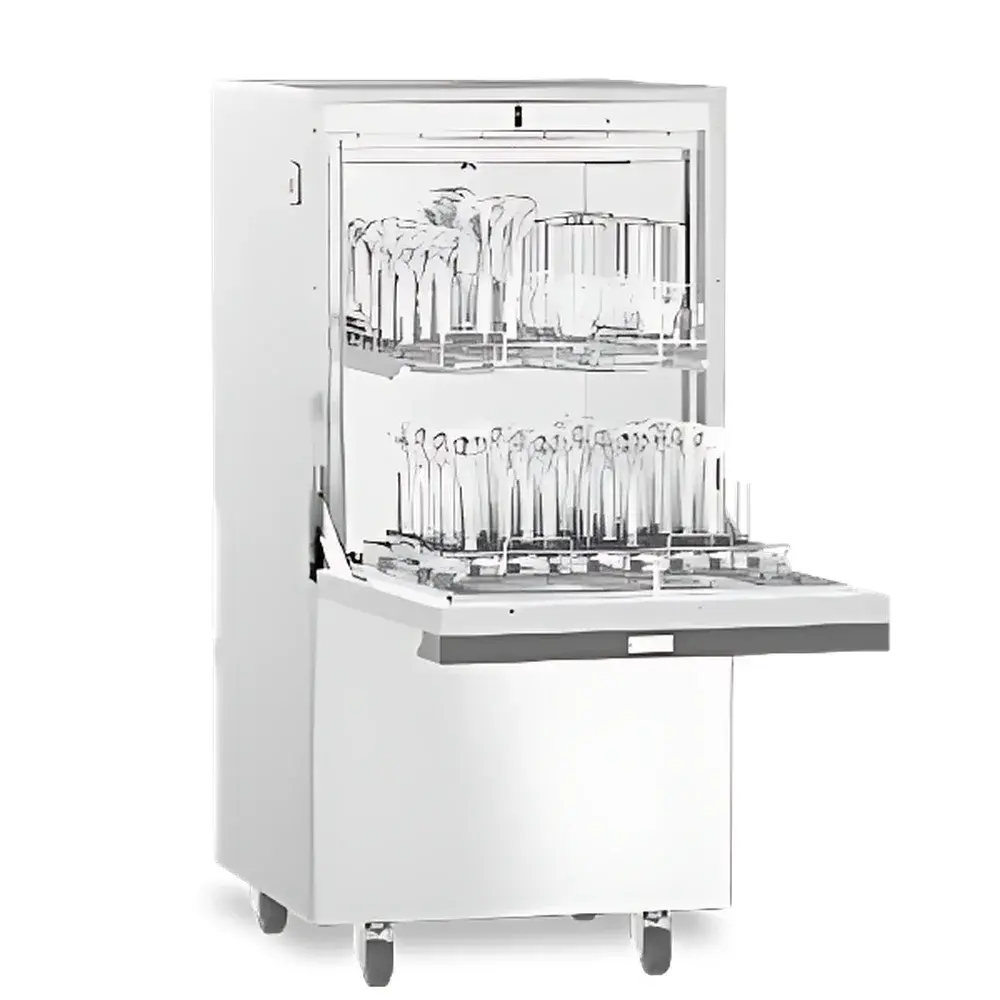
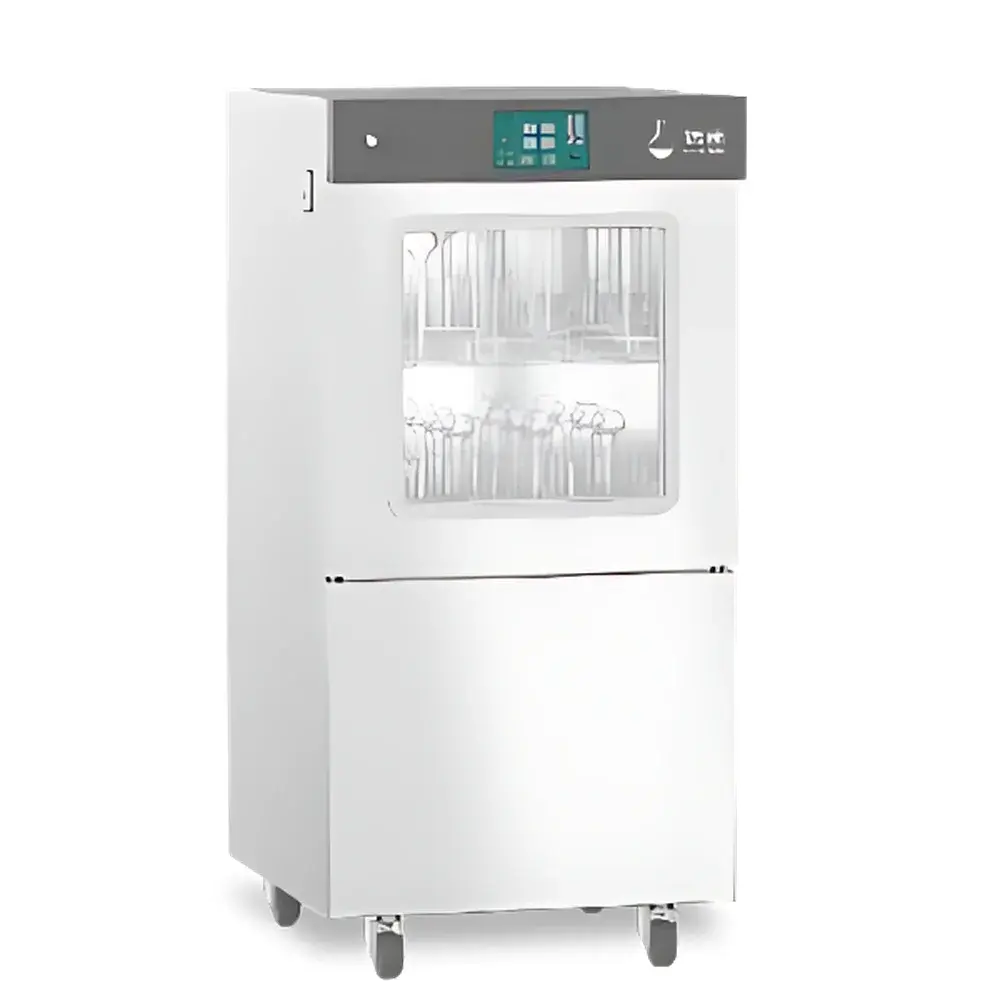
EURPING Q850D Laboratory Bottle Washer
| Brand | EURPING |
|---|---|
| Origin | Tianjin, China |
| Manufacturer Type | Direct Manufacturer |
| Model | Q850D |
| Chamber Volume | 223 L |
| Heating Power | 10 kW |
| Wash Temperature Range | Ambient to 95 °C |
| Compatible Cleaning Agents | Acidic & Alkaline Solutions |
| External Dimensions (L×W×D) | 670 × 760 × 1400 mm |
Overview
The EURPING Q850D is a fully automated, high-capacity laboratory bottle washer engineered for precision cleaning, thermal disinfection, and HEPA-filtered drying of glassware and plastic labware. Designed in accordance with ISO 15883-1 (washer-disinfectors for medical devices) and aligned with GLP/GMP operational expectations, the Q850D employs a closed-loop, programmable aqueous cleaning process based on controlled temperature, pressure, flow dynamics, and chemical dosing. Its dual-layer stainless steel chamber—constructed from electropolished 316L inner walls and 304 stainless steel outer casing—ensures corrosion resistance against aggressive acidic and alkaline detergents while maintaining structural integrity under repeated thermal cycling. The system integrates real-time sensor feedback (pressure, temperature, flow, door status, detergent level), full-cycle audit logging, and multi-tier user access control to support regulatory traceability requirements including FDA 21 CFR Part 11 compliance when paired with validated software configurations.
Key Features
- 223-liter monolithic wash chamber with seamless, weld-free 316L stainless steel interior—optimized for uniform spray coverage and minimal dead zones
- Dual independent HEPA-filtered hot-air drying system with vacuum-assisted extraction (max. −110 mbar) and adjustable drying temperature (ambient to 120 °C) and duration (0–300 min)
- Intelligent basket recognition technology that dynamically adjusts water volume and spray intensity based on loaded rack configuration
- Back-fed FL-EXCH modular rack system—interchangeable half-rack units enable flexible loading of volumetric flasks (≥250 mL), pipettes, test tubes, Erlenmeyer flasks, beakers, cylinders, and 2-mL autosampler vials (up to 600 per cycle)
- Microprocessor-based control system (non-PLC architecture) with 7-inch capacitive touchscreen, 30 pre-validated wash programs, and 120 customizable protocols
- Triple-level user authentication: role-based access control (administrator, operator, reviewer) with optional fingerprint biometric integration and SD-card-based audit trail storage
- “Black box” event logger capturing timestamped status of all electrical components, sensor readings, and actuator commands throughout each cycle
- Soft-start variable-frequency circulation pump (0–600 L/min), integrated pipeline pressure transducer, and EU-W condensing heat recovery system for water and energy conservation
Sample Compatibility & Compliance
The Q850D accommodates standard laboratory vessels including Class A volumetric flasks (10–2000 mL), borosilicate glass test tubes, conical flasks (50–1000 mL), graduated cylinders, wide-mouth bottles, and HPLC/GC autosampler vials. Its chamber geometry and nozzle array are calibrated to ensure complete wetting and mechanical impingement across all surfaces—even narrow-necked or bottom-heavy containers. All materials contacting wash solution meet USP Class VI biocompatibility standards. The system supports validation documentation packages compliant with ISO 13485, ASTM E2500, and EU Annex 15 guidelines for equipment qualification (IQ/OQ/PQ). Optional IQ/OQ documentation templates and calibration certificates for temperature, pressure, and time sensors are available upon request.
Software & Data Management
The embedded control firmware records every critical parameter—including inlet water temperature, chamber temperature profile, rinse conductivity, final rinse resistivity, pump runtime, detergent dosage events, and door open/close cycles—with millisecond-level timestamps. Audit logs are stored locally on an encrypted SD card with write-protection and tamper-evident file hashing. Data export is supported via USB or Ethernet (Modbus TCP) for integration into LIMS or electronic lab notebook (ELN) platforms. When configured with network-enabled security settings, the system satisfies 21 CFR Part 11 requirements for electronic records and signatures—including user authentication, audit trail retention, and record integrity verification.
Applications
The Q850D serves quality control laboratories in pharmaceutical, biotechnology, environmental testing, food safety, and clinical research sectors where reproducible removal of organic residues, endotoxins, and particulate contaminants is essential prior to analytical use. It is routinely deployed for preparation of sample containers used in ICP-MS, HPLC, GC-MS, and dissolution testing; cleaning of reusable cell culture flasks and media bottles; and decontamination of glassware exposed to radioactive or cytotoxic compounds. Its programmable chemistry delivery and thermal profiling make it suitable for residue removal validation studies per ICH Q5C and USP .
FAQ
Does the Q850D support validation documentation for GMP environments?
Yes—EURPING provides IQ/OQ protocol templates, factory calibration reports, and traceable sensor certificates compatible with GMP and ISO 17025 workflows.
Can the system be integrated into an existing laboratory network for centralized monitoring?
Yes—via Ethernet interface with Modbus TCP or OPC UA protocols; optional remote diagnostics and alarm notification modules are available.
What is the maximum load capacity for standard 100-mL volumetric flasks?
Up to 128 units per cycle when using dedicated dual-layer racks.
Is the drying system capable of removing residual moisture from narrow-bore pipettes or serological pipettes?
Yes—the dual HEPA air injection system directs heated, filtered airflow directly into vessel interiors through precision-engineered nozzles mounted on the FL-EXCH rack modules.
How does the machine handle detergent depletion during extended unattended operation?
Integrated level sensors trigger visual and audible alerts on the HMI screen and pause the cycle until replenishment is confirmed by authorized personnel.



