
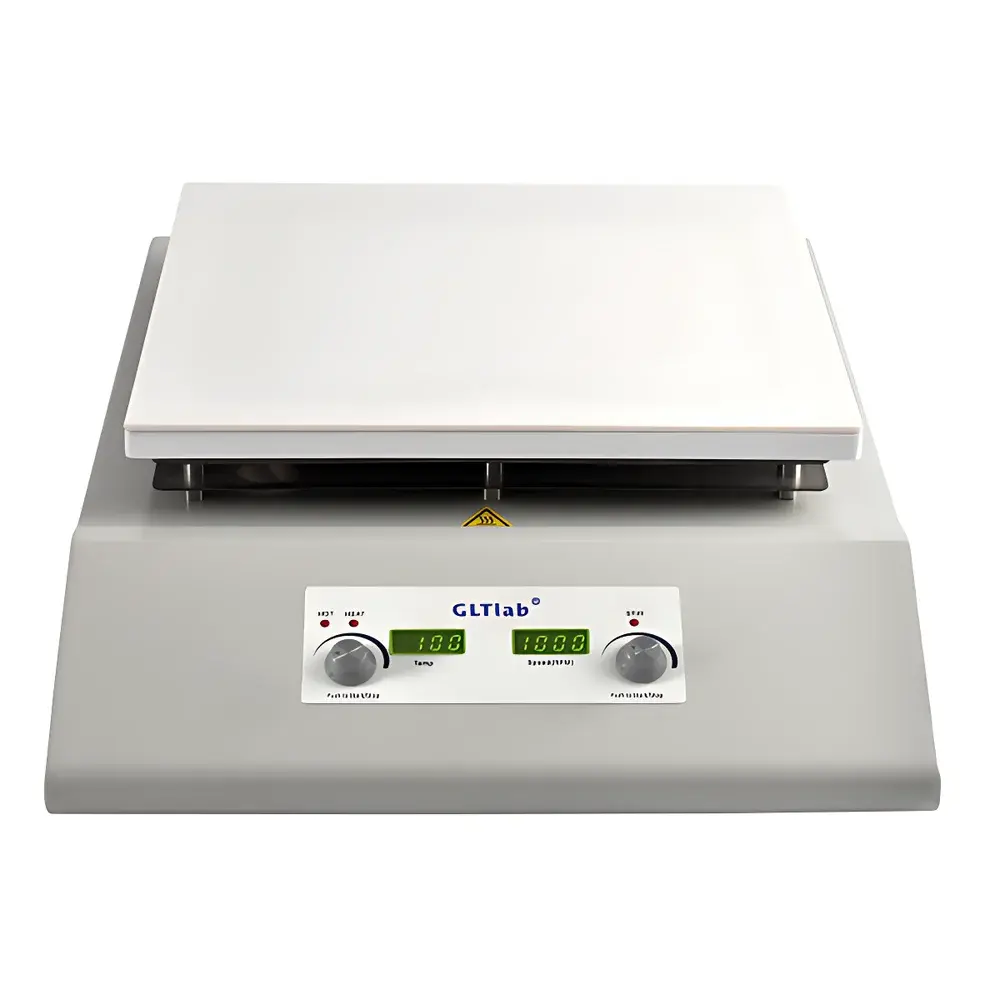
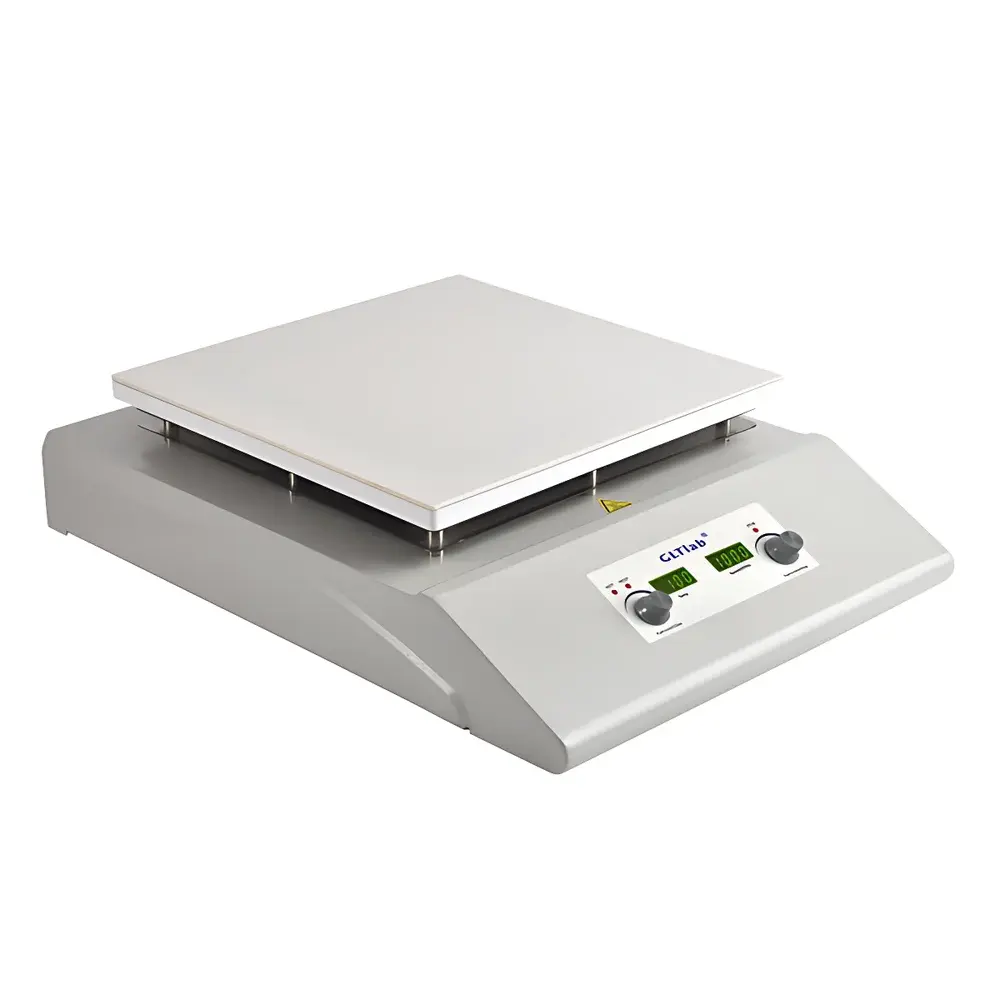
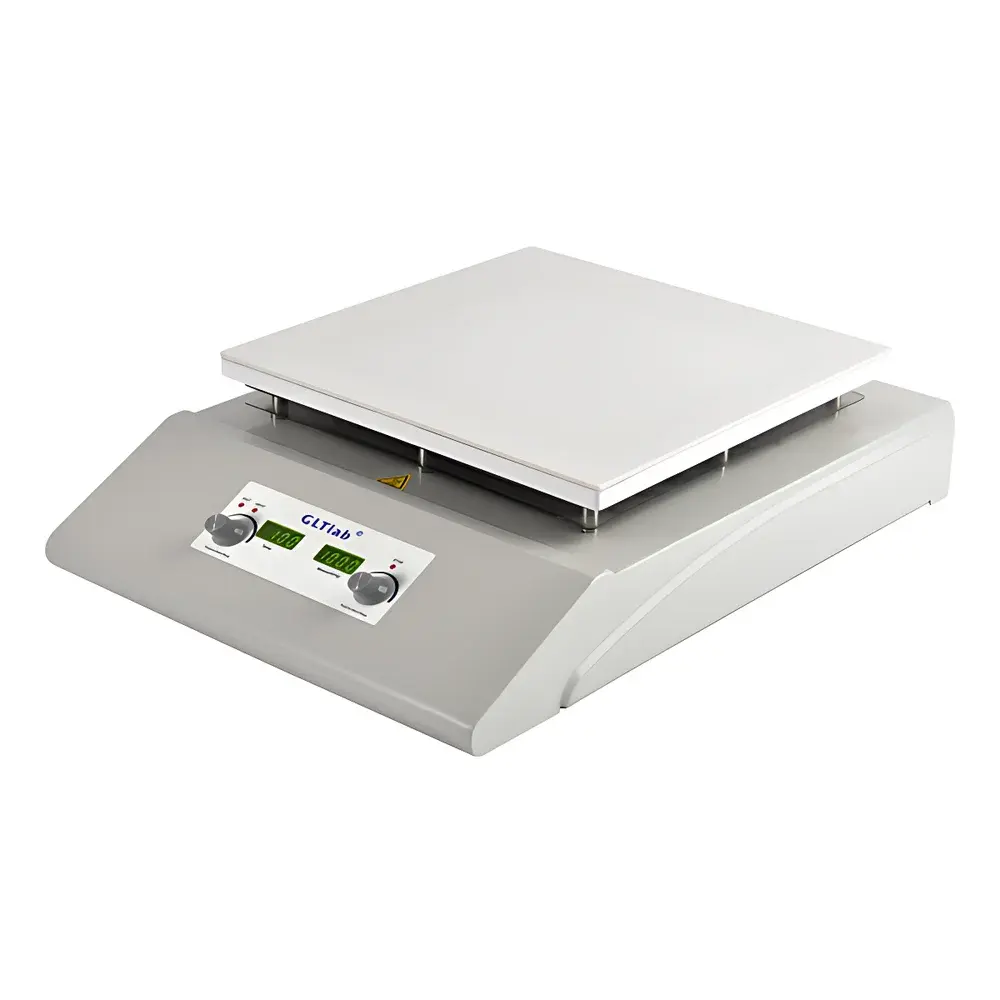
GLTlab SH-2W 12-Inch Ceramic-Plate Heated Magnetic Stirrer
| Brand | GLTlab |
|---|---|
| Origin | Guangdong, China |
| Manufacturer Type | Direct Manufacturer |
| Instrument Type | Heated Magnetic Stirrer |
| Model | SH-2W |
| Maximum Stirring Volume | 20 L (H₂O) |
| Speed Range | 150–1500 rpm |
| Solution Temperature Range | 35–200 °C |
| Plate Surface Temperature Range | 35–500 °C |
| Temperature Setting Resolution (Solution) | 0.1 °C |
| Temperature Setting Resolution (Plate) | 1 °C |
| Temperature Stability | ±1 °C |
| PT1000 Sensor Accuracy | ±0.5 °C |
| External Probe Calibration Function | Yes |
| Heating Power | 1600 W |
| Ceramic Plate Dimensions | 300 × 300 mm |
| Input Voltage | 100–130 V / 200–240 V AC |
| Frequency | 50/60 Hz |
| Operating Ambient | 5–40 °C, ≤80% RH |
| Protection Rating | IP21 |
| Net Weight | 8.5 kg |
| Overall Dimensions (W × H × D) | 290 × 110 × 423 mm |
Overview
The GLTlab SH-2W is a high-capacity, dual-function heated magnetic stirrer engineered for precision thermal control and consistent mechanical agitation in research laboratories, quality control environments, and pilot-scale synthesis workflows. It operates on the principle of rotating magnetic coupling—where a rotating permanent magnet beneath the ceramic plate induces synchronous rotation of a magnetic stir bar immersed in the sample—while simultaneously delivering uniform conductive heating via an embedded high-power resistive element. The 300 × 300 mm alumina-based ceramic top plate provides exceptional thermal stability, chemical inertness, and mechanical durability—resisting thermal shock up to 500 °C surface temperature and withstanding exposure to common solvents, acids, and bases encountered in analytical and preparative chemistry. Unlike standard hotplates or compact stirrers, the SH-2W integrates closed-loop temperature regulation using a factory-calibrated PT1000 resistance thermometer, enabling accurate solution temperature control within ±0.5 °C across its full 35–200 °C operating range—critical for reproducible kinetic studies, dissolution testing, and temperature-sensitive reagent mixing.
Key Features
- 12-inch (300 × 300 mm) high-purity ceramic heating surface with rapid thermal response and long-term dimensional stability
- Dual-mode temperature control: independent setting for plate surface (35–500 °C) and solution (35–200 °C), each with dedicated resolution (1 °C and 0.1 °C respectively)
- Wide-speed stirring motor (150–1500 rpm) with digital feedback loop ensuring consistent torque delivery up to 20 L aqueous volume
- Integrated PT1000 external probe input with user-accessible calibration function for traceable temperature validation per ISO/IEC 17025 guidelines
- LED display interface with real-time dual-parameter readout (speed + temperature), overheat warning indicator, and auto-shutdown on thermal fault detection
- Universal power input (100–130 V / 200–240 V, 50/60 Hz) and IP21-rated enclosure suitable for general laboratory environments per IEC 61010-1 safety standards
Sample Compatibility & Compliance
The SH-2W accommodates a broad range of vessel geometries—including round-bottom flasks (up to 20 L), beakers, crystallization dishes, and jacketed reactors—provided magnetic coupling remains effective (e.g., stir bar length ≥1.5× vessel diameter). Its chemically resistant ceramic surface ensures compatibility with aggressive media such as concentrated HCl, NaOH solutions, and organic solvents including acetone, ethanol, and DMF. From a regulatory standpoint, the instrument supports GLP-compliant workflows through configurable audit-trail-ready operation logs (when paired with optional RS232/USB data export), meets electrical safety requirements per EN 61010-1:2010, and facilitates temperature verification protocols aligned with ASTM E2251 and USP . While not inherently 21 CFR Part 11 compliant, its hardware architecture allows integration into validated systems when deployed with approved electronic lab notebook (ELN) or LIMS platforms.
Software & Data Management
The SH-2W operates as a standalone benchtop instrument with no embedded operating system; however, it supports analog and digital connectivity options for external monitoring and control. An optional RS232 or USB interface enables bidirectional communication with host software for remote parameter adjustment, real-time data streaming (speed, setpoint, actual temperature), and time-stamped event logging. Compatible third-party applications include LabVIEW-compatible drivers, Python-based PySerial control scripts, and MATLAB instrument control toolboxes—facilitating automated method execution in DOE-driven experimental designs. All temperature readings are referenced to the calibrated PT1000 sensor output, and raw data exports conform to CSV format for downstream statistical analysis in JMP, Minitab, or R environments.
Applications
- Kinetic reaction monitoring requiring simultaneous heating and homogeneous mixing (e.g., esterification, hydrolysis, polymerization initiation)
- Dissolution testing of pharmaceutical dosage forms per USP , where precise bath temperature maintenance and rotational consistency are mandatory
- Preparation of colloidal suspensions, nanoparticle dispersions, and emulsions demanding extended agitation at elevated temperatures
- Standardization of buffer solutions and reagent stock preparations under controlled thermal conditions
- Teaching laboratories conducting calorimetry fundamentals, Arrhenius plot derivation, or viscosity-temperature profiling
- QC/QA labs performing incoming raw material verification involving thermal equilibration and homogenization prior to spectroscopic or chromatographic analysis
FAQ
What is the maximum recommended vessel size for optimal stirring performance?
For reliable vortex formation and uniform mixing at full speed (1500 rpm), use vessels with internal diameters between 80 mm and 250 mm. Larger volumes (>10 L) require longer stir bars (≥80 mm) and lower speeds (≤800 rpm) to maintain laminar flow and avoid splashing.
Can the SH-2W be used with non-aqueous solvents such as toluene or THF?
Yes—the ceramic surface is chemically inert toward most organic solvents. However, ensure adequate ventilation and verify stir bar coating compatibility (e.g., PTFE-coated bars preferred for halogenated solvents).
Is external temperature probe calibration traceable to national standards?
The built-in calibration function allows users to adjust offset values against a NIST-traceable reference thermometer, supporting internal metrological verification per ISO/IEC 17025 Clause 6.5.
Does the unit support programmable ramp-and-soak temperature profiles?
No—the SH-2W provides manual setpoint control only. For multi-step thermal protocols, integration with external programmable controllers or PC-based automation is required.
How often should the PT1000 sensor be recalibrated?
Annual recalibration is recommended for routine QC use; more frequent verification (e.g., before critical batches) is advised when operating near temperature extremes or after mechanical impact.



