
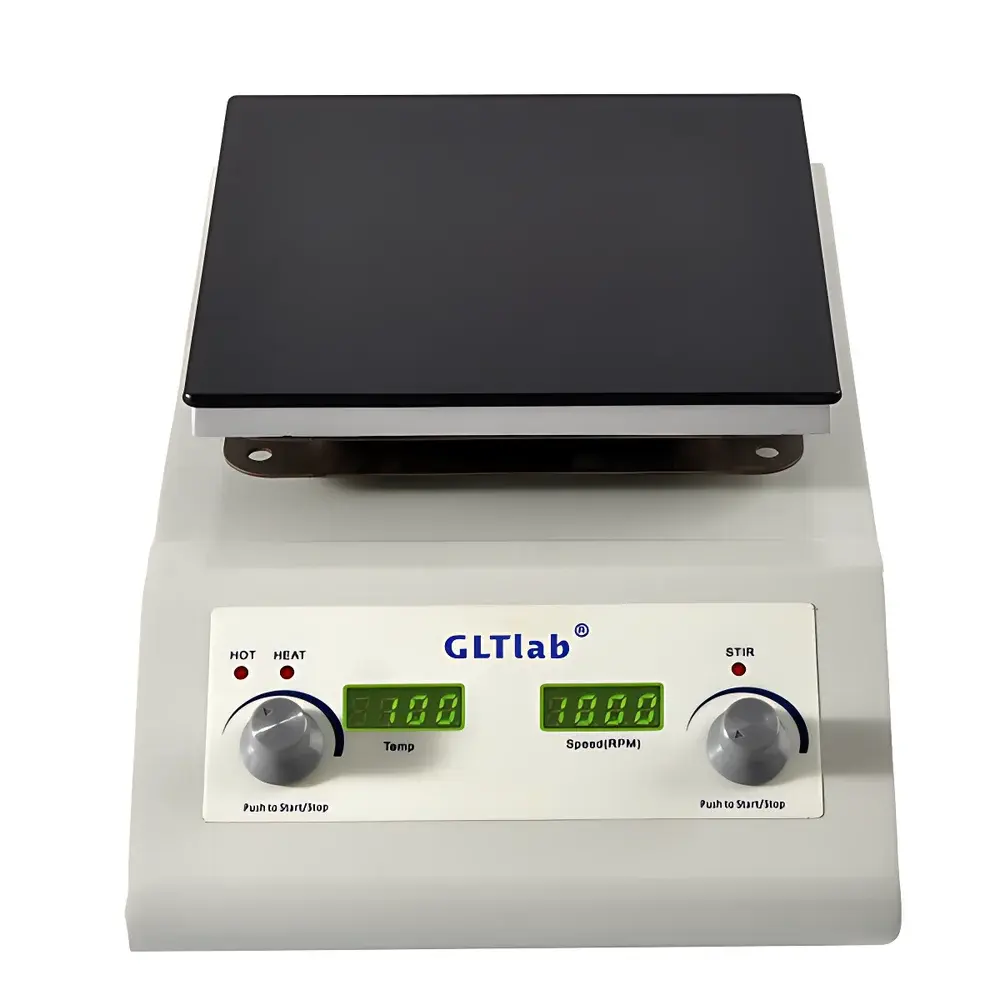
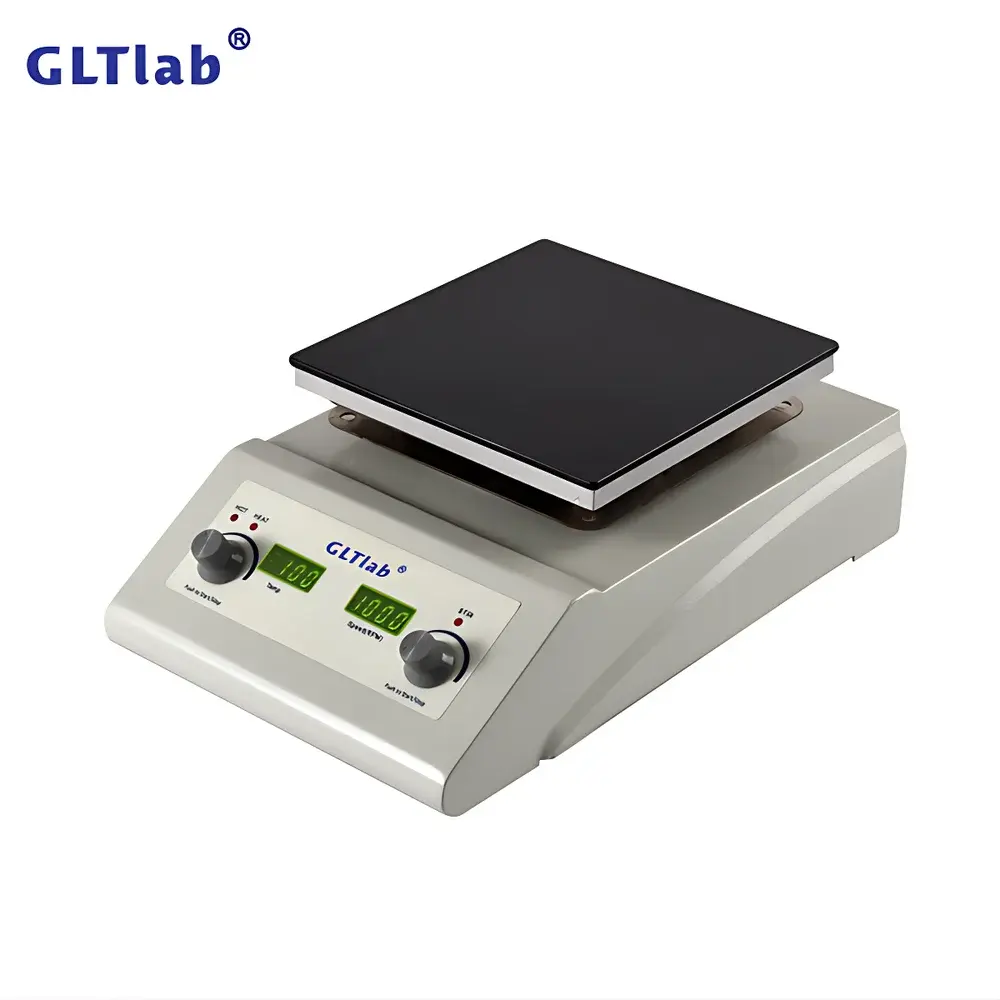
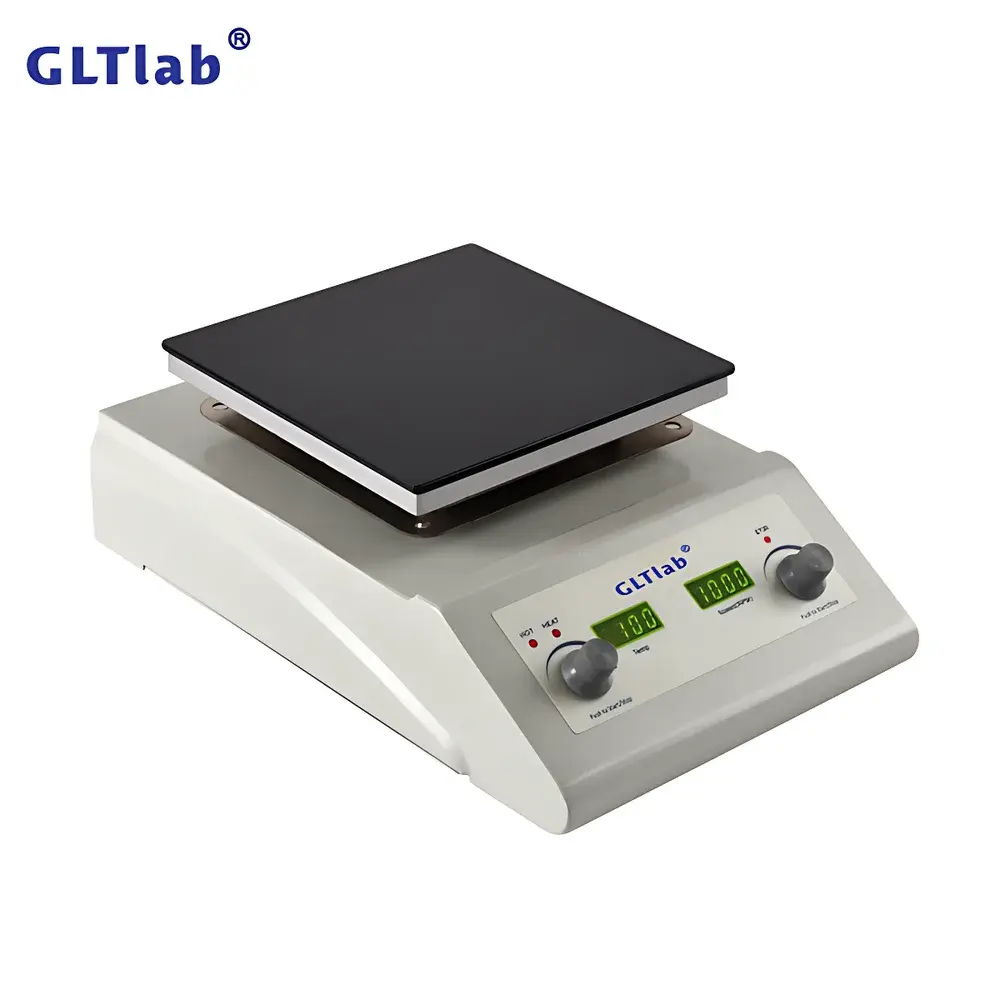
GLTlab SHC-1B Ceramic-Plate High-Temperature Magnetic Stirrer
| Brand | GLTlab |
|---|---|
| Origin | Guangdong, China |
| Manufacturer Type | Direct Manufacturer |
| Instrument Type | Magnetic Stirrer |
| Max Stirring Volume | 10 L (H₂O) |
| Speed Range | 150–1500 rpm |
| Solution Temperature Range | 35–200 °C |
| Ceramic Plate Temperature Range | 35–550 °C |
| Plate Heating Resolution | 1 °C |
| Solution Temperature Setpoint Resolution | 0.1 °C |
| Temperature Stability | ±1 °C |
| PT1000 Sensor Accuracy | ±0.5 °C |
| External Probe Calibration Function | Yes |
| Stirring Position Count | 1 |
| Stir Bar Length Compatibility | 25–60 mm |
| Dimensions (W×D×H) | 180 × 290 × 100 mm |
| Weight | 3.5 kg |
| Operating Ambient | 5–40 °C, ≤80% RH |
| IP Rating | IP21 |
| Voltage | 100–130 V / 200–240 V AC |
| Frequency | 50/60 Hz |
| Power Consumption | 600 W |
Overview
The GLTlab SHC-1B is a precision-engineered ceramic-plate magnetic stirrer designed for laboratories requiring simultaneous high-temperature plate heating and stable rotational agitation of aqueous and low-viscosity solutions. Unlike conventional stainless-steel or aluminum hotplates, its fully fused ceramic top surface withstands continuous operation up to 550 °C—enabling rapid thermal equilibration of reaction vessels, evaporation control, and pre-heating of glassware prior to sample introduction. The instrument employs a brushless DC motor coupled with closed-loop speed regulation to maintain consistent rotational torque across the full 150–1500 rpm range, even under variable load conditions. Its dual-zone thermal architecture separates plate surface temperature control (35–550 °C) from solution temperature monitoring (35–200 °C), allowing users to decouple ambient heating from actual sample thermal management—a critical capability for protocols involving solvent reflux, controlled crystallization, or temperature-sensitive reagent addition.
Key Features
- Ceramic heating plate rated for continuous operation at up to 550 °C, offering superior chemical resistance, thermal shock resilience, and long-term dimensional stability compared to metallic alternatives
- Integrated PT1000 resistance temperature detector with ±0.5 °C accuracy and user-accessible external probe calibration function for traceable temperature validation
- Independent digital setpoints for plate temperature (1 °C resolution) and solution temperature (0.1 °C resolution), each with real-time feedback and auto-compensation algorithms
- Thermal warning system with audible and visual alerts triggered when surface temperature exceeds safe handling thresholds or deviates beyond preset stability bands
- Robust mechanical design featuring vibration-dampened housing, reinforced base geometry, and IP21-rated enclosure for reliable performance in shared lab environments
- Universal dual-voltage power supply (100–130 V / 200–240 V AC, 50/60 Hz) compliant with international electrical safety standards including IEC 61010-1
Sample Compatibility & Compliance
The SHC-1B accommodates standard laboratory glassware including beakers (up to 1000 mL), Erlenmeyer flasks (up to 2000 mL), and round-bottom flasks (with appropriate support stands). Its 160 × 160 mm ceramic platform ensures uniform heat distribution beneath vessels with flat or slightly curved bases. Stir bar compatibility spans 25–60 mm lengths and standard diameters (4–10 mm), supporting both PTFE-coated and PTFE/glass-core configurations. From a regulatory standpoint, the device supports Good Laboratory Practice (GLP) workflows through its calibrated temperature control architecture and audit-ready parameter logging capabilities. While not inherently 21 CFR Part 11-compliant, its firmware permits integration with validated third-party data acquisition systems that provide electronic signature, audit trail, and user access control layers required for regulated pharmaceutical or clinical testing environments.
Software & Data Management
The SHC-1B operates via an embedded microcontroller with non-volatile memory storing up to 10 user-defined protocols—including ramp rates, hold times, speed profiles, and temperature setpoints. All operational parameters are displayed on a high-contrast LED interface with tactile push-button navigation. Though it lacks native USB or Ethernet connectivity, the unit supports analog output (0–10 V or 4–20 mA) for external process monitoring and can be interfaced with programmable logic controllers (PLCs) or SCADA systems using optional signal conditioning modules. Temperature and speed data are timestamped and retained across power cycles, enabling retrospective analysis of thermal history during method development or failure investigation.
Applications
- Controlled heating and mixing in synthetic organic chemistry, particularly for reactions requiring precise thermal ramping (e.g., Suzuki couplings, esterifications)
- Preparation of homogeneous buffer solutions and calibration standards where thermal homogeneity and particle suspension are critical
- Accelerated solvent evaporation studies under inert atmosphere using sealed vessels with magnetic stirring
- Quality control testing of viscosity modifiers and dispersants in aqueous media at elevated temperatures
- Material science applications involving ceramic precursor suspensions, nanoparticle dispersion, and sol-gel processing
- Environmental testing labs performing digestion protocols compliant with EPA Method 3050B and ISO 11466
FAQ
What is the maximum recommended vessel size for stable operation?
For optimal thermal transfer and mechanical stability, use vessels with base diameters ≤140 mm; larger formats may require auxiliary support to prevent tipping during high-speed agitation.
Can the SHC-1B be used under inert gas or vacuum conditions?
Yes—provided the vessel is appropriately sealed and the stir bar is chemically compatible; however, vacuum applications require verification of gasket integrity and thermal expansion mismatch between vessel and ceramic surface.
Is the PT1000 sensor replaceable by the end user?
The integrated PT1000 is factory-calibrated and sealed within the ceramic substrate; replacement requires return to authorized service centers to maintain metrological traceability.
Does the unit support programmable temperature ramps?
Yes—users may define multi-step heating profiles with independent ramp rates (°C/min), dwell durations, and associated speed adjustments per segment.
How is temperature stability verified during routine qualification?
Laboratories should perform periodic verification using a NIST-traceable secondary thermometer immersed in a water bath at three points across the operating range (e.g., 50 °C, 100 °C, 150 °C), recording deviation against setpoint over 30 minutes.



