
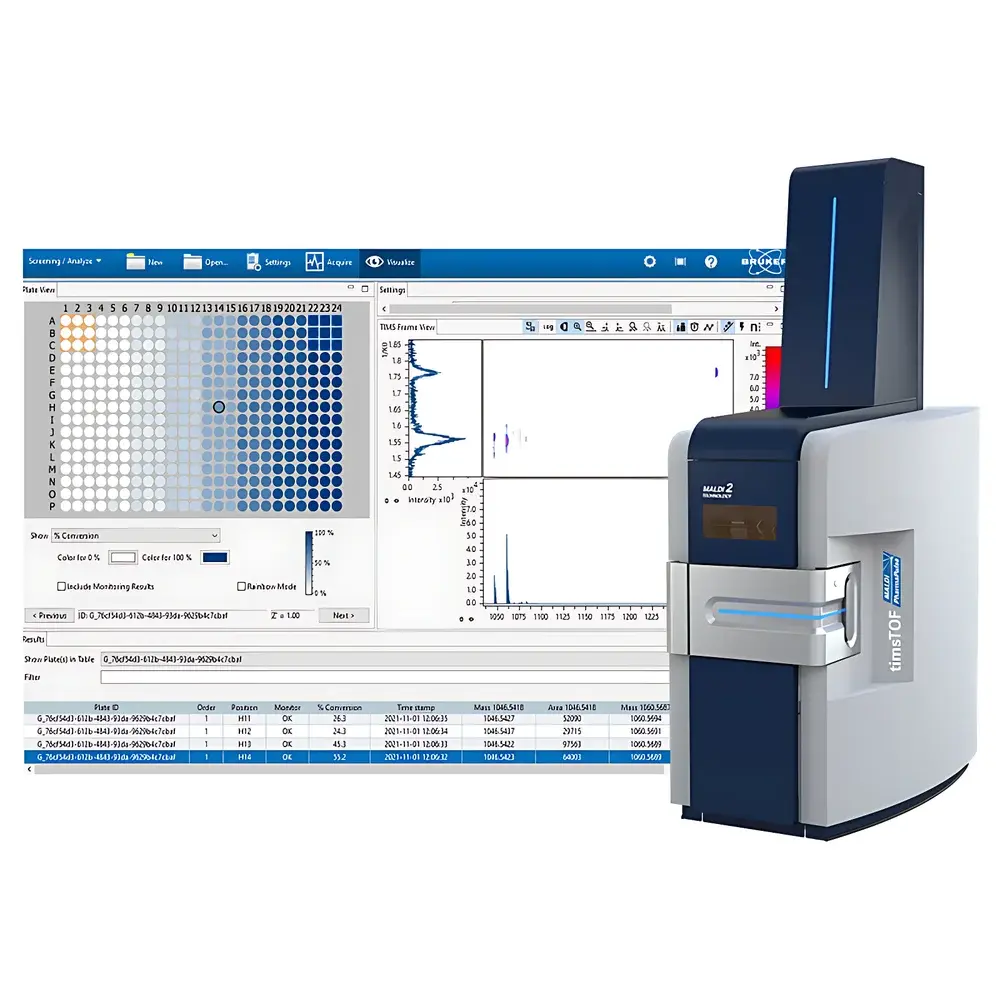
Bruker timsTOF MALDI PharmaPulse®
| Brand | Bruker |
|---|---|
| Origin | Germany |
| Instrument Type | Trapped Ion Mobility Spectrometry–Time-of-Flight Mass Spectrometer (TIMS-TOF MS) |
| Ionization Modes | Dual MALDI/ESI |
| Application Focus | Label-free Ultra-High-Throughput Screening (uHTS) in Drug Discovery |
| Software Platform | MALDI PharmaPulse® 2023 |
| Compliance Ready | GLP/GMP-aligned data handling, 21 CFR Part 11–compatible audit trail (via optional software configuration) |
| Throughput | Up to 3 samples/sec on 1536-well plates |
| CCS Calibration | Yes, with internal standards |
| MALDI Source | 10 kHz smartbeam™ 3D laser, MALDI-2 option available |
| Sample Handling | Robotic MALDI target auto-loader, disposable targets (96–1536-well compatible) |
| Data Export | Native support for Genedata Screener®, Assay Explorer, and other HTS informatics platforms |
Overview
The Bruker timsTOF MALDI PharmaPulse® is a purpose-built, label-free ultra-high-throughput screening (uHTS) platform engineered for early-stage drug discovery. It integrates Bruker’s proprietary trapped ion mobility spectrometry (TIMS) technology with high-resolution quadrupole time-of-flight (QTOF) mass spectrometry and matrix-assisted laser desorption/ionization (MALDI), delivering a unique orthogonal separation dimension—collision cross section (CCS)—in addition to m/z and retention time. Unlike conventional label-dependent assays, this system enables direct, unbiased detection and quantification of small molecules, metabolites, peptides, and enzymatic reaction products without chemical derivatization or affinity reagents. The instrument operates on the physical principle that ions of identical m/z but differing three-dimensional structures exhibit distinct mobility behaviors under controlled electric and gas-phase collision conditions; TIMS captures and separates these species within milliseconds, enabling unambiguous resolution of isobaric interferences—including structural isomers such as glucose vs. fructose (both C6H12O6)—directly in the gas phase. This capability fundamentally enhances assay specificity in complex biological matrices, reducing false discovery rates (FDR) and eliminating reliance on surrogate readouts.
Key Features
- Dual-ionization architecture supporting both MALDI and electrospray ionization (ESI), enabling method flexibility across compound classes and assay formats.
- 10 kHz smartbeam™ 3D laser system optimized for reproducible, low-ablation-threshold MALDI ion generation across high-density sample formats (96-, 384-, and 1536-well plates).
- Trapped Ion Mobility Spectrometry (TIMS) module providing sub-second CCS-based separation with intrinsic calibration using polyalanine or tuning calibrants—enabling quantitative CCS value assignment for every detected ion.
- MALDI-2 post-ionization option extending detection coverage to low-polarity, non-protonatable, and thermally labile compounds previously inaccessible by standard MALDI.
- Integrated robotic MALDI target auto-loader with lightweight, robot-compatible target adapters—designed for seamless integration into fully automated HTS workflows.
- Disposable MALDI targets compatible with liquid handlers and plate sealers, minimizing carryover and enabling cost-effective, high-integrity sample preparation at scale.
Sample Compatibility & Compliance
The timsTOF MALDI PharmaPulse® supports broad sample compatibility across drug discovery contexts: enzymatic reaction mixtures, cell lysates, synthetic chemistry output plates, and purified compound libraries. Its robust MALDI source demonstrates >10,000 shots per target spot without signal degradation—critical for sustained uHTS operation. From a regulatory perspective, the system is engineered for GLP- and GMP-aligned environments. When configured with MALDI PharmaPulse® 2023 software and optional security modules, it supports full 21 CFR Part 11 compliance—including electronic signatures, role-based access control, and immutable audit trails for all acquisition parameters, processing steps, and result exports. Data integrity is further ensured via native support for FAIR (Findable, Accessible, Interoperable, Reusable) principles: raw .baf files retain full TIMS mobility scan metadata, and processed results are exportable in standardized .mzML and .ccsML formats compliant with HUPO-PSI specifications.
Software & Data Management
MALDI PharmaPulse® 2023 is a workflow-centric software suite designed explicitly for HTS laboratories. It provides intuitive method templates for common applications—including enzyme activity profiling, hit confirmation, and reaction monitoring—with preconfigured TIMS-MS and TIMS-MS/MS acquisition methods. The software features an open automation API compatible with third-party scheduling platforms (e.g., Agilent VWorks, Thermo Scientific SampleManager, Beckman Biomek). All acquired data—including CCS values, accurate mass, isotopic fidelity, and CID fragmentation spectra—are stored in a structured project database with version-controlled method histories. Seamless export to downstream analysis tools—including Genedata Screener®, Dotmatics, and Assay Explorer—is supported via standardized file formats and direct ODBC connectivity. Batch reprocessing, retrospective CCS recalibration, and multi-batch alignment are natively implemented to ensure longitudinal data consistency across screening campaigns.
Applications
- Label-free enzymatic activity screening: Quantification of substrates and products (e.g., glucose from hexokinase assays) with internal 13C-labeled standards yields RSDs of 0.1–3.7% across >1,000 replicates—demonstrating analytical robustness required for primary HTS.
- Isomer-resolved pharmacokinetic profiling: Differentiation and quantification of stereoisomers and regioisomers directly from microsomal incubations without chromatographic separation.
- Near-real-time reaction monitoring in high-throughput synthesis: Integration with automated synthesizers enables immediate product confirmation based on multi-dimensional identification criteria: exact mass, isotopic pattern, CCS, and diagnostic MS/MS fragments—reducing cycle time from days to minutes.
- Off-target binding assessment: Detection of covalent adducts or non-covalent complexes in crude lysates via TIMS-enhanced selectivity, avoiding antibody-based enrichment or radiolabeling.
- Cellular metabolic phenotyping: Direct analysis of intracellular metabolite pools from 96-well adherent or suspension cultures with minimal sample workup.
FAQ
What distinguishes timsTOF MALDI PharmaPulse® from conventional MALDI-TOF systems?
It adds a TIMS separation stage prior to TOF analysis, enabling CCS measurement and resolving power beyond m/z alone—particularly critical for isobaric interference removal in complex HTS matrices.
Can the system be integrated into existing robotic HTS infrastructure?
Yes—its hardware interface protocols and MALDI PharmaPulse® 2023 automation API support bidirectional communication with major laboratory automation vendors.
Is CCS calibration traceable and reproducible across instruments?
Yes—CCS values are derived from internal calibrants with documented collision gas composition, temperature, and field strength; Bruker provides certified CCS reference standards for cross-platform validation.
Does the system support quantitative analysis without internal standards?
While absolute quantitation requires isotopically labeled internal standards for highest accuracy, relative quantitation across plates achieves CVs <5% using TIMS peak area normalization and mobility-resolved background subtraction.
What level of IT infrastructure is required for deployment?
The system operates on a dedicated acquisition workstation (Windows 10/11 LTSB); raw data storage scales linearly with plate density—1536-well runs generate ~2–4 GB/hour—and benefits from NAS or SAN storage with SMB 3.0 support.
Related Products





