
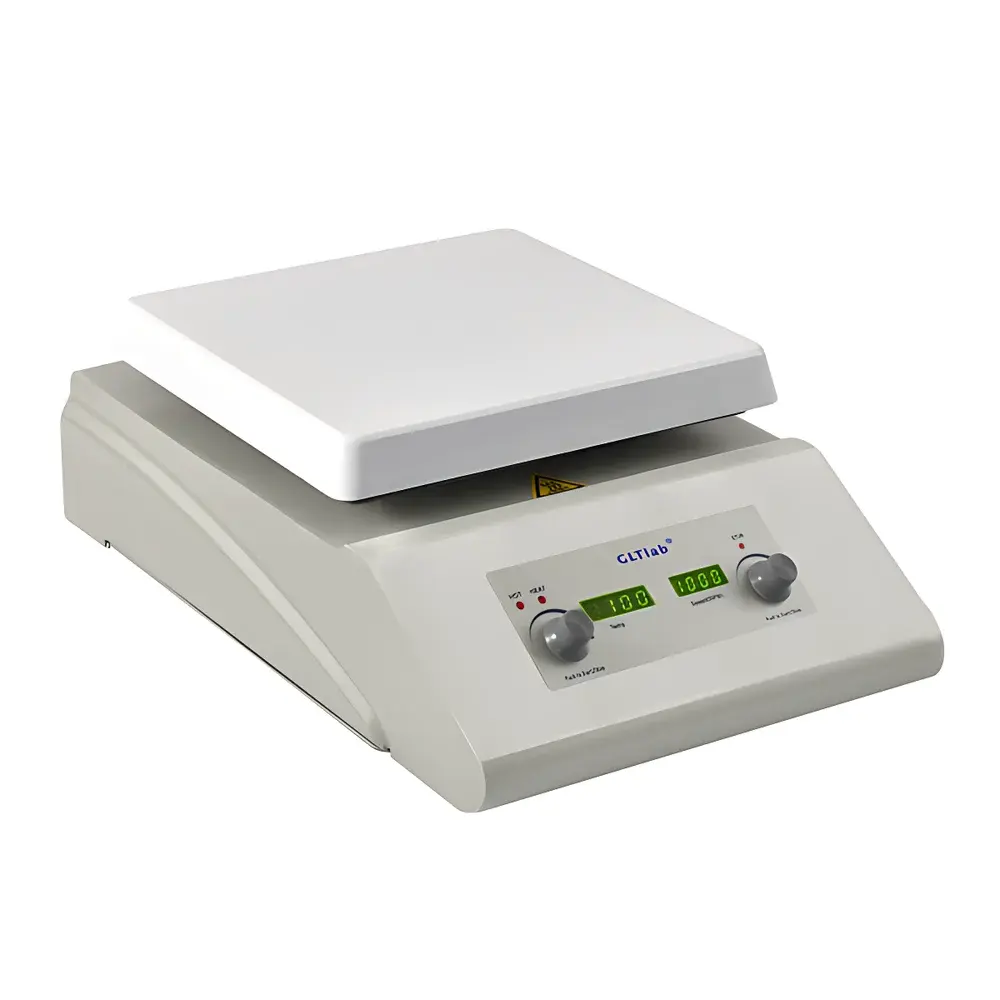
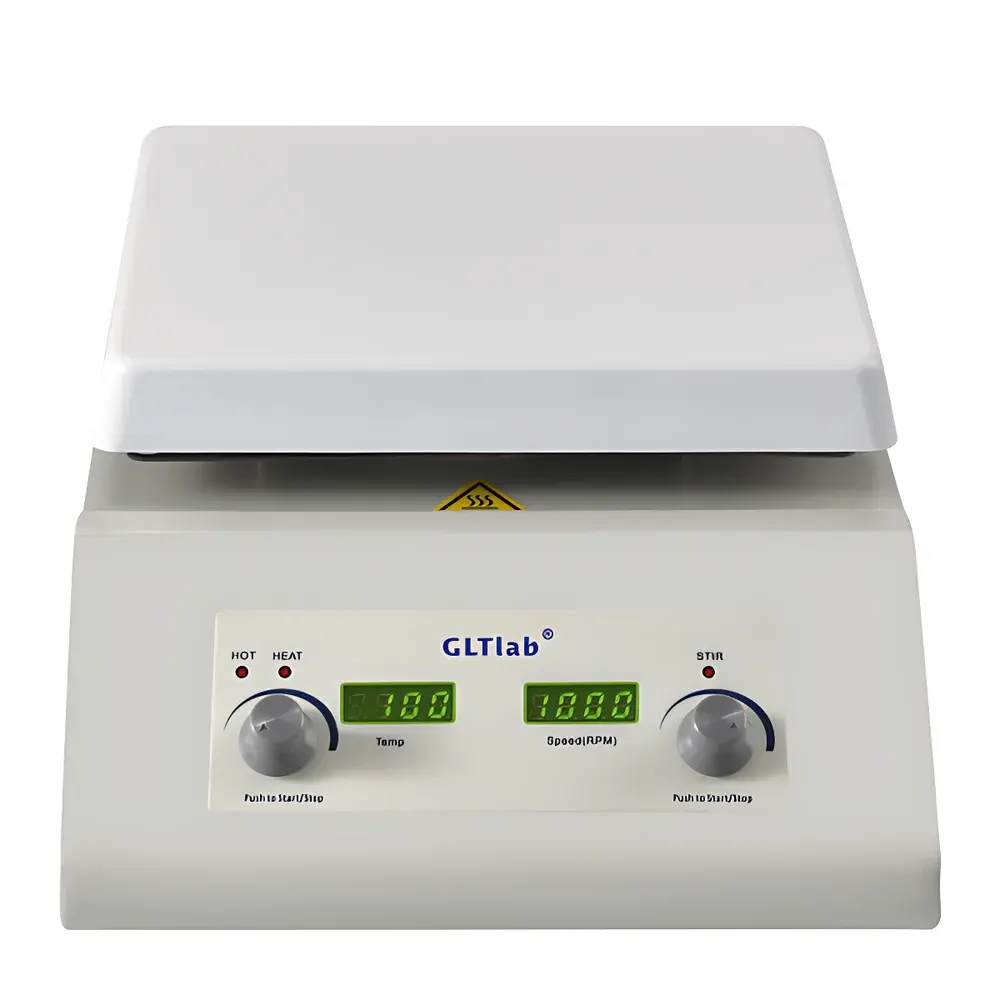
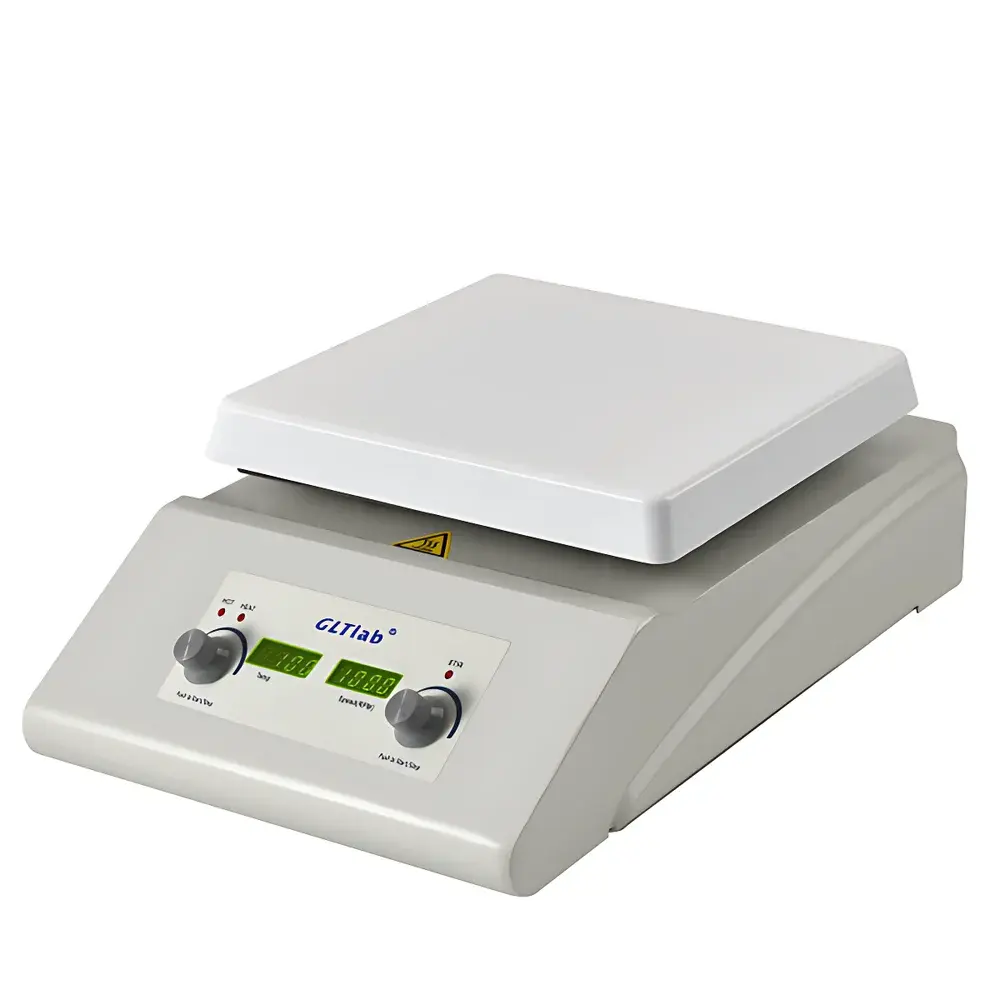
GLTlab SHA-1-2D 7-Inch Ceramic-Coated Aluminum Hotplate Magnetic Stirrer with Dual-Mode Temperature Control (Solution & Surface, up to 400°C)
| Brand | GLTlab |
|---|---|
| Model | SHA-1-2D |
| Heating Plate Material | Ceramic-coated aluminum |
| Plate Diameter | 150 mm (7 in) |
| Max. Stirring Volume (H₂O) | 10 L |
| Speed Range | 150–1500 rpm |
| Surface Heating Range | 35–400 °C |
| Solution Temperature Range | 35–200 °C |
| Temperature Setting Resolution (Surface) | 1 °C |
| Temperature Setting Resolution (Solution, with PT1000 probe) | 0.1 °C |
| Temperature Stability | ±1 °C |
| PT1000 Sensor Accuracy | ±0.5 °C |
| External Probe Calibration Function | Yes |
| Stirring Position | Single |
| Stir Bar Length Compatibility | 25–60 mm |
| Dimensions (W×D×H) | 190 × 290 × 100 mm |
| Weight | 3.5 kg |
| Power Supply | 100–130 V / 200–240 V, 50/60 Hz |
| Rated Power | 900 W |
| Operating Ambient | 5–40 °C, ≤80% RH |
| Protection Class | IP21 |
| Thermal Warning Indicator | Yes |
| Origin | Guangdong, China |
| Manufacturer | GLTlab |
Overview
The GLTlab SHA-1-2D is a precision-engineered hotplate magnetic stirrer designed for demanding laboratory environments requiring simultaneous high-temperature surface heating and accurate solution temperature control. Unlike conventional single-mode hotplates, the SHA-1-2D implements dual independent thermal regulation: one mode controls the ceramic-coated aluminum heating surface (up to 400 °C), while the second—enabled by an integrated PT1000 external temperature probe—regulates the actual sample temperature in real time (range: 35–200 °C). This architecture eliminates thermal lag and overshoot commonly observed in open-loop systems, making it suitable for applications where thermal consistency directly impacts reaction kinetics, crystallization behavior, or polymer dissolution profiles. The device operates on the principle of electromagnetic induction-driven rotation of PTFE- or glass-coated stir bars within conductive or non-viscous liquid media, combined with resistive heating of a thermally stable ceramic-aluminum composite plate. Its robust mechanical design, IP21-rated enclosure, and dual-voltage compatibility (100–130 V / 200–240 V) ensure reliable operation across global laboratory infrastructures.
Key Features
- Ceramic-coated aluminum heating plate (Ø150 mm) offering rapid thermal response, uniform heat distribution, and resistance to chemical splashes and mechanical abrasion
- Dual-mode temperature control: surface heating (35–400 °C) and closed-loop solution monitoring (35–200 °C) via calibrated PT1000 sensor with 0.1 °C resolution
- High-torque DC motor enabling stable stirring from 150 to 1500 rpm across viscosities up to 10,000 mPa·s (with appropriate stir bar geometry)
- LED digital interface with intuitive parameter navigation, thermal warning indicator, and real-time display of both setpoint and measured values
- External probe calibration function supporting traceable adjustment per ISO/IEC 17025-compliant lab practices
- Single-position configuration optimized for reproducible batch-scale mixing (max. 10 L H₂O equivalent); compatible with standard stir bars 25–60 mm in length
- 900 W power rating ensures rapid ramp-up to target temperatures without sustained voltage sag under load
Sample Compatibility & Compliance
The SHA-1-2D accommodates a broad range of aqueous, organic, and mildly corrosive solutions when used with chemically inert stir bars (e.g., PTFE-coated or glass-jacketed). It supports vessels from 50 mL beakers to 10 L round-bottom flasks, provided base diameter does not exceed 140 mm for optimal thermal coupling. While not certified for hazardous area use (e.g., ATEX or IECEx), its IP21 ingress protection provides basic shielding against vertically falling drips and solid objects >12.5 mm—suitable for general-purpose chemistry, materials synthesis, and QC labs operating under ISO 17025 or GLP frameworks. All temperature readouts are referenced to NIST-traceable PT1000 standards, and the external probe calibration routine facilitates audit readiness for FDA 21 CFR Part 11–aligned data integrity requirements when paired with compliant logging software.
Software & Data Management
The SHA-1-2D operates as a standalone instrument with no proprietary software dependency. However, its analog-compatible PT1000 output (2-wire, 0–1000 Ω linear range) allows integration into third-party data acquisition systems (e.g., LabVIEW, MATLAB, or SCADA platforms) via standard signal conditioners. For regulated environments, users may configure external loggers to record timestamped temperature and speed values with audit trail functionality. The unit retains no internal memory or network interface; all operational parameters are manually set and displayed locally—minimizing cybersecurity exposure and simplifying 21 CFR Part 11 validation efforts for electronic records.
Applications
- Controlled-temperature synthesis of metal-organic frameworks (MOFs) and coordination polymers requiring prolonged heating at 180–250 °C
- Standardized dissolution testing per USP , particularly for extended-release formulations where bath temperature stability ±0.5 °C is critical
- Preparation of homogeneous catalyst slurries in petrochemical R&D, where viscosity changes during heating must be mitigated via precise rotational feedback
- Calibration of reference thermometers and thermal sensors using defined temperature plateaus (e.g., paraffin wax melt at 48 °C or potassium nitrate transition at 334 °C)
- Accelerated stability studies in pharmaceutical development, where multi-day constant-temperature agitation at 40 °C/75% RH simulates long-term storage conditions
FAQ
Does the SHA-1-2D support multiple simultaneous stir positions?
No. It is engineered as a single-position system to maximize thermal uniformity and torque delivery per vessel.
Can the PT1000 probe be used in aggressive solvents such as concentrated HNO₃ or HF?
The standard stainless-steel-sheathed PT1000 probe is rated for pH 2–12 and non-halogenated organics. For hydrofluoric acid or fuming nitric acid, a custom Hastelloy C-276 or PFA-coated probe must be specified separately.
Is the 400 °C surface rating applicable when using the solution temperature control mode?
No. When external probe feedback is active, the maximum surface temperature is dynamically limited to prevent thermal runaway; the 400 °C capability applies only in surface-only heating mode.
What maintenance is required to sustain accuracy over time?
Annual verification of PT1000 probe calibration against a certified reference thermometer (e.g., Fluke 724) is recommended. Clean the ceramic surface with isopropanol after each use; avoid abrasive cleaners that degrade emissivity.
Does the unit comply with electromagnetic compatibility (EMC) directives for EU laboratories?
Yes. It meets EN 61326-1:2013 for laboratory equipment emission and immunity, with CE marking valid for operation within the declared voltage and frequency ranges.



