
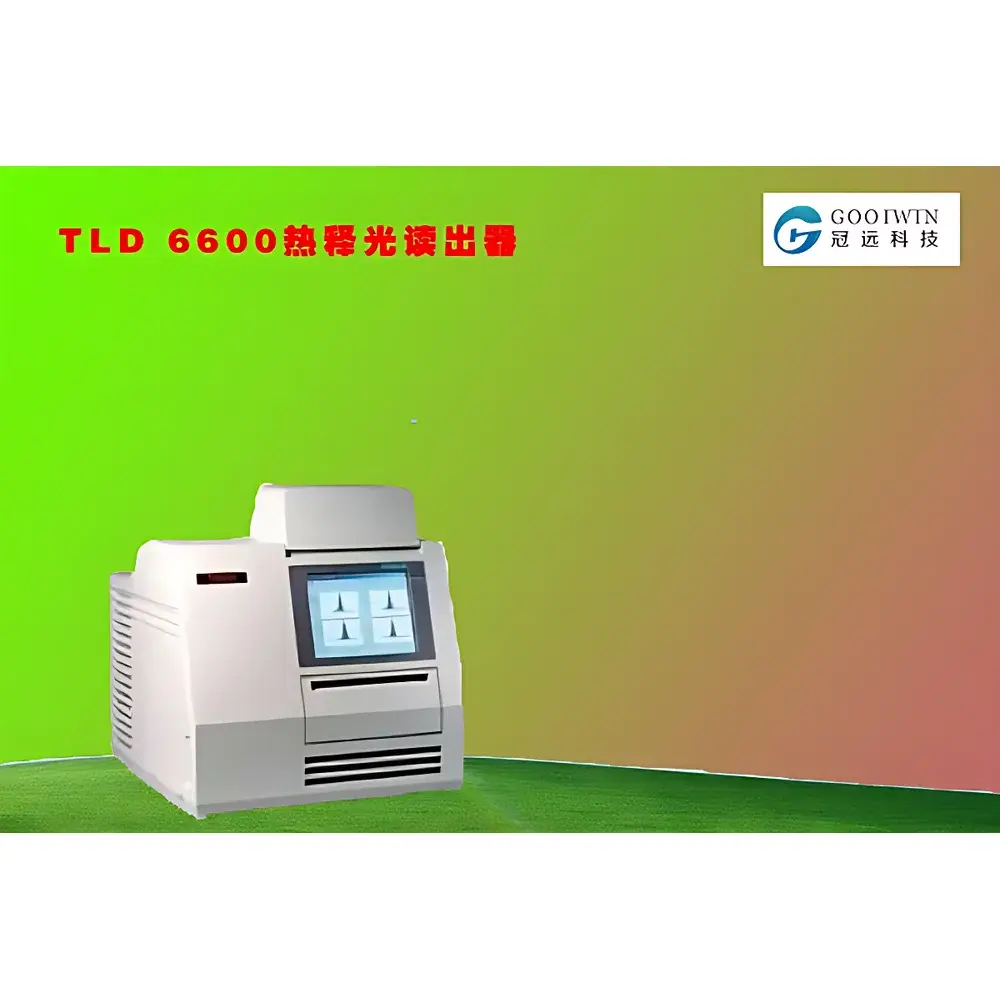
UNION TLD 6600 Thermoluminescent Dosimeter Reader – Calibration Traceability System
| Brand | UNION |
|---|---|
| Origin | Germany |
| Model | TLD 6600 |
| Manufacturer Type | Authorized Distributor (Non-OEM) |
| Import Status | Imported Instrument |
| Pricing | Available Upon Request |
Overview
The UNION TLD 6600 Thermoluminescent Dosimeter (TLD) Reader is a precision radiation dosimetry instrument engineered for quantitative readout of thermoluminescent materials—such as LiF:Mg,Ti (TLD-100), CaSO4:Dy, or Al2O3:C—following controlled thermal stimulation. Its operational principle relies on the measurement of light emission intensity (photons per unit mass) during programmed heating, where the integrated luminescence signal is linearly proportional to the absorbed dose in the range of 10 µGy to 10 Gy, depending on phosphor type and reader configuration. As a metrologically critical device used in personnel monitoring, environmental dosimetry, radiotherapy QA, and nuclear facility safety programs, the TLD 6600 must maintain demonstrable traceability to national and international radiation standards. This requirement is governed by ISO/IEC 17025:2017 (General requirements for the competence of testing and calibration laboratories), IEC 62387-1:2012 (Radiation protection instrumentation — Passive integrating dosimetry systems for environmental and personal monitoring), and EURAMET cg-18 (Guidelines on the calibration of passive dosimeters). Traceability ensures that every dose reading reported by the TLD 6600 can be linked—through an unbroken chain of calibrations—to primary standards maintained by national metrology institutes (NMIs), such as PTB (Germany), NPL (UK), or NIST (USA), with documented uncertainties at each step.
Key Features
- Programmable heating profile (linear ramp rates from 1–20 °C/s; plateau hold up to 600 s) optimized for reproducible glow-curve deconvolution
- Low-noise photomultiplier tube (PMT) detection system with spectral response matched to common TLD phosphors (300–650 nm)
- Integrated reference light source for daily stability verification (NIST-traceable LED or calibrated lamp)
- Automatic background subtraction and zero-dose baseline correction algorithms compliant with IEC 62387-1 Annex B
- Modular design supporting optional high-sensitivity mode (extended integration time) and multi-sample carousel (up to 75 positions)
- Compliance-ready firmware architecture enabling audit trails, user access control, and electronic signature support per FDA 21 CFR Part 11 requirements
Sample Compatibility & Compliance
The TLD 6600 supports standardized TLD elements in chip, rod, disc, and powder formats across major international certification schemes—including IEC 62387-1, ISO 21909:2020 (Passive neutron dosimetry), and ANSI N13.32 (Performance criteria for thermoluminescent dosimetry systems). All calibrations are performed using secondary standard dosimeters traceable to PTB’s primary 60Co and 137Cs gamma reference fields. For environmental dose rate measurements below 10 µGy/h, the system utilizes calibrated 241Am or 226Ra sources operated under strictly defined geometric conditions (e.g., 50 cm source-to-detector distance, air kerma rate verified via ionization chamber). The instrument conforms to GLP (Good Laboratory Practice) and GMP (Good Manufacturing Practice) documentation requirements when deployed in regulated environments such as radiopharmaceutical production or clinical dosimetry accreditation (e.g., ACR, AAPM TG-155).
Software & Data Management
UNION TLD Control Suite v4.x provides full lifecycle data management—from raw glow-curve acquisition and peak analysis (using Gross–Weinberg or GlowFit algorithms) to automated uncertainty budgeting per GUM (Guide to the Expression of Uncertainty in Measurement). Calibration certificates issued by accredited laboratories (e.g., DAkkS-certified providers in Germany) include expanded uncertainties (k = 2), coverage intervals, and explicit statements of traceability to PTB or other CIPM MRA signatory NMIs. Software logs all calibration events, user actions, and instrument parameter changes with timestamped, non-erasable records. Export formats include CSV, XML (for LIS/HIS integration), and PDF reports compliant with ISO/IEC 17025 clause 7.8.2.
Applications
- Personnel dosimetry accreditation (e.g., ISO 4037-3:2019 compliant dose assessment for occupational exposure monitoring)
- Environmental radiation surveillance networks requiring long-term stability (e.g., EU EURDEP reporting infrastructure)
- Radiotherapy beam calibration QA using TLD-based output factor verification (IAEA TRS-398 protocol)
- Nuclear power plant in-service inspection dosimetry (ASME BPVC Section III, Division 5)
- Research applications involving mixed-field neutron/gamma dosimetry (with appropriate filter combinations and correction algorithms)
FAQ
What constitutes valid traceability for the TLD 6600 according to international standards?
Valid traceability requires a documented, unbroken calibration chain to a national or international standard, with each step accompanied by a certificate stating measurement uncertainty, coverage factor, and accreditation status (e.g., DAkkS, UKAS, or ANAB).
Can the TLD 6600 be used without periodic calibration?
No. Per IEC 62387-1 Clause 6.3.2, recalibration intervals must not exceed 12 months—or shorter if dictated by usage frequency, environmental stress, or quality assurance program requirements.
Why must calibration sources never be used directly for field dose rate determination?
Because calibration geometry (source-detector distance, collimation, scattering environment) differs fundamentally from operational field conditions; direct use introduces systematic bias exceeding ±5%—violating ISO/IEC 17025 uncertainty reporting requirements.
Does the TLD 6600 support automated inter-laboratory comparison (ILC) reporting?
Yes. The software exports structured datasets compatible with EURAMET and IAEA proficiency testing platforms, including mandatory metadata fields for participant ID, irradiation date, reference dose, and expanded uncertainty.
How is measurement error distinguished from measurement uncertainty in TLD dosimetry?
Measurement error is the difference between a single result and the true (but unknowable) value; uncertainty quantifies the dispersion of values that could reasonably be attributed to the measurand—calculated per GUM using Type A (statistical) and Type B (systematic) components.




