
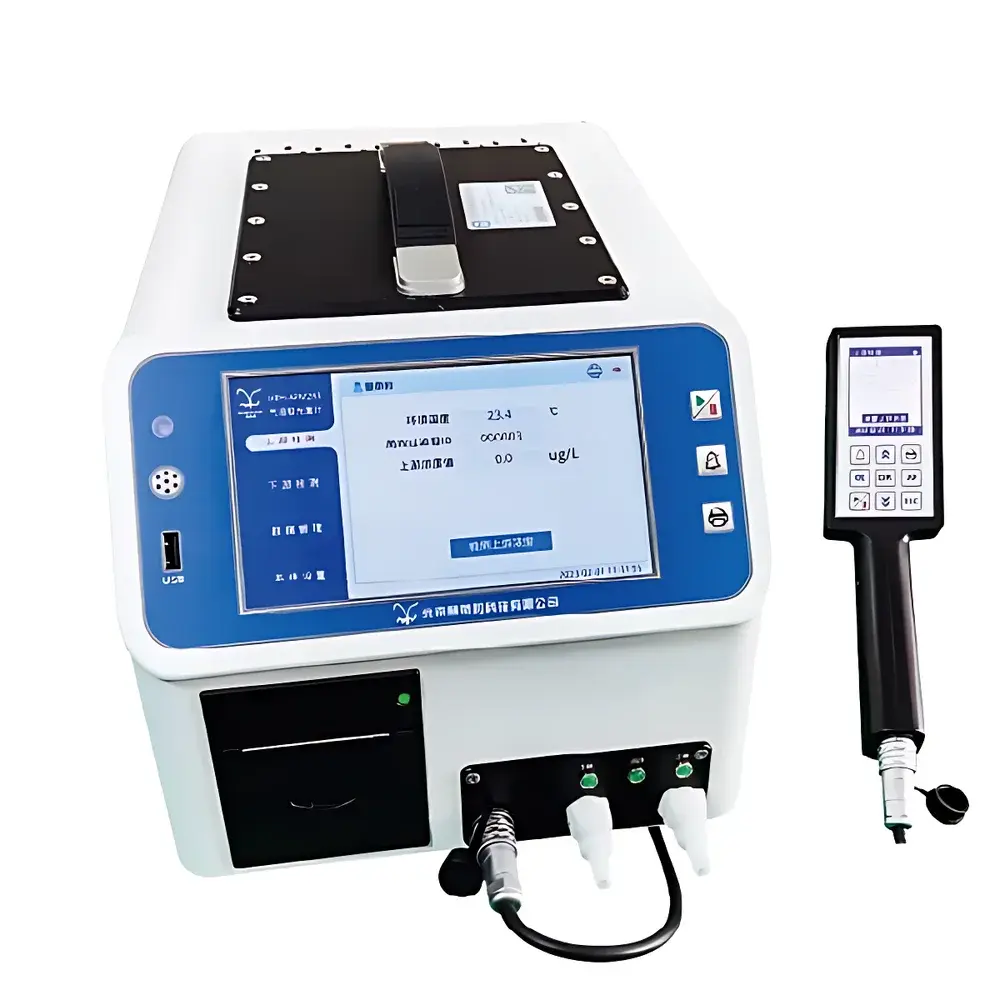
Aerosol Photometer HRH-APM283
| Brand | HRH |
|---|---|
| Origin | Beijing, China |
| Model | HRH-APM283 |
| Flow Range | 0.02–10 mL/min |
| Tubing Size | 2 × 1 mm (ID × OD) |
| Speed Range | 0.1–80 rpm |
| Speed Resolution | 0.1 rpm |
| Delivery Accuracy | <0.5% |
| Power Supply | DC 24 V / 2 A |
| Communication Interface | RS485, Modbus RTU protocol |
| Operating Environment | 0–40 °C, RH <80% |
| Ingress Protection | IP31 |
| Dimensions (L×W×H) | 110 × 60 × 150 mm |
| Weight | 0.85 kg |
Overview
The HRH-APM283 Aerosol Photometer is a precision-engineered optical instrument designed for real-time, quantitative measurement of aerosol mass concentration in laboratory and controlled exposure environments. Unlike generic particle counters, the HRH-APM283 employs calibrated light-scattering photometry—based on Mie scattering theory—to deliver stable, traceable responses proportional to aerosol mass loading (typically reported in mg/m³ or µg/L). Its primary operational context is inhalation toxicology studies, where it serves as both a dosimetric monitor during whole-body or nose-only exposure experiments and a calibration verification tool for aerosol generation systems. The device integrates seamlessly into ISO 10993-compliant inhalation test platforms and supports GLP-aligned data integrity requirements through deterministic analog output and digital communication interfaces.
Key Features
- High-accuracy volumetric delivery subsystem with <0.5% repeatability across full flow range (0.02–10 mL/min), enabling precise aerosol generation from liquid precursors such as saline, surfactant solutions, or nanoparticle suspensions.
- Optimized peristaltic pump architecture featuring chemically resistant silicone tubing (2 × 1 mm ID/OD), rated for continuous operation under acidic, alkaline, and organic solvent conditions.
- Low-profile mechanical design (110 × 60 × 150 mm) facilitates integration into compact exposure chambers and laminar-flow inhalation rigs without compromising accessibility or serviceability.
- Dual-mode control capability: local keypad operation for standalone use, plus RS485 serial interface supporting Modbus RTU protocol for synchronized triggering, flow ramping, and status polling within automated exposure protocols.
- Stable optical path with temperature-compensated photodetector and factory-calibrated zero/reference offset—ensuring minimal drift over extended 24+ hour exposures typical in subchronic inhalation studies.
Sample Compatibility & Compliance
The HRH-APM283 is validated for use with aqueous and low-viscosity non-volatile suspensions commonly employed in inhalation toxicology—including sodium chloride aerosols, titanium dioxide nanoparticles (≤100 nm), carbon black dispersions, and pharmaceutical dry powder formulations reconstituted in propylene glycol/water blends. It complies with mechanical and electrical safety requirements outlined in IEC 61010-1 for laboratory equipment. While not a certified medical device, its performance characteristics align with ASTM E1755-22 (Standard Test Method for Determining Mass Median Aerodynamic Diameter of Aerosols) when used in conjunction with cascade impactors. Data logging configurations may be configured to meet FDA 21 CFR Part 11 audit trail requirements when paired with compliant SCADA or LIMS software.
Software & Data Management
The instrument outputs analog voltage (0–5 V or 4–20 mA) proportional to measured aerosol concentration, compatible with standard DAQ systems (e.g., National Instruments cDAQ, LabVIEW-based acquisition). Digital communication via RS485 enables bidirectional parameter exchange—including real-time flow rate, motor speed, error flags, and internal temperature—using open Modbus RTU registers. No proprietary software is required; integration with Python, MATLAB, or industrial PLCs is supported via documented register maps. Firmware supports configurable averaging intervals (1–60 s) and user-defined alarm thresholds for out-of-spec aerosol concentration events—critical for maintaining exposure chamber SOP adherence.
Applications
- Inhalation toxicology: Continuous monitoring of test article aerosol concentration during OECD 412 (subacute) and OECD 413 (subchronic) inhalation studies.
- Pharmaceutical development: Verification of metered-dose inhaler (MDI) or dry powder inhaler (DPI) plume consistency and deposition efficiency in cascade impactor setups.
- Medical device testing: Evaluation of filter penetration efficiency for surgical masks, N95 respirators, and ventilator circuit components under standardized challenge aerosols.
- Environmental chamber validation: Mapping spatial uniformity and temporal stability of aerosol distribution in ISO 14644-classified cleanrooms or exposure ducts.
- Chemical safety assessment: Quantitative release profiling of nanomaterials during handling simulations or thermal decomposition tests.
FAQ
Is the HRH-APM283 suitable for measuring oil-based aerosols?
Yes—provided the aerosol is optically stable and does not coat the optical window. For hydrocarbon or silicone oil mists, routine cleaning of the detection chamber with isopropanol is recommended every 4–6 hours of continuous operation.
Can the device be calibrated against NIST-traceable standards?
The photometric sensor is factory-calibrated using polydisperse polystyrene latex (PSL) spheres and referenced to gravimetrically prepared sodium chloride aerosols. End-user recalibration requires an ISO 17025-accredited lab and is performed annually or after major maintenance.
Does the pump support sterile fluid handling for in vivo studies?
The peristaltic mechanism ensures no fluid contact with internal components beyond the disposable tubing. Sterilization is achieved by autoclaving compatible tubing (e.g., PharMed BPT) or using gamma-irradiated pre-sterilized sets—validated per ISO 11137.
What is the maximum allowable ambient humidity for reliable operation?
Relative humidity must remain below 80% non-condensing. Above this threshold, condensation risk increases on optical surfaces, leading to signal attenuation and baseline drift.
Is firmware update capability available remotely?
Firmware updates require physical connection via RS485 and are executed using a vendor-provided utility. No over-the-air (OTA) update functionality is implemented, preserving system determinism for regulated environments.
Related Products







