
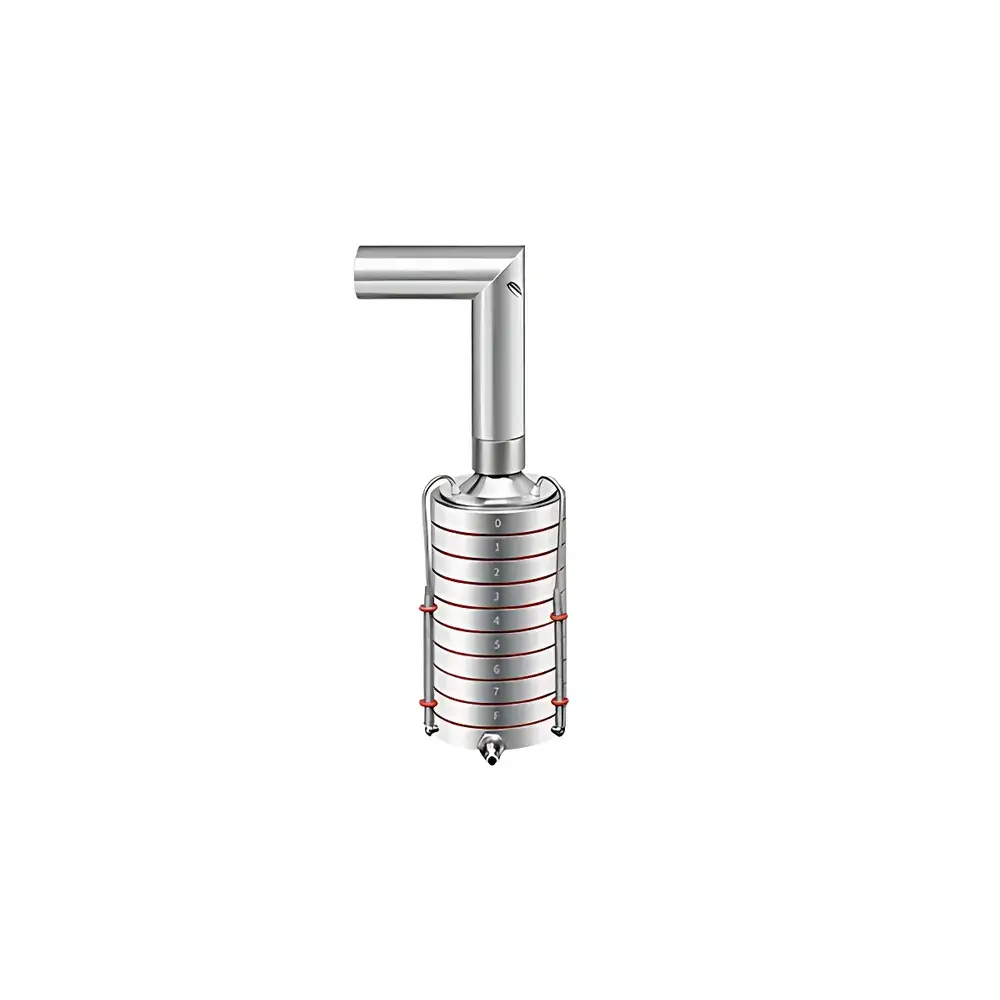
Pharmaceutical Eight-Stage Andersen Cascade Impactor (ACI)
| Brand | Huironghe |
|---|---|
| Origin | Beijing, China |
| Manufacturer Type | Authorized Distributor |
| Country of Origin | China |
| Model | HRH-HRH1 |
| Pricing | Available Upon Request |
Overview
The Pharmaceutical Eight-Stage Andersen Cascade Impactor (ACI), model HRH-HRH1, is a precision-engineered inertial multistage impactor designed for the aerodynamic particle size distribution (APSD) characterization of orally inhaled drug products (OIDPs). It operates on the principle of inertial impaction—where aerosolized particles are sequentially separated across eight progressively finer stages based on their aerodynamic diameter (da) under controlled flow conditions (typically 28.3 L/min or 60 L/min per pharmacopoeial requirements). Each stage consists of a precisely machined stainless-steel impactor plate with defined nozzle geometry and spacing, calibrated to achieve target cut-points aligned with USP <601>, Ph. Eur. 2.9.18, and ChP 0951. The final stage collects submicron residual material on a filter membrane (e.g., gelatin or PVC), enabling quantitative recovery and chemical assay. This ACI is not a standalone device but an integral component of a validated inhalation testing system—including an induction port (artificial throat), inhaler adapter, vacuum pump with mass flow controller, and environmental monitoring sensors.
Key Features
- Eight-stage cascade design compliant with USP <601>, Ph. Eur. 2.9.18, and ChP 0951 specifications for aerodynamic cut-point fidelity and inter-stage deposition efficiency.
- Stainless-steel construction throughout impactor body and plates ensures corrosion resistance, mechanical stability, and compatibility with solvent-based formulations and cleaning protocols.
- Modular configuration supports both pressurized metered-dose inhaler (pMDI) and dry powder inhaler (DPI) testing: includes dedicated pre-separator attachment for DPIs to remove non-inhalable coarse fraction (>10 µm) prior to entry into Stage 0.
- Standardized induction port (artificial throat) interface enables reproducible coupling with USP/Ph. Eur.-compliant mouth-throat models (e.g., Alberta Idealized Throat or USP Induction Port).
- Interchangeable nozzle plates and calibrated spacers allow traceable maintenance and requalification per ISO 17025-accredited procedures.
- Designed for integration with gravimetric and/or chemical analysis workflows—each stage and filter may be processed individually for assay, HPLC, or LC-MS quantification.
Sample Compatibility & Compliance
The HRH-HRH1 ACI accommodates all major inhalation dosage forms: solution and suspension pMDIs, nebulized solutions, and multi-dose DPIs containing lactose-based or carrier-free formulations. It supports testing under ambient temperature (20–25 °C) and relative humidity (40–60% RH) conditions as required by regulatory guidance (FDA Draft Guidance on Aerosols, 2022; EMA CHMP Q5C). All dimensional tolerances, surface finish specifications, and flow-path geometries conform to pharmacopoeial definitions of “Andersen-type” impactors. The system meets essential requirements for GLP-compliant studies and is routinely deployed in bioequivalence, product development, and stability testing laboratories subject to FDA 21 CFR Part 11 and EU Annex 11 data integrity expectations.
Software & Data Management
While the HRH-HRH1 ACI itself is a passive mechanical device, it is intended for use within digitally enabled inhalation test platforms. When paired with compatible flow controllers and pressure transducers (e.g., TSI 4000 series or Copley Scientific APS), raw flow rate, temperature, and differential pressure data can be logged via validated software such as Copley Inhaler Testing Suite or Westech AeroTest. These systems generate audit-trail-enabled reports compliant with 21 CFR Part 11, including electronic signatures, version-controlled calibration records, and stage-wise deposition mass tables. All hardware interfaces adhere to RS-232 or USB CDC protocols, supporting seamless integration into laboratory information management systems (LIMS) for long-term data archival and cross-study trending.
Applications
- Regulatory submission support for ANDA, NDA, and MAA filings requiring APSD data per ICH Q5A(R2) and Q5C guidelines.
- In-process control during formulation development—evaluating excipient effects on fine particle fraction (FPF) and mass median aerodynamic diameter (MMAD).
- Comparative performance assessment between reference listed drugs (RLDs) and proposed generic products.
- Stability-indicating method development for detecting physical changes (e.g., coalescence, crystallization) affecting aerosol performance over shelf life.
- Qualification of inhaler devices—including actuator geometry, valve design, and dose metering consistency—under standardized environmental conditions.
FAQ
Is the HRH-HRH1 ACI supplied with calibration certificates or traceable documentation?
Yes—each unit ships with a manufacturer’s certificate of conformance referencing ISO 8503-2 surface roughness verification and dimensional inspection reports against master gauges calibrated to NIST-traceable standards.
Can this ACI be used for nasal spray testing?
No—the HRH-HRH1 is specifically configured for oral inhalation testing per pharmacopoeial definitions; nasal spray evaluation requires alternative impactors such as the Next Generation Impactor (NGI) operated at lower flow rates (e.g., 30 L/min) with modified induction ports.
What filter membrane types are recommended for the final stage?
Gelatin filters (e.g., Sartorius 11305) are preferred for gravimetric analysis due to low blank interference, while PVDF or PTFE membranes are suitable for subsequent solvent extraction and HPLC analysis.
Does the system include an induction port and pre-separator?
The base configuration includes the eight-stage impactor body and standard top cover; the USP/Ph. Eur.-compliant induction port and DPI pre-separator are available as optional accessories, each supplied with individual qualification documentation.
How often must the impactor be cleaned and requalified?
Per USP <601> recommendations, full cleaning and visual inspection should occur after every 10 runs; full requalification—including flow profile mapping and cut-point verification—is required annually or after any mechanical modification or repair.



