
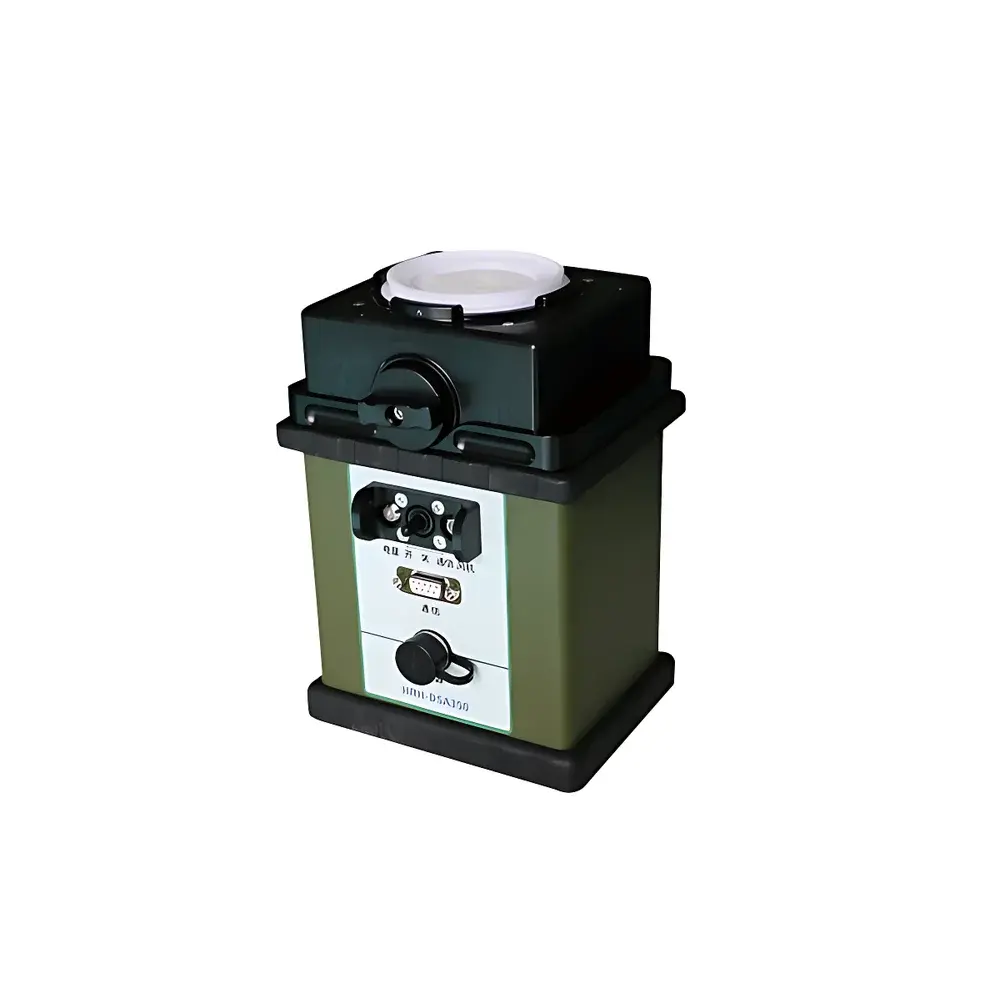
HRH-DSA350 High-Flow Bioaerosol Sampler
| Brand | HRH |
|---|---|
| Model | DSA350 |
| Sampling Principle | Electrostatic Filter Capture |
| Flow Range | 100–300 L/min (adjustable) |
| Flow Accuracy | ±2.5% of reading above 350 L/min |
| Sampling Efficiency | ≥70% for particles ≤0.5 µm |
| Operating Temperature | −40 °C to +70 °C |
| Storage Temperature | −40 °C to +70 °C |
| Relative Humidity | ≤95% RH at 35 °C |
| Battery Runtime | >30 h continuous operation (≥300 L/min, fully charged) |
| Weight | <3 kg (including battery) |
| Noise Level | ≤60 dB(A) |
| Enclosure | IP65-rated aluminum alloy housing, EMI-shielded per GJB151B-2013 |
| Control Interface | Wired (DB-9) and wireless (Wi-Fi/Bluetooth) |
| Software Functions | Programmable sampling rate, total volume, cycle time/interval, start delay, cycle count, device ID, and network discovery |
| Compliance | GB/T 39990–2021 Technical Specifications for Particulate Bioaerosol Samplers |
Overview
The HRH-DSA350 High-Flow Bioaerosol Sampler is an engineered field-deployable instrument designed for quantitative collection of airborne biological particles—including bacteria, viruses, fungal spores, and bacterial endospores—from ambient or indoor air environments. It operates on the principle of electrostatic filtration: aerosol-laden air is drawn through a high-efficiency, charge-enhanced polytetrafluoroethylene (PTFE) membrane, where particles are retained via combined inertial impaction, diffusion, and electrostatic attraction mechanisms. This method ensures high capture fidelity across a broad aerodynamic diameter range (0.1–10 µm), with validated efficiency exceeding 70% for submicron particles—a critical capability for detecting pathogenic respiratory bioaerosols. Unlike impactor-based systems that risk particle re-aerosolization or desiccation-induced viability loss, the DSA350 preserves sample integrity by minimizing shear stress and thermal load during aspiration. Its robust thermal design supports extended operation in extreme climates—from arctic field deployments to tropical transit hubs—without condensation-related filter clogging or sensor drift.
Key Features
- Adjustable high-flow sampling (100–300 L/min) with real-time flow compensation to maintain volumetric accuracy under variable backpressure conditions
- Integrated on-site elution module enabling rapid (<60 s) transfer of captured bioaerosols into liquid suspension—compatible with downstream PCR, culture, immunoassay, and metagenomic workflows
- Dual-mode power architecture: rechargeable lithium-ion battery supporting >30 h continuous operation at maximum flow; also compatible with external 12–24 V DC input for fixed-site deployment
- EMI-hardened aluminum enclosure meeting GJB151B–2013 military-grade electromagnetic compatibility requirements—suitable for use near radar installations, mobile command units, or border inspection checkpoints
- Multi-trigger sampling logic: manual initiation, time-scheduled cycles, hardware TTL pulse triggering (e.g., synchronized with door sensors or HVAC status), and remote software activation via encrypted Wi-Fi or Bluetooth LE
- IP65 ingress protection with corrosion-resistant surface finish—enabling reliable operation in high-humidity transit stations, livestock barns, and maritime quarantine zones
- Real-time telemetry dashboard displaying cumulative sampled volume, elapsed runtime, remaining battery capacity, cycle completion status, and instantaneous flow deviation
Sample Compatibility & Compliance
The HRH-DSA350 is validated for compatibility with standard nucleic acid extraction kits (e.g., QIAamp Viral RNA Mini Kit), selective growth media (e.g., Tryptic Soy Agar for bacteria, Sabouraud Dextrose Agar for fungi), and commercial immunoassay platforms. Its electrostatic capture mechanism maintains structural integrity of fragile viral envelopes and avoids enzymatic degradation pathways associated with impaction-based collectors. All firmware and control software comply with data integrity principles outlined in FDA 21 CFR Part 11 for electronic records and signatures, including audit trail logging of parameter changes, user authentication, and timestamped event records. The system meets the performance criteria specified in GB/T 39990–2021 for particulate bioaerosol samplers—including flow stability, collection efficiency verification protocols, and environmental resilience testing. While not certified to ISO 14698 or EN 13098, its operational parameters align with recommended practices for environmental monitoring in cleanrooms (ISO 14644), pharmaceutical manufacturing (EU GMP Annex 1), and biosafety level 2+ facilities.
Software & Data Management
The proprietary HRH-SamplingSuite v3.2 provides full configuration and monitoring capabilities via Windows/macOS desktop application or Android/iOS mobile interface. Users define complex sampling sequences—including staggered multi-device campaigns across distributed sites—with granular control over flow setpoints, total target volume (L), inter-cycle rest intervals, and programmable start delays. Each unit stores local metadata (GPS coordinates if enabled, temperature/humidity logs, pump duty cycle history) in tamper-evident binary files compliant with ALCOA+ principles (Attributable, Legible, Contemporaneous, Original, Accurate, Complete, Consistent, Enduring, Available). Export options include CSV for LIMS integration and PDF summary reports containing QC flags, calibration certificate references, and traceable chain-of-custody fields. Firmware updates are delivered via signed OTA packages with SHA-256 hash verification to prevent unauthorized modification.
Applications
- Public health surveillance in mass-transit infrastructure (airports, subway stations, bus terminals) during seasonal influenza or pandemic response
- Environmental monitoring in pharmaceutical aseptic processing suites and isolator glove ports per EU GMP Annex 1 guidance
- Occupational exposure assessment in poultry farms, swine confinement units, and composting facilities
- Frontline biodefense screening at postal sorting centers, customs inspection bays, and military forward operating bases
- Indoor air quality (IAQ) characterization in hospitals, schools, and long-term care facilities—supporting correlation studies between airborne microbial load and nosocomial infection rates
- Field validation of HVAC filtration efficacy and room air exchange modeling in LEED-certified buildings
FAQ
What types of biological agents can the DSA350 effectively collect?
The sampler demonstrates validated recovery of Gram-positive/negative bacteria (e.g., Staphylococcus aureus, Pseudomonas aeruginosa), non-enveloped (e.g., MS2 coliphage) and enveloped viruses (e.g., influenza A/H1N1), fungal conidia (e.g., Aspergillus niger), and heat-resistant bacterial spores (e.g., Bacillus atrophaeus)—all within their native aerosolized state.
Is the electrostatic filter reusable?
No. Each PTFE membrane is single-use and sterilized pre-installation to prevent cross-contamination. Used filters are disposed of as biohazardous waste following institutional biosafety protocols.
Can the DSA350 be integrated into existing building management systems (BMS)?
Yes—via Modbus RTU over RS-485 (optional adapter) or MQTT over Ethernet/Wi-Fi. Predefined register maps enable real-time ingestion of flow status, battery voltage, and error codes into SCADA or cloud-based environmental dashboards.
Does the system support GLP-compliant data archiving?
Yes. Audit trails, electronic signatures, and immutable session logs meet core GLP requirements for nonclinical laboratory studies (OECD 1998, FDA 21 CFR Part 58). Validation documentation packages are available upon request for IQ/OQ/PQ execution.
What maintenance is required between sampling campaigns?
Routine cleaning of the inlet nozzle and flow path with isopropyl alcohol; annual recalibration of the mass flow sensor against NIST-traceable standards; biannual verification of battery capacity retention using built-in discharge diagnostics.







