
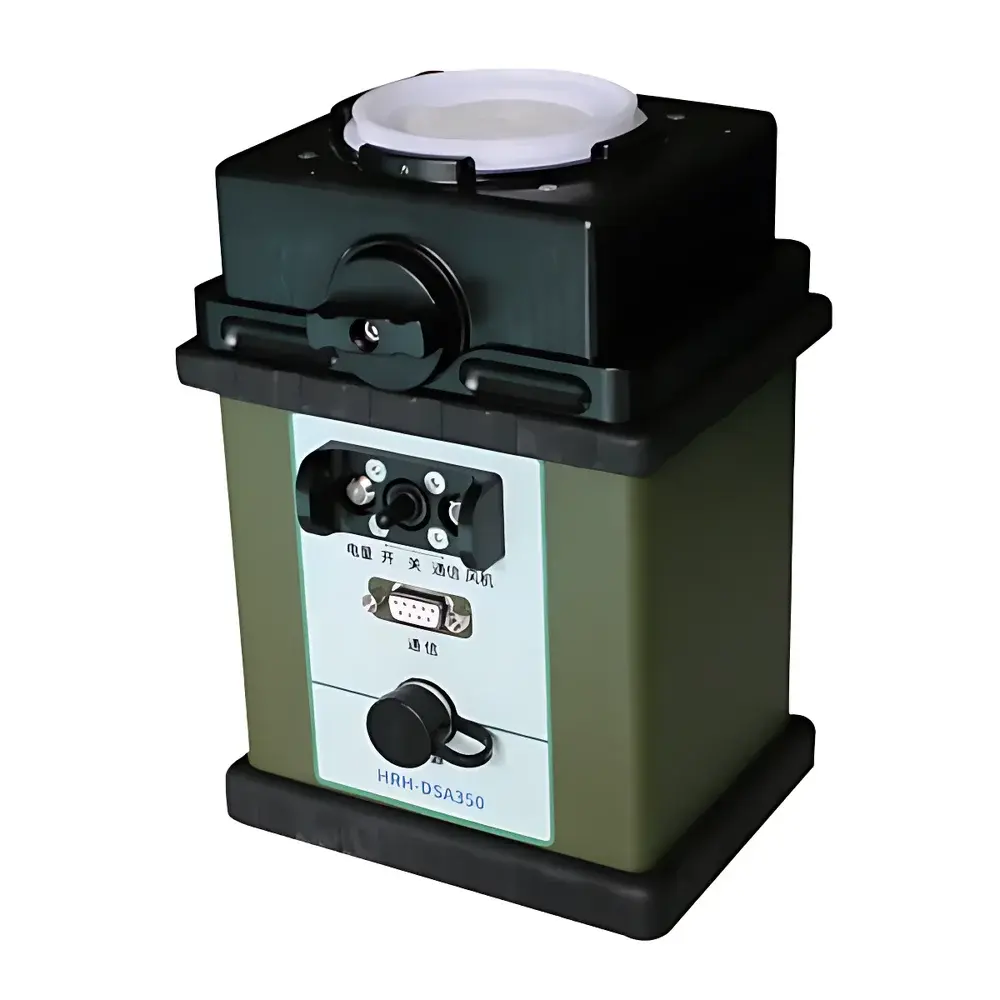
HRH-DSA300 High-Flow Bioaerosol Sampler by Huironghe
| Brand | Huironghe |
|---|---|
| Model | HRH-DSA300 |
| Sampling Principle | Electret Filter-Based Electrostatic Capture |
| Airflow Rate | ≥350 L/min (adjustable 50–350 L/min) |
| Collection Efficiency | ≥90% for 0.5–1 μm particles |
| Elution Recovery Efficiency | ≥75% |
| Sample Volume | ≤5 mL |
| Operating Temperature | –20 °C to +50 °C |
| Relative Humidity | ≤95% RH at 35 °C |
| Power Supply | AC 220 V/50 Hz or DC 12/24 V |
| Continuous Operation Time | >30 h on external DC power |
| Pump Lifetime | 60,000 h |
| Control Interface | Wired Ethernet + Wireless (Wi-Fi/Bluetooth) |
| Sampling Modes | Manual, Automatic, Hardware Trigger, Software Trigger |
| Sample Preparation Time | <1 min from air intake to liquid suspension |
Overview
The HRH-DSA300 High-Flow Bioaerosol Sampler is an engineered solution for rapid, quantitative collection of airborne biological particles—including bacteria, fungal spores, viruses, and pollen—in field, laboratory, and biosafety-critical environments. It operates on the electret filter principle: a permanently charged polypropylene membrane generates an electrostatic field that enhances inertial impaction and dielectrophoretic capture of submicron and micron-sized bioaerosols without requiring high-voltage circuitry or consumable reagents. Unlike cascade impactors or impingers, the HRH-DSA300 integrates real-time aerosol concentration with immediate post-sampling elution—enabling direct transfer of captured bioparticles into aqueous suspension within ≤60 seconds. This design supports downstream molecular, culture-based, and immunoassay analyses while minimizing particle re-aerosolization and viability loss. Its high volumetric flow rate (≥350 L/min) ensures statistically robust detection limits for low-concentration bioaerosol events, meeting operational requirements for environmental surveillance, outbreak investigation, and occupational health monitoring.
Key Features
- Electret-based electrostatic filtration system with validated capture efficiency: ≥90% for 0.5–1 μm particles and ≥95% for ≥2 μm particles per ISO 21501-4 and ASTM D6624 protocols.
- Integrated elution module enabling automated transfer of captured particles into ≤5 mL sterile sampling fluid—completed in under 60 seconds post-sampling.
- Four configurable sampling modes: manual initiation, time-scheduled automatic cycles, hardware-triggered acquisition (e.g., via external sensor pulse), and software-controlled remote activation.
- Dual-power architecture supporting AC mains (220 V/50 Hz) and field-deployable DC inputs (12 V or 24 V), enabling uninterrupted operation >30 hours on battery-backed DC supply.
- Industrial-grade brushless centrifugal blower with rated service life of 60,000 hours—designed for continuous duty in variable ambient conditions (–20 °C to +50 °C; ≤95% RH at 35 °C).
- Hybrid control interface: wired Ethernet for secure LAN integration and wireless connectivity (Wi-Fi 802.11n + Bluetooth 5.0) for local device pairing and firmware updates.
Sample Compatibility & Compliance
The HRH-DSA300 collects viable and non-viable biological particulates onto standardized 37-mm or 47-mm electret filters compatible with common microbiological processing workflows (e.g., ISO 14698-1, USP , EN 13098). Eluted samples are directly compatible with qPCR, digital PCR, NGS library prep, colony-forming unit (CFU) enumeration, and ELISA platforms. The instrument’s mechanical design complies with IP54 ingress protection standards for dust and water resistance. Data logging meets GLP/GMP-aligned audit trail requirements when used with optional timestamped metadata export (CSV/JSON). While not certified as medical device under FDA 21 CFR Part 820, its performance validation aligns with EPA Method TO-11A and ISO/IEC 17025-accredited laboratory practices for environmental bioaerosol assessment.
Software & Data Management
The embedded Linux-based controller runs proprietary firmware supporting scheduled sampling logs, real-time flow calibration status, and pump runtime diagnostics. Optional desktop and mobile applications provide remote configuration, live flow-rate visualization, and batch export of metadata including start/stop timestamps, ambient temperature/humidity (via optional external sensor input), and elution success flags. All exported data include machine-readable headers compliant with MIAME and MIAPE metadata standards. Audit-trail functionality records user login events, parameter changes, and firmware update history—supporting 21 CFR Part 11 readiness when deployed with validated identity authentication modules.
Applications
- Environmental monitoring of indoor air quality in hospitals, cleanrooms, and pharmaceutical manufacturing facilities.
- Rapid response sampling during suspected airborne pathogen releases (e.g., anthrax, influenza, SARS-CoV-2 variants).
- Long-term atmospheric bioaerosol profiling in urban, agricultural, and coastal settings.
- Validation of HVAC filtration efficacy and containment integrity testing per ISO 14644-3.
- Field-deployable surveillance in border control, military CBRN scenarios, and disaster recovery zones.
FAQ
What filter types are compatible with the HRH-DSA300?
Standard 37-mm or 47-mm electret membranes (polypropylene or PTFE-coated) meeting ISO 21501-4 particle size calibration specifications.
Can the elution volume be adjusted?
Yes—the system supports programmable elution volumes from 1.0 mL to 5.0 mL in 0.5-mL increments, optimized for downstream assay sensitivity.
Is flow calibration traceable to national standards?
Each unit ships with factory calibration certificate traceable to NIM (China National Institute of Metrology); optional annual recalibration service available with ISO/IEC 17025 reporting.
Does the sampler support integration with building management systems (BMS)?
Yes—via Modbus TCP over Ethernet or MQTT over Wi-Fi, enabling real-time status telemetry and event-driven sampling triggers.
What is the recommended maintenance interval for the electret filter and pump?
Filters are single-use and must be replaced per sampling event; the blower requires no scheduled maintenance but benefits from quarterly inlet filter inspection in high-dust environments.







