
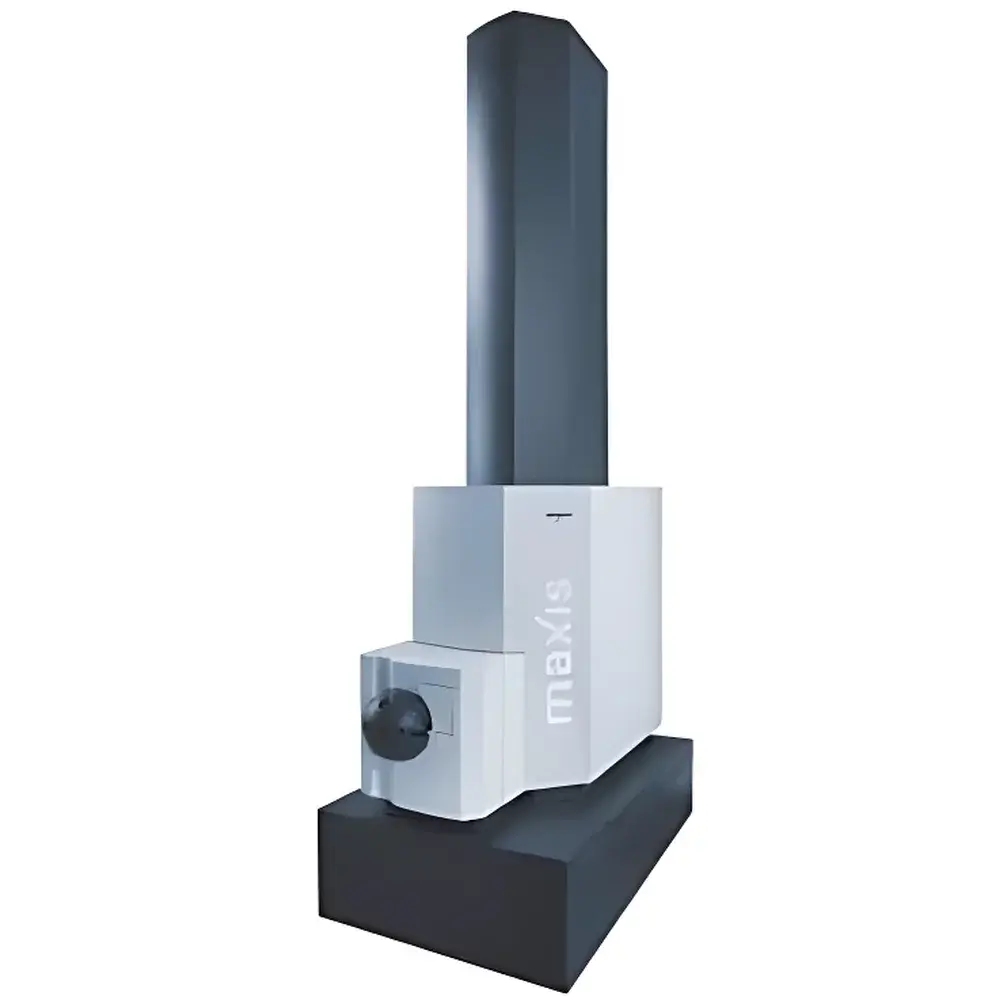
Bruker maXis II Quadrupole-Time-of-Flight (QTOF) Mass Spectrometer
| Brand | Bruker |
|---|---|
| Origin | Germany |
| Instrument Type | Quadrupole-TOF |
| Application Scope | Universal LC-MS/MS |
| Optional Features | ETD, HighMass Mode |
| Resolution (FSR) | >80,000 at full sensitivity |
| Mass Accuracy | <1 ppm RMS (calibrated, typical) |
| Mass Range | Up to 20,000 m/z (HighMass mode) |
| Isotopic Pattern Fidelity | True Isotopic Pattern (TIP) enabled |
| Software Platform | Compass DataAnalysis, Compass AutoPrep, SmartFormula™, SmartFormula 3D™ |
| Regulatory Compliance | FDA 21 CFR Part 11 compliant workflows available |
Overview
The Bruker maXis II is a high-performance quadrupole-time-of-flight (QTOF) mass spectrometer engineered for ultra-high-resolution, accurate-mass liquid chromatography–tandem mass spectrometry (LC-MS/MS). Leveraging orthogonal acceleration time-of-flight (oa-TOF) physics with a dual-stage reflectron and advanced ion optics, the maXis II delivers exceptional mass resolving power (>80,000 full sensitivity resolution, FSR) across its entire mass range without signal intensity compromise. Its hybrid quadrupole-TOF architecture enables both precursor ion selection (via RF/DC-controlled quadrupole) and high-fidelity fragment ion detection (via time-of-flight analyzer), supporting data-dependent acquisition (DDA), data-independent acquisition (DIA), and targeted MS/MS workflows. Designed for demanding applications in biopharmaceutical characterization, metabolomics, environmental analysis, and small-molecule discovery, the maXis II operates under vacuum conditions optimized for ion transmission efficiency and temporal stability—critical for reproducible quantitative and qualitative analysis.
Key Features
- Full-sensitivity resolution exceeding 80,000 FSR across the mass range—maintained without attenuation or dynamic range sacrifice
- True Isotopic Pattern (TIP) detection capability, enabling confident elemental composition assignment and elimination of false-positive formula candidates
- SmartFormula™ and SmartFormula 3D™ algorithms for de novo molecular formula generation from accurate-mass spectra, including stereochemical inference where supported by retention and fragmentation behavior
- Electron Transfer Dissociation (ETD) option for top-down and middle-down proteomics—preserving labile post-translational modifications (PTMs) such as phosphorylation and glycosylation during fragmentation
- HighMass mode extension (optional) for native MS analysis of intact protein complexes, monoclonal antibodies (mAbs), antibody–drug conjugates (ADCs), and large biomolecular assemblies up to 20,000 m/z
- Robust ion source design compatible with electrospray ionization (ESI), nano-ESI, and atmospheric pressure chemical ionization (APCI), supporting both reversed-phase and hydrophilic interaction liquid chromatography (HILIC)
- Compass software suite with integrated instrument control, real-time spectral processing, and automated calibration routines traceable to NIST-traceable standards
Sample Compatibility & Compliance
The maXis II accommodates diverse sample types—from low-abundance metabolites in biological fluids to intact monoclonal antibodies in formulation buffers—without requiring method re-optimization. Its dynamic range exceeds 4 orders of magnitude in a single run, supporting simultaneous quantification of high- and low-intensity analytes. The system complies with international regulatory expectations for analytical instrumentation: Compass software supports 21 CFR Part 11-compliant electronic records and signatures when deployed with appropriate IT infrastructure and administrative controls. Audit trails, user role-based permissions, and secure data archiving are configurable to meet GLP and GMP requirements. Method validation documentation aligns with ICH Q2(R2), USP , and ISO/IEC 17025 frameworks. All hardware components conform to CE, UL, and RoHS directives.
Software & Data Management
Data acquisition and interpretation are unified within the Compass platform, which includes DataAnalysis for spectral visualization and annotation, AutoPrep for automated peak picking and alignment across LC-MS datasets, and BioTools for protein identification and PTM localization. Raw data files (.baf format) are stored in a structured, vendor-neutral binary container supporting long-term archival and third-party tool interoperability (e.g., via ProteoWizard conversion). Metadata—including instrument parameters, calibration history, and user annotations—is embedded directly into each file. Batch processing workflows support retrospective reprocessing with updated algorithms or recalibration models, ensuring data integrity over time. Cloud-enabled remote monitoring and diagnostics are available via Bruker’s Compass Connect service.
Applications
- Intact and subunit-level characterization of therapeutic monoclonal antibodies—including charge variant profiling, deamidation, oxidation, C-terminal lysine clipping, and glycoform mapping
- Native mass spectrometry of protein–ligand and protein–protein complexes to determine stoichiometry, binding affinity, and conformational heterogeneity
- Comprehensive small-molecule identification in untargeted metabolomics and forensic toxicology using accurate-mass MS/MS libraries and in silico fragmentation prediction
- Top-down sequencing of proteins up to ~50 kDa using ETD fragmentation, enabling residue-specific PTM localization without enzymatic digestion
- Impurity profiling and structural elucidation of synthetic pharmaceuticals per ICH Q5 and Q3 guidelines
- Environmental contaminant screening (e.g., PFAS, pesticides, microplastics) with non-targeted workflow support and isotopic pattern confirmation
FAQ
What distinguishes the maXis II from earlier QTOF platforms?
The maXis II introduces enhanced ion transmission efficiency, improved mass accuracy stability (<1 ppm RMS over 24 h), and higher FSR at full sensitivity—enabled by refined reflectron geometry and digital signal processing firmware.
Is ETD available as a field-upgradeable option?
Yes, ETD functionality can be added post-purchase via hardware installation (electron transfer cell) and software license activation.
Can the maXis II perform quantitative analysis?
Yes—when coupled with stable isotope-labeled internal standards and optimized DDA/DIA acquisition methods, it supports precise label-free and labeled quantitation with CVs <15% across biological replicates.
Does HighMass mode require special calibration standards?
Calibration in HighMass mode uses proprietary polymer standards traceable to NIST SRM 1939, with optional custom calibrants for native protein complexes.
How is data security managed in regulated environments?
Compass supports role-based access control, encrypted data storage, electronic signature capture, and immutable audit logs—all configurable to satisfy FDA, EMA, and PMDA inspection requirements.
Related Products




