
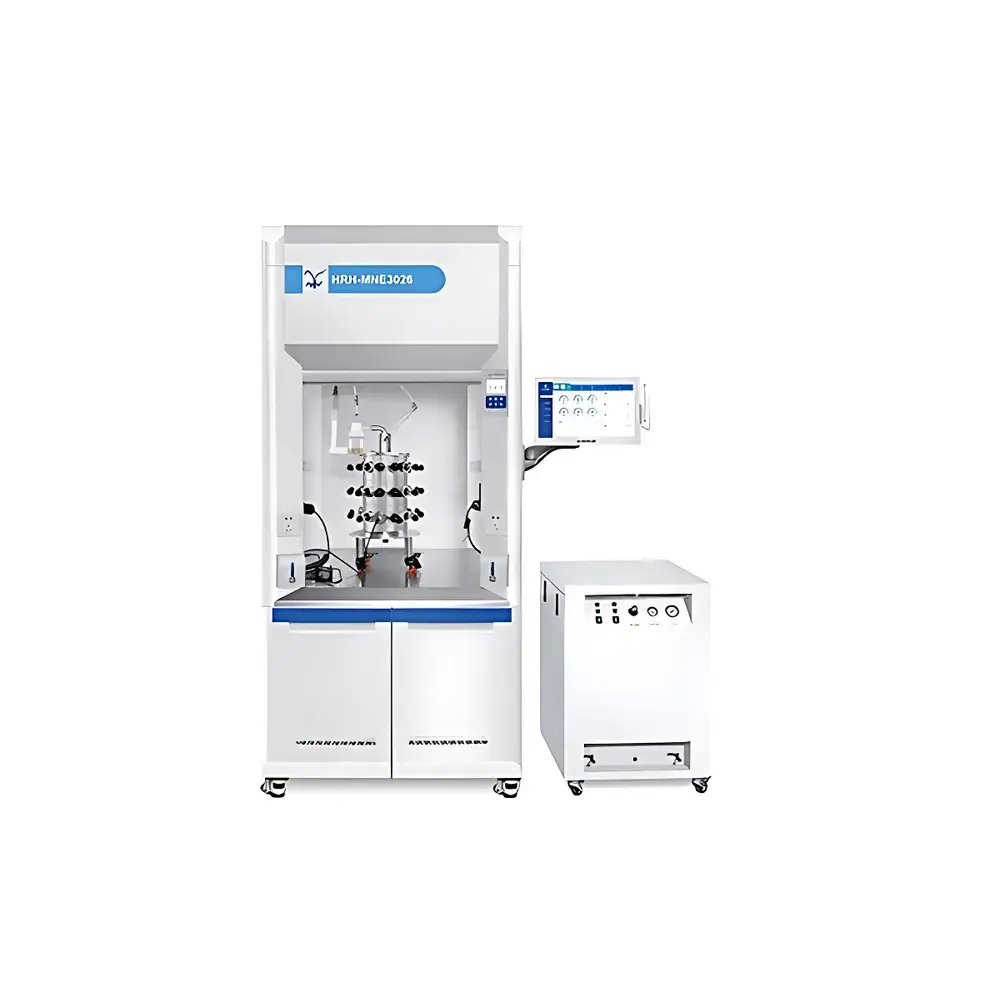
Huiron HRH-MNE3026 Nose-Only Inhalation Exposure System for Small Rodents
| Brand | Huiron |
|---|---|
| Model | HRH-MNE3026 |
| Origin | Beijing, China |
| Instrument Type | Nose-Only Inhalation Exposure Chamber |
| Compliance | OECD TG 403, 412, 413, 436 |
| Chamber Configuration | Dual-stainless-steel-cylinder (inner positive pressure / outer negative pressure) |
| Aerosol Uniformity | ±8% (gaseous), ±10% (liquid aerosol), ±20% (particulate/dust/nanoparticle aerosol) |
| Safety | Integrated HEPA/activated carbon filtration, operator negative-pressure containment |
| Software | GLP-compliant with user role management, audit trail, electronic signature, immutable data storage |
Overview
The Huiron HRH-MNE3026 Nose-Only Inhalation Exposure System is an engineered platform designed for precise, reproducible, and regulatory-compliant inhalation toxicology studies in small rodents—including rats, mice, and guinea pigs. It operates on the principle of nose-only (or head-only) exposure, wherein animals are restrained in individual tapered tubes that deliver test atmospheres directly to the nares while isolating the respiratory tract from dermal or oral contamination. This configuration ensures strict control over delivered dose, minimizes inter-animal variability, and eliminates confounding deposition in fur or bedding—critical for quantitative toxicokinetic and dose-response assessments. The system supports a broad spectrum of test agents: volatile organic compounds (VOCs), vapors, liquid-based aerosols (e.g., nebulized pharmaceuticals), dry powder aerosols, engineered nanoparticles, combustion-generated smoke, and radio-labeled particulates. Its dual-chamber stainless-steel architecture—featuring a positively pressurized inner cylinder and negatively pressurized outer shell—prevents exhaled air from diluting or contaminating the exposure atmosphere, thereby maintaining fidelity in concentration-time profiles across all exposure ports.
Key Features
- Dual-cylinder stainless-steel exposure chamber with independent pressure regulation: inner cylinder maintained at +25–50 Pa (positive), outer shell at −50 to −100 Pa (negative) to ensure unidirectional airflow and prevent cross-contamination.
- Real-time aerosol monitoring via integrated photometric or gravimetric sensors (optional interface for SMPS, APS, or CPC systems), enabling continuous feedback control of generator output.
- On-line sampling port compatible with ISO 29463-certified filter cassettes or impingers for concurrent chemical or particle-size distribution analysis.
- High-precision mass flow controllers (MFCs) and laminar-flow conditioning sections ensure uniform aerosol delivery across up to 30 simultaneous exposure positions, with concentration homogeneity validated per OECD guidance.
- Exhaust air passes through redundant filtration: primary HEPA H14 (≥99.995% @ 0.3 µm) followed by activated carbon bed for VOC and odor abatement—effluent meets China’s GB 16297–1996 and EU Directive 2010/75/EU emission thresholds.
- Integrated safety interlocks: automatic shutdown upon door breach, pressure deviation >±15%, or filter saturation alarm; audible/visual alerts logged in system event history.
Sample Compatibility & Compliance
The HRH-MNE3026 accommodates aerosols spanning 10 nm to >100 µm aerodynamic diameter, including but not limited to: saline nebulates, liposomal drug formulations, TiO₂ and SiO₂ nanoparticles, diesel exhaust particles (DEP), agricultural spray mists, and radiolabeled iodine vapor. All exposure protocols align with internationally recognized regulatory frameworks: OECD Test Guidelines 403 (acute), 412 (28-day subacute), 413 (90-day subchronic), and 436 (stepwise acute); as well as Chinese national standards GB/T 15670.6–2017 through GB/T 15670.26–2017 for pesticide registration toxicology. Chamber performance validation—including flow uniformity, aerosol stability (RSD ≤8% for gases, ≤10% for liquid aerosols, ≤20% for dusts), and leak integrity (<0.5% volume loss/min at 1 kPa)—is documented per ISO/IEC 17025 requirements and suitable for inclusion in study reports submitted to NMPA, EPA, EMA, or PMDA.
Software & Data Management
The embedded exposure control software (v3.2+) provides full GLP compliance per FDA 21 CFR Part 11 and OECD Principles of Good Laboratory Practice. Core capabilities include: hierarchical user access (Administrator, Study Director, Technician, Viewer), time-stamped audit trail capturing all parameter changes and manual interventions, cryptographic electronic signatures for protocol approval and raw data sign-off, and write-once-read-many (WORM) storage architecture ensuring data immutability. All exposure logs—including real-time concentration traces, pressure differentials, temperature/humidity, and system alarms—are exported in CSV and PDF/A-2 format, with metadata embedded for traceability. Optional integration with LIMS platforms via ASTM E1578-compliant API enables automated ingestion into enterprise data repositories.
Applications
- Preclinical safety assessment of inhaled therapeutics (e.g., mRNA lipid nanoparticles, bronchodilators, anti-fibrotics) under ICH S7B and S11 guidelines.
- Respiratory disease modeling: COPD, asthma, pulmonary fibrosis, and viral pneumonia via controlled challenge with LPS, ozone, or influenza A aerosols.
- Regulatory hazard identification for industrial chemicals, agrochemicals, nanomaterials, and combustion byproducts per REACH Annexes VII–X and EPA OPPTS 870.1300.
- Radiation biology studies involving inhaled radionuclides (e.g., 212Pb, 223Ra aerosols) with alpha-particle dosimetry support.
- Inhalational vaccine development and mucosal immunity evaluation using adjuvanted protein or viral vector aerosols.
- Space life sciences: microgravity-simulated inhalation studies for lunar/Mars mission risk assessment (NASA Human Research Program Standard 2410).
FAQ
What rodent species and weight ranges are supported?
The system accommodates mice (18–35 g), rats (150–300 g), and guinea pigs (300–600 g) using interchangeable restraint tubes calibrated to ASTM F2912–13 anthropometric dimensions.
Can the system be validated for GMP-regulated inhalation product testing?
Yes—IQ/OQ/PQ protocols are available, and the system supports qualification per USP , , and ISO 14644-1 Class 7 cleanroom integration when installed in controlled environments.
Is remote monitoring and intervention possible during long-duration exposures?
All operational parameters are accessible via encrypted web interface; critical alarms trigger SMS/email notifications, and emergency override can be executed from offsite locations with two-factor authentication.
Does the software support 21 CFR Part 11 Subpart B requirements for electronic records?
Yes—full implementation includes role-based e-signatures, system-generated audit trails with hash-verified integrity checks, and retention policies aligned with 21 CFR 11.10(d) and ISO/IEC 27001:2022.
How is aerosol generation method selected and qualified?
The system interfaces with industry-standard generators (e.g., collision nebulizers, fluidized bed dry powder dispersers, spark discharge nanoparticle sources); each generator undergoes aerosol characterization per ISO 15528 and ISO/TC 229/NP 22589 prior to study initiation.





