
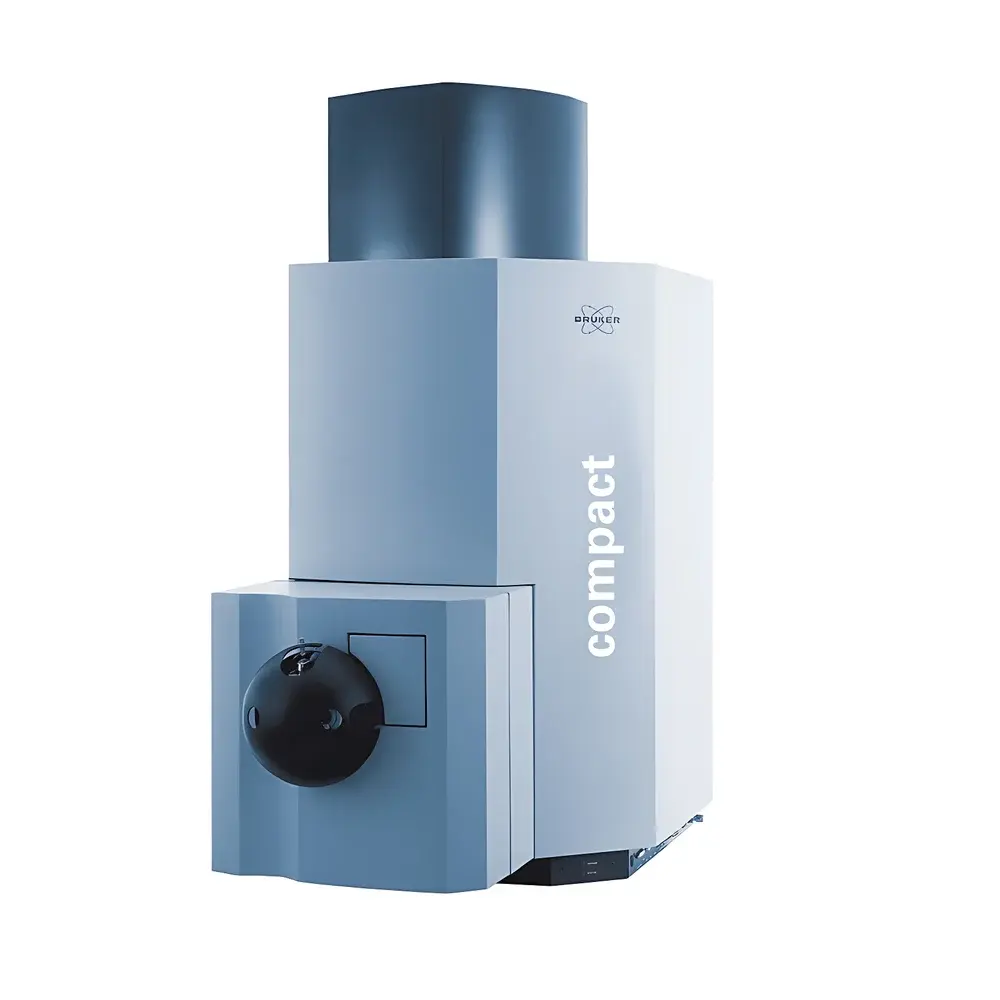
Bruker compact QTOF Mass Spectrometer
| Brand | Bruker |
|---|---|
| Origin | Germany |
| Manufacturer Type | Authorized Distributor |
| Origin Category | Imported |
| Model | compact |
| Instrument Type | Quadrupole-Time-of-Flight (QTOF) |
| Application Scope | Universal LC-MS/MS Platform |
| Key Specifications | 50 GBit/sec acquisition rate |
| Resolution | Ultra-High Resolution TOF (UHR-TOF) |
Overview
The Bruker compact QTOF Mass Spectrometer is a benchtop quadrupole-time-of-flight (QTOF) system engineered for uncompromised performance in liquid chromatography–mass spectrometry (LC-MS/MS) applications. Leveraging Bruker’s proprietary ultra-high-resolution time-of-flight (UHR-TOF) architecture, the compact delivers research-grade mass accuracy, resolution, and sensitivity without requiring instrument tuning or method-dependent compromises. Its orthogonal acceleration TOF design ensures consistent ion transmission efficiency and picosecond-level time measurement precision—critical for achieving sub-ppm mass accuracy across broad m/z ranges (typically 50–2000 Da) in both positive and negative ion modes. Unlike conventional scanning instruments, the compact acquires full-spectrum data at up to 50 GBit/sec, preserving high resolution and sensitivity even during ultra-fast UHPLC gradients (<1 min). This enables simultaneous quantitative and qualitative analysis within a single run—supporting untargeted screening, structural elucidation, and retrospective data mining without re-injection.
Key Features
- True full-scan sensitivity: Sub-picogram detection limits in full-scan MS and MS/MS modes—comparable to triple quadrupole platforms, yet retaining exact mass information.
- Auto-calibration workflow: Internal calibration with lock-mass correction ensures long-term mass accuracy better than 1 ppm without manual intervention or external standards per run.
- No trade-off architecture: Maintains maximum resolution (>35,000 FWHM at m/z 556) and sensitivity concurrently—eliminating the need to switch between “high-res” and “high-sensitivity” acquisition modes.
- Extended dynamic range: >4 orders of magnitude linear dynamic range enables quantitation of low-abundance analytes in complex matrices (e.g., plasma, cell lysates, environmental extracts) without dilution or fractionation.
- Benchtop footprint with research-grade robustness: Compact mechanical design integrates vacuum, ion optics, and detector into a stable, low-maintenance platform suitable for regulated and academic laboratories alike.
Sample Compatibility & Compliance
The compact supports diverse sample introduction methods including electrospray ionization (ESI), atmospheric pressure chemical ionization (APCI), and optional nano-ESI sources. It is routinely deployed for small-molecule characterization (e.g., pharmaceuticals, metabolites, contaminants), intact protein analysis (up to ~150 kDa), and top-down proteomics workflows. The system complies with key regulatory frameworks: raw data files adhere to open, vendor-neutral mzML format; audit trails and electronic signatures are supported via Bruker’s Compass software suite, facilitating compliance with FDA 21 CFR Part 11, ISO/IEC 17025, and GLP/GMP documentation requirements. Method validation protocols align with ICH Q2(R2) and USP guidelines for identification and quantitation.
Software & Data Management
Controlled by Bruker’s Compass software platform—including DataAnalysis, Compound Discoverer, and BioPharmaBuilder—the compact enables end-to-end workflows from acquisition to reporting. Real-time processing supports automated peak detection, formula generation (with isotopic pattern matching), and database searching against HMDB, METLIN, MassBank, and UniProt. All raw data are stored in encrypted, timestamped .baf files with embedded metadata (instrument parameters, calibration history, user ID). Version-controlled method templates ensure reproducibility across operators and shifts. Integration with LIMS via standard API interfaces allows traceable sample tracking and automated report generation compliant with laboratory QA/QC procedures.
Applications
- Synthetic chemistry: Confirmation of reaction products, impurity profiling, and regioisomer differentiation using accurate mass and MS/MS spectral libraries.
- Forensic toxicology & doping control: High-confidence identification of novel psychoactive substances, anabolic steroids, and masked metabolites in urine and blood matrices.
- Pharmaceutical development: Forced degradation studies, metabolite identification (MetID), extractable/leachable analysis, and peptide mapping of monoclonal antibodies.
- Proteomics & metabolomics: Label-free quantitation, PTM localization, and pathway mapping with confidence-based false discovery rate (FDR) control.
- Environmental & food safety: Multi-residue screening for pesticides, mycotoxins, and veterinary drug residues in compliance with EU SANTE/11312/2021 guidelines.
FAQ
Does the compact require daily mass calibration?
No—its real-time internal calibration system maintains sub-ppm mass accuracy over multi-hour acquisitions without manual recalibration.
Can it perform targeted quantitation with the same accuracy as a triple quadrupole?
Yes—using extracted ion chromatograms (XIC) from high-resolution full-scan data, it achieves comparable precision and LOD/LOQ for validated bioanalytical methods.
Is method transfer possible between compact and other Bruker QTOF systems?
Yes—method files (.xml) and processing workflows are fully interoperable across the timsTOF and maXis series, enabling seamless scalability from discovery to routine QC.
What level of IT infrastructure is required for data storage?
A minimum of 500 GB SSD per week of continuous operation is recommended; raw file compression (via baf2mzML) reduces storage footprint by ~60% without loss of fidelity.
Is remote monitoring and troubleshooting supported?
Yes—Bruker Remote Support (BRS) provides secure, auditable access for firmware updates, diagnostic logging, and collaborative method optimization under ISO 27001-compliant protocols.
Related Products






