
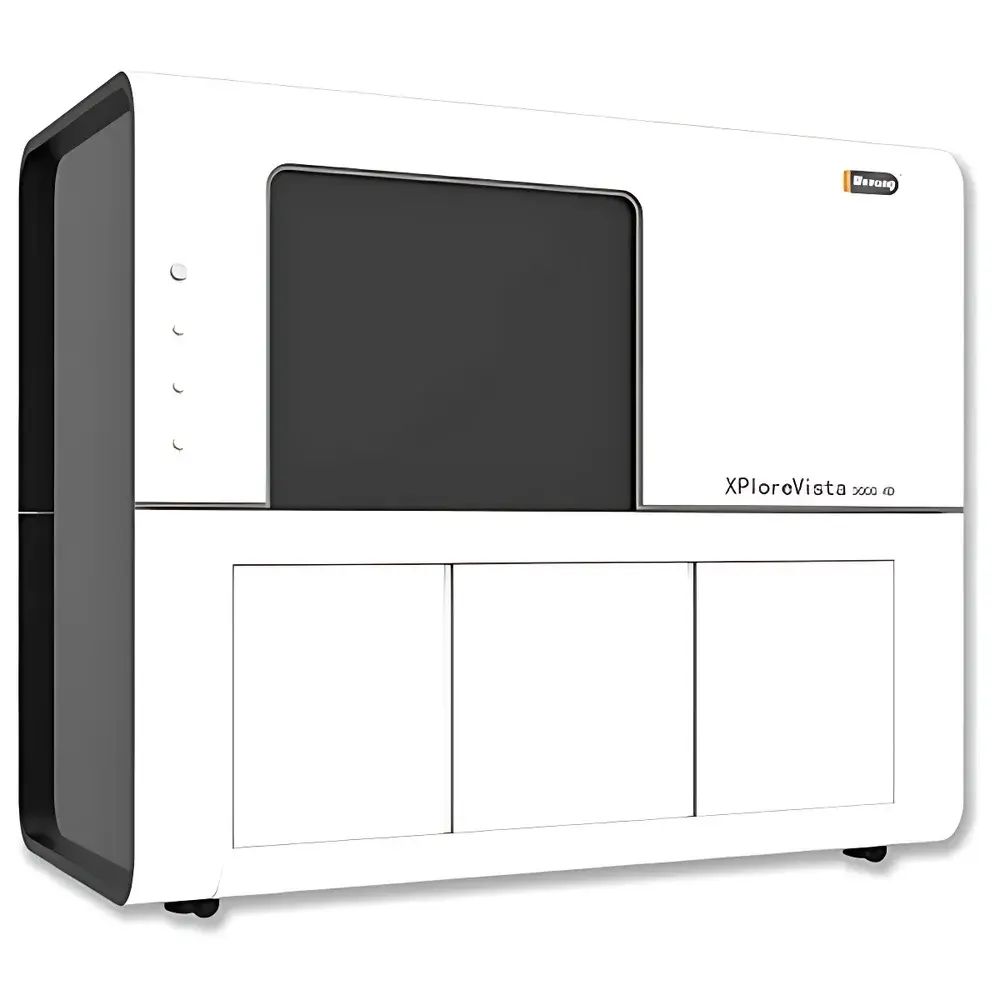
Wkuang XPloreVista 3000 4D Industrial Micro-Computed Tomography System
| Brand | Wkuang |
|---|---|
| Origin | Jiangsu, China |
| Manufacturer Type | Authorized Distributor |
| Country of Origin | China |
| Model | XPloreVista 3000 4D |
| Spatial Resolution | ≥500 nm |
| Dimensions | 2430 mm × 1280 mm × 2170 mm |
Overview
The Wkuang XPloreVista 3000 4D is a high-resolution industrial micro-computed tomography (micro-CT) system engineered for non-destructive, volumetric 3D and time-resolved 4D structural characterization at the nanoscale. Leveraging a state-of-the-art nanofocus X-ray source with sub-micron focal spot size, the system operates on the principle of cone-beam computed tomography—acquiring hundreds to thousands of projection images across a full 360° rotation, followed by iterative or filtered back-projection reconstruction to generate isotropic 3D voxel datasets. Its rigid, thermally stabilized mechanical architecture minimizes drift and vibration-induced artifacts, enabling consistent acquisition stability during long-duration scans. Designed explicitly for in situ and operando experiments, the XPloreVista 3000 4D integrates precision motion stages and environmental chambers without compromising spatial fidelity—making it suitable for dynamic process monitoring in materials science, additive manufacturing, geoscience, and advanced electronics packaging.
Key Features
- Nanofocus X-ray source with ≤500 nm effective focal spot size, optimized for high signal-to-noise ratio and minimal beam hardening at low kV settings (typically 20–90 kV)
- High-stiffness, granite-based gantry with active thermal compensation and vibration-damped optical table integration
- Integrated in situ stage compatibility: supports tensile/compression, heating (up to 1200 °C), cooling (down to –180 °C), fluid flow, and electrochemical cells—all with real-time CT synchronization
- Large field-of-view (FOV) flexibility: configurable from 25 mm³ (for macro-scale context), maintaining geometric accuracy across magnifications
- Dual-detector option: high-sensitivity CMOS flat-panel detector (with scintillator coupling) and optional direct-conversion photon-counting detector for enhanced contrast in low-Z materials
- Real-time reconstruction pipeline supporting on-the-fly 3D volume generation and 4D temporal registration using GPU-accelerated algorithms
Sample Compatibility & Compliance
The XPloreVista 3000 4D accommodates samples ranging from sub-millimeter ceramic MEMS devices to 150 mm diameter rock cores or battery electrode stacks. Sample mounting is facilitated via standardized kinematic fixtures compatible with ISO 10360-compliant metrology workflows. The system adheres to IEC 61000-6-3 (EMC emissions) and IEC 61000-6-4 (industrial immunity) standards. Radiation safety complies with national regulatory requirements for cabinet X-ray systems (e.g., FDA 21 CFR 1020.40, GBZ 138–2019). All operational parameters—including tube voltage, current, exposure time, and geometry—are logged with timestamped audit trails, supporting GLP/GMP-aligned documentation practices and traceability per ISO/IEC 17025.
Software & Data Management
Control, reconstruction, and analysis are unified within Wkuang’s proprietary VistaCT Suite v4.x—a modular platform built on Qt and CUDA frameworks. Acquisition modules support programmable scan protocols (e.g., helical, multi-angle, dose-optimized sparse sampling). Reconstruction employs both FDK and SART algorithms with ring artifact correction, beam hardening compensation, and phase-retrieval-enabled edge enhancement. Quantitative analysis tools include porosity mapping (per ASTM E2911), grain segmentation (using watershed + machine learning classifiers), fiber orientation tensor calculation (per ISO 16232), and dimensional metrology with uncertainty estimation (traceable to NIST-traceable phantoms). Data export conforms to DICOM-CT, HDF5, and TIFF stack formats; metadata embedding follows the µCT Data Standard (µCDS) v1.2 specification.
Applications
- Materials science: pore network modeling in catalysts, sintered metals, and aerogels; crack propagation tracking under mechanical load
- Additive manufacturing: as-built defect detection (lack-of-fusion, keyholing), powder bed characterization, and residual stress-induced distortion analysis
- Electronics: solder joint void quantification, wire bond integrity assessment, and encapsulant delamination kinetics
- Geoscience: digital rock physics simulations (permeability, capillary pressure), fossil morphology reconstruction, and diagenetic feature quantification
- Life sciences (ex vivo): bone microarchitecture (trabecular thickness, connectivity density per ISO 10993-12), dental implant osseointegration, and vascular corrosion casting analysis
FAQ
What is the minimum achievable voxel size under optimal conditions?
Under ideal sample geometry, high-contrast configuration, and extended acquisition time, the system achieves isotropic voxels down to 250 nm—validated using NIST SRM 2099 line-pair test objects.
Does the system support automated batch scanning and report generation?
Yes. VistaCT Suite includes scriptable workflow automation (Python API) and customizable PDF/HTML reporting templates compliant with internal QA templates or ISO 17025 documentation requirements.
Is remote operation and monitoring supported?
The system features secure TLS-encrypted remote access via web-based dashboard, enabling real-time status monitoring, queue management, and emergency stop—fully auditable and role-based permission controlled.
Can the XPloreVista 3000 4D be integrated into existing laboratory information management systems (LIMS)?
It provides RESTful API endpoints and HL7/DICOM-SR export options, enabling bidirectional data exchange with major LIMS platforms including LabWare, Thermo Fisher SampleManager, and Siemens Teamcenter.



