
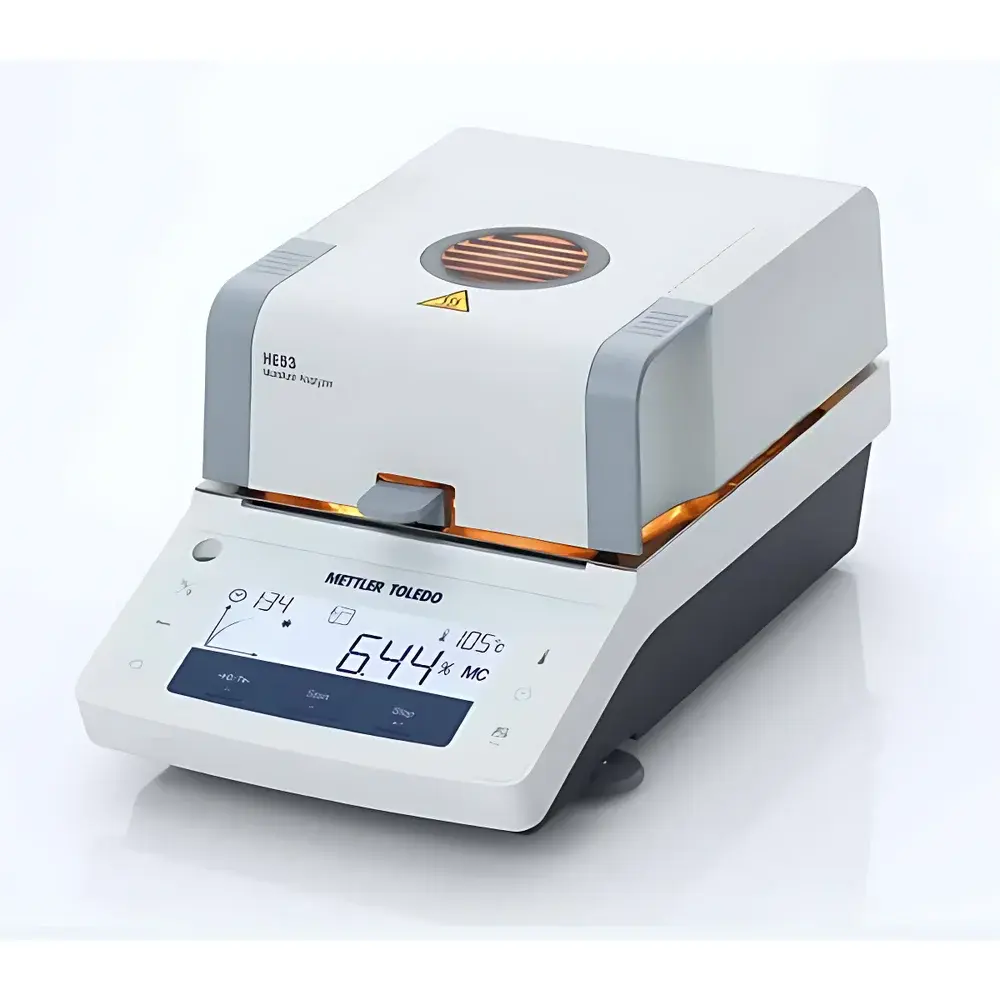
METTLER TOLEDO HE53 Halogen Moisture Analyzer
| Brand | METTLER TOLEDO |
|---|---|
| Origin | Shanghai, China |
| Model | HE53 |
| Heating Source | Halogen Lamp |
| Readability | 0.01 % MC (1 mg) |
| Weighing Range | 54 g |
| Drying Temperature Range | 50–160 °C (1 °C increments) |
| Repeatability (2 g sample) | 0.15 % SD |
| Repeatability (10 g sample) | 0.05 % SD |
| Method Storage | 1 method |
| Result Storage | 1 result |
| Display Modes | ATRO moisture %, ATRO solids %, g, moisture %, solids % |
| Interface | RS232 |
| Compliance | SOC 3 auto-calibration at 100 °C / 160 °C |
| Power Supply | 230 V |
Overview
The METTLER TOLEDO HE53 Halogen Moisture Analyzer is a thermogravimetric instrument engineered for rapid, reliable determination of moisture content and solid content in diverse solid and semi-solid materials. It operates on the principle of loss-on-drying (LOD): a precisely weighed sample is heated under controlled halogen lamp irradiation, driving off volatile components—primarily water—while an integrated high-resolution balance continuously monitors mass loss in real time. The instrument calculates moisture content (%) as the relative mass difference between initial and final dry weight, referenced to either the original wet weight (standard %MC) or the final dry weight (ATRO mode). Designed for routine quality control environments, the HE53 delivers traceable, GLP-compliant results without requiring advanced operator training or complex calibration protocols.
Key Features
- Halogen heating system with precise temperature control from 50 °C to 160 °C in 1 °C increments—ensuring reproducible thermal profiles across sample matrices.
- High-sensitivity weighing unit with 0.01 % moisture content readability (equivalent to 1 mg mass resolution at full 54 g capacity), optimized for small-quantity QC testing.
- Single pre-programmed drying method with automatic endpoint detection based on mass stabilization criteria (SOC 3 standard), eliminating subjective judgment.
- Backlit LCD interface with intuitive step-by-step guidance: tare pan → load sample → close lid → start. No software installation or PC dependency required.
- Robust mechanical architecture with compact footprint (W × D × H ≈ 200 × 300 × 150 mm) and reinforced housing—engineered for stability in both laboratory benches and production floor environments.
- RS232 serial port enables direct connection to external printers or legacy LIMS systems for audit-ready hardcopy output or basic data logging.
Sample Compatibility & Compliance
The HE53 is validated for use with homogeneous powders, granules, pellets, pastes, and thin-film solids commonly encountered in food, pharmaceutical, chemical, and agricultural industries. Its halogen-based thermal delivery provides faster and more uniform heating than traditional infrared emitters, reducing charring risk for heat-sensitive organics. While not certified for regulated GMP manufacturing environments requiring 21 CFR Part 11 electronic records, the instrument supports foundational GLP practices through its built-in SOC 3 calibration verification at two reference temperatures (100 °C and 160 °C), traceable to internal temperature sensors and factory calibration certificates. All displayed results—including moisture %, solids %, and absolute mass values—are time-stamped and uneditable within device memory, satisfying basic documentation requirements per ISO/IEC 17025 clause 7.7.
Software & Data Management
The HE53 operates independently of proprietary PC software. All configuration, operation, and result display occur via its embedded firmware and front-panel interface. Results are retained in volatile memory (one record only) until overwritten or powered off; no internal non-volatile storage or user-accessible data export is provided. For compliance-driven workflows, the RS232 interface permits integration with third-party data acquisition tools or simple ASCII-printer setups. Users may manually transcribe readings into Excel or LIMS platforms, or configure automated serial capture using standard terminal emulation (e.g., Tera Term, PuTTY) with configurable baud rate (9600 bps default) and line-ending protocols. No encryption, digital signature, or audit trail functionality is implemented—consistent with its role as a dedicated entry-level LOD instrument.
Applications
- Food industry: moisture verification in flour, sugar, dairy powders, coffee beans, and snack products per AOAC 952.08 and ASTM D4457.
- Pharmaceutical excipients: rapid batch release testing of lactose monohydrate, microcrystalline cellulose, and starch derivatives against USP <731> limits.
- Chemical manufacturing: incoming raw material inspection of catalysts, pigments, and polymer additives where residual solvent or hydration water impacts reactivity.
- Agricultural feed analysis: routine screening of grain, soybean meal, and silage for storage stability and nutritional labeling compliance.
- Plastics & composites: pre-processing moisture checks on hygroscopic resins (e.g., nylon, PET) prior to extrusion or injection molding.
FAQ
What standards does the HE53 comply with?
The HE53 supports method development aligned with AOAC, ASTM, and ISO moisture determination guidelines. It includes SOC 3 calibration verification at 100 °C and 160 °C but is not certified for 21 CFR Part 11 or EU Annex 11 compliance.
Can I store multiple drying methods on the HE53?
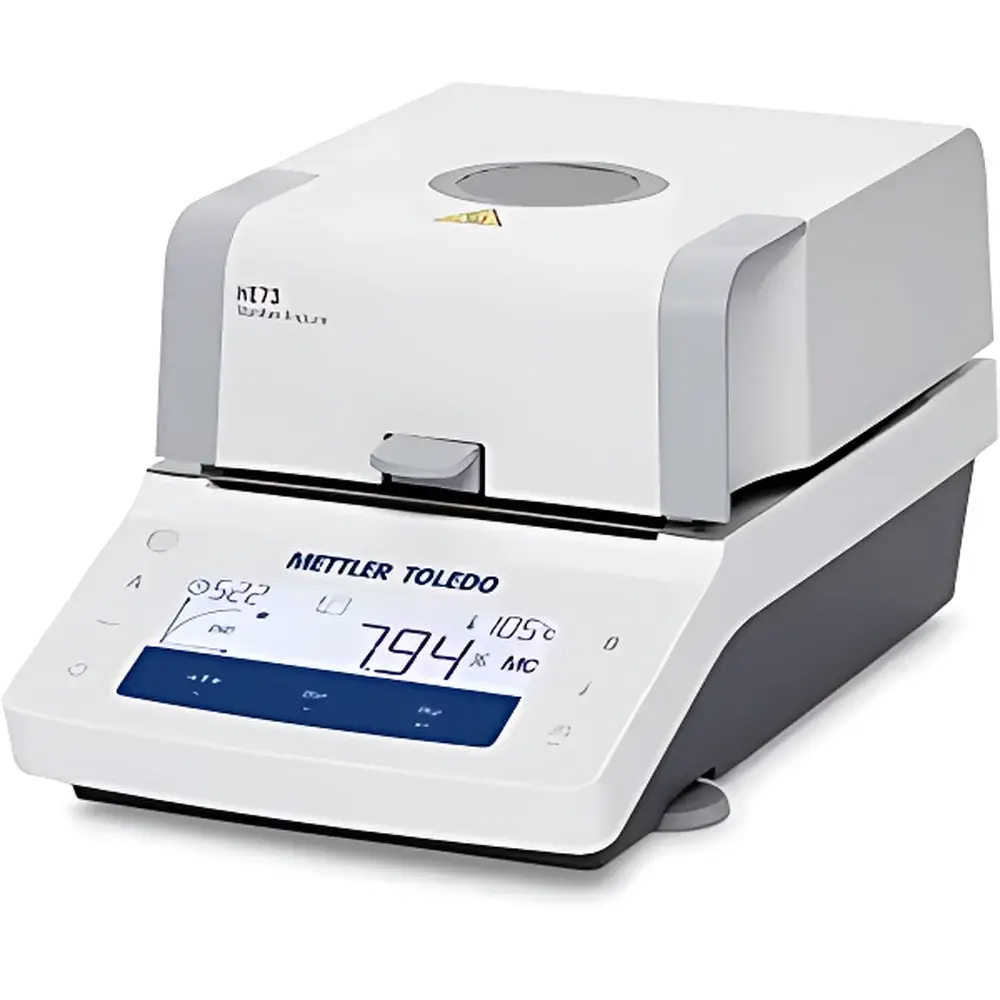
No—the HE53 supports only one user-defined drying method. For multi-method flexibility, consider the HE73 or HR83 models.
Is the HE53 suitable for volatile organic solvents?
It is not recommended for samples containing flammable or highly volatile solvents (e.g., acetone, ethanol) due to open-chamber design and lack of vapor containment or explosion-proof certification.
Does the HE53 require annual recalibration?
Yes—routine verification using certified reference weights and temperature standards is advised per ISO/IEC 17025 and internal quality procedures. METTLER TOLEDO recommends biannual performance checks for QC-critical applications.
What is the typical measurement time for a standard test?
Most routine determinations complete in 3–8 minutes depending on sample mass, initial moisture level, and selected drying temperature—significantly faster than oven-drying per AOAC 950.46.
Related Products





