
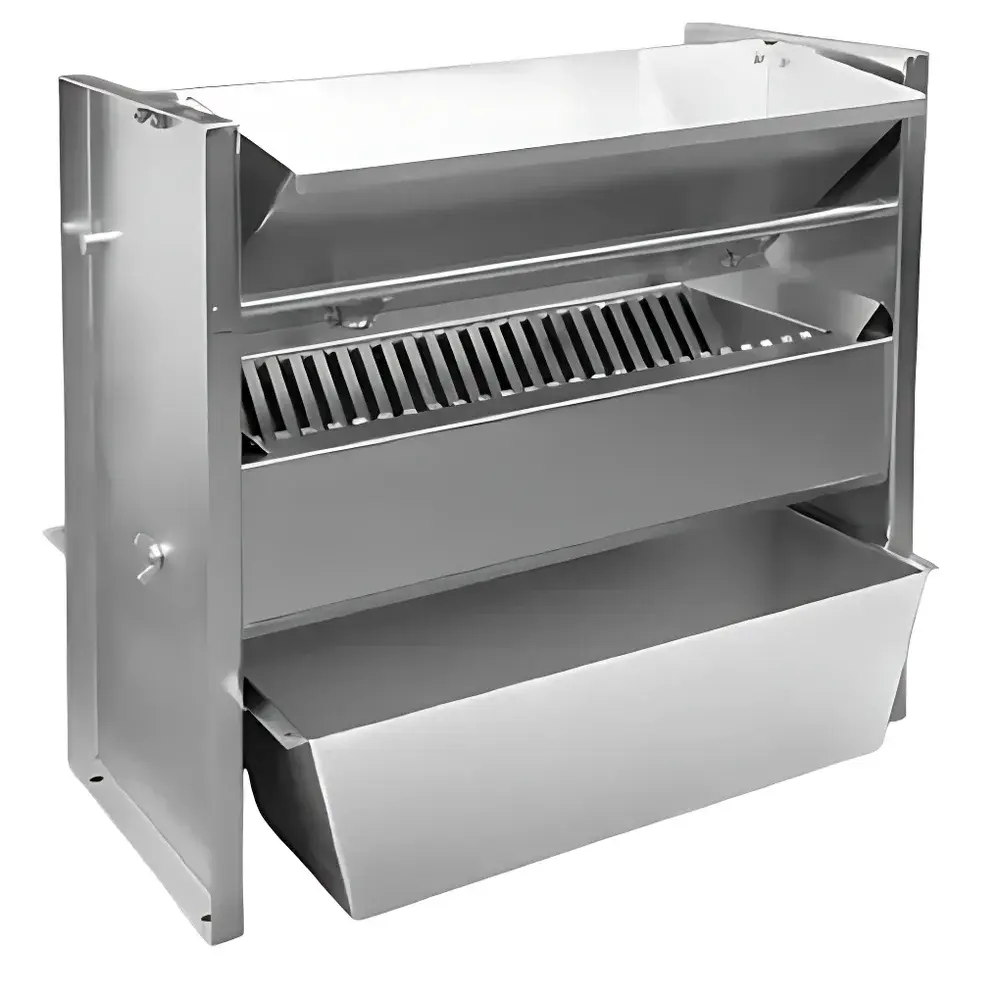
RETSCH RT 100 Grooved Sample Divider
| Brand | RETSCH |
|---|---|
| Origin | Germany |
| Model | RT 100 |
| Compliance | DIN 51701 |
| Sample Feed Type | Gravity-fed groove-based division |
| Adjustable Groove Width | Yes |
| Application Scope | Dry, free-flowing granular and powdered materials |
| Construction | Stainless steel body with wear-resistant grooved divider plate |
| Intended Use | Laboratory and field sampling for representative sub-sampling prior to particle size analysis, chemical assay, or quality control testing |
Overview
The RETSCH RT 100 Grooved Sample Divider is a precision mechanical sample splitting device engineered for reproducible, bias-free subdivision of dry, free-flowing bulk solids. It operates on the principle of gravitational sample distribution across a series of parallel, equally spaced grooves—each channel directing an identical volumetric portion of the feed material into separate collection vessels. This physical partitioning method ensures statistically representative sub-samples in accordance with DIN 51701, the German standard governing mechanical sample division for particulate materials. Unlike rotary or riffle dividers that may induce segregation by particle size or density, the RT 100’s fixed-groove geometry minimizes stratification effects during gravity-driven flow, making it particularly suitable for heterogeneous powders, granules, and coarse aggregates where compositional homogeneity must be preserved across split fractions.
Key Features
- Stainless steel construction with corrosion-resistant, wear-hardened groove plates for long-term dimensional stability and contamination control
- Manually adjustable groove width (typically ranging from 6 mm to 16 mm) to accommodate coarse feed materials such as gravel, seeds, slag, or cement clinker without bridging or jamming
- Modular base design enabling stable placement on laboratory benches or portable deployment in field environments (e.g., quarry sites, agricultural testing stations)
- No external power supply required—fully manual operation ensures intrinsic safety in explosive atmospheres (ATEX-compliant when used per manufacturer guidelines)
- Integrated sample guide funnel with adjustable height and centering mechanism to ensure centered feed onto the groove array, reducing edge effects and flow asymmetry
- Calibrated alignment system ensuring parallelism between groove rows and consistent channel depth across the full divider width
Sample Compatibility & Compliance
The RT 100 is validated for use with dry, non-cohesive, and moderately cohesive particulates having particle sizes ranging from ~100 µm to 25 mm. It is routinely employed for pre-analytical sample reduction prior to sieve analysis (ISO 9276, ASTM E11), chemical composition determination (ISO 12932, ASTM D3682), or moisture content measurement (ISO 11464). Its performance aligns with DIN 51701 requirements for relative standard deviation (RSD) ≤ 2% in replicate splits under defined operating conditions. While not intrinsically compliant with ISO/IEC 17025 accreditation requirements, the RT 100 supports GLP-aligned workflows when integrated into documented sampling SOPs—including operator training records, equipment calibration logs (groove width verification using certified gauge blocks), and split fraction traceability protocols.
Software & Data Management
As a purely mechanical instrument, the RT 100 does not incorporate embedded electronics, firmware, or digital interfaces. Consequently, it requires no software installation, firmware updates, or cybersecurity validation. All operational parameters—including groove width setting, feed rate estimation, and collection vessel labeling—are recorded manually in laboratory notebooks or electronic lab notebooks (ELNs) compliant with 21 CFR Part 11 when deployed in regulated environments (e.g., pharmaceutical excipient QC or fertilizer certification labs). Traceability is maintained through standardized metadata tagging: date/time, operator ID, lot number of original bulk sample, RT 100 serial number, groove width setting, and mass of each split fraction.
Applications
- Preparation of representative test portions from bulk shipments of agricultural commodities (e.g., wheat, soybeans, coffee beans) prior to mycotoxin screening or nutritional profiling
- Reduction of heterogeneous mineral ore samples prior to XRF or ICP-OES analysis in geochemical laboratories
- Sub-sampling of construction aggregates (sand, crushed stone, slag) for gradation testing per EN 933 or ASTM C136
- Division of metal powders used in additive manufacturing feedstock qualification, ensuring consistency across build cycles
- Field-based sampling of soil or sediment cores for environmental monitoring programs requiring chain-of-custody integrity
- Quality assurance of detergent powders, fertilizers, and food-grade starches where homogeneity verification is mandated by ISO 8586 or AOAC Official Methods
FAQ
Does the RT 100 require calibration certificates or periodic metrological verification?
Yes—while no electrical calibration is needed, groove width must be verified annually using traceable gauge blocks (e.g., certified to ISO/IEC 17025), and mechanical alignment should be checked before high-stakes sampling campaigns.
Can the RT 100 handle moist or slightly agglomerated materials?
No—it is strictly intended for dry, free-flowing materials. Hygroscopic or damp samples risk groove clogging and non-uniform flow; such materials require prior drying or alternative division methods (e.g., cone quartering under controlled humidity).
Is the RT 100 compatible with automated sample handling systems?
Not natively. However, its modular footprint and standardized mounting dimensions allow integration into custom-engineered sample preparation lines via pneumatic feed hoppers and robotic arm interfaces—subject to third-party engineering validation.
What documentation accompanies the RT 100 upon delivery?
A Declaration of Conformity (DIN 51701), CE marking certificate, stainless steel material test report (EN 10204 3.1), and detailed operating instructions including groove width adjustment procedure and cleaning protocol.
How many split fractions can be generated in a single pass?
The RT 100 produces two equal-mass fractions per operation; sequential re-splitting may be performed, though statistical guidance (e.g., ISO 3310-1 Annex B) recommends limiting cumulative splits to avoid cumulative error propagation.
Related Products



