
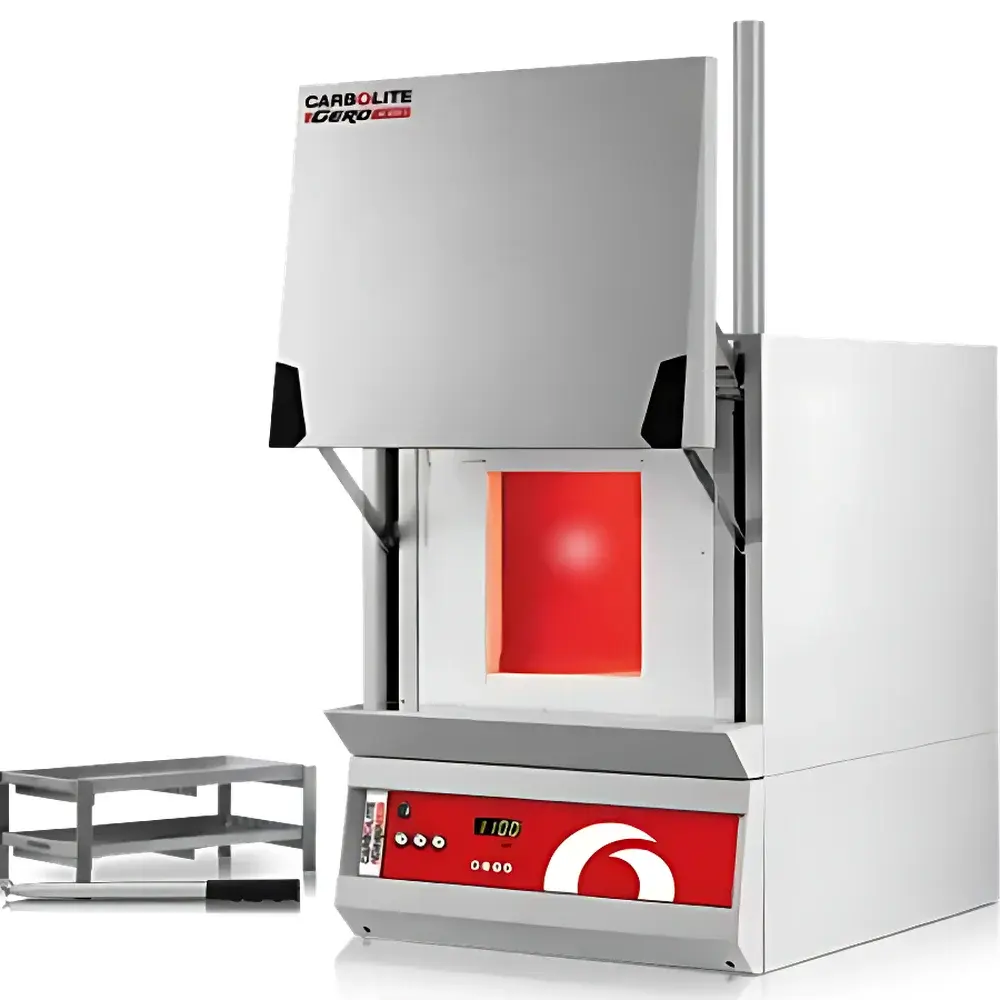
Carbolite Gero AAF 11/18 and AAF 12/18 Ashing Furnaces
| Brand | Carbolite Gero |
|---|---|
| Origin | Germany |
| Model | AAF 11/18 and AAF 12/18 |
| Maximum Temperature | 1100 °C (AAF 11/18) / 1200 °C (AAF 12/18) |
| Controller | PID301 single-segment programmable controller |
| Chamber Type | Box-type muffle furnace |
| Heating Configuration | Dual-side heating |
| Heating Element Protection | Silicon carbide felt sheathing |
| Air Preheating | Yes |
| Sample Capacity | Doubled via dual-tier sample support system with ergonomic handling handles |
| Application Scope | Ashing of foodstuffs, plastics, coal, and hydrocarbon-based materials |
Overview
The Carbolite Gero AAF 11/18 and AAF 12/18 are precision-engineered box-type muffle furnaces designed for controlled high-temperature ashing of organic and carbonaceous samples in analytical laboratories. Operating on the principle of complete oxidative decomposition—where volatile components are driven off under regulated airflow and elevated thermal conditions—these furnaces deliver consistent, reproducible residue quantification essential for gravimetric analysis. The AAF 11/18 achieves a maximum operating temperature of 1100 °C, while the AAF 12/18 extends capability to 1200 °C, enabling full combustion of refractory matrices including lignite, polymer composites, and mineralized biological tissues. Constructed in Germany to DIN EN ISO 9001-certified manufacturing standards, each unit integrates robust thermal architecture with process-critical safety and environmental controls.
Key Features
- Dual-side heating configuration ensures uniform temperature distribution across the entire working chamber (18 L internal volume), minimizing axial and radial thermal gradients—critical for ASTM D3174 (ash content in coal) and ISO 1171 (determination of ash in solid mineral fuels).
- Heating elements encapsulated in high-purity silicon carbide felt provide long-term resistance against chemical attack from carbon-rich volatiles and acidic combustion byproducts (e.g., SOx, Clx), significantly extending element service life compared to bare-wire or ceramic-sheathed alternatives.
- Integrated air preheating system introduces ambient air into the furnace chamber at elevated temperature, reducing thermal shock during sample loading and enhancing oxidation kinetics without compromising chamber integrity.
- PID301 programmable controller offers single-segment ramp-hold functionality with ±1 °C temperature stability over the full operating range, supporting GLP-compliant documentation when paired with optional data logging modules.
- Ergonomically designed dual-tier sample support system—including removable ceramic fiber trays and insulated handling tools—enables simultaneous processing of two independent sample batches, effectively doubling throughput without requiring additional footprint or energy input.
Sample Compatibility & Compliance
These furnaces accommodate standard crucibles (alumina, platinum, silica) up to 100 mL capacity and are validated for use with heterogeneous, high-moisture, or volatile-laden matrices—including dairy powders, municipal sludge, thermoset resins, and ASTM-standard coal reference materials. All models comply with IEC 61000-6-3 (EMC emissions), IEC 61000-6-2 (immunity), and meet essential requirements of the EU Machinery Directive 2006/42/EC. Optional CE-marked exhaust ducting kits enable connection to laboratory fume hoods in accordance with EN 14175-3, ensuring safe venting of CO, NOx, and particulate matter generated during ashing.
Software & Data Management
While the base PID301 controller operates as a standalone analog/digital hybrid interface, the AAF series supports seamless integration with Carbolite Gero’s optional PC-based control software (FurnaceLink™ v3.2). This platform enables remote monitoring, real-time temperature profiling, automated report generation (PDF/CSV), and audit-trail-enabled event logging compliant with FDA 21 CFR Part 11 requirements—including electronic signatures, user access levels, and immutable timestamped records. Data export is compatible with LIMS environments via OPC UA or Modbus TCP protocols.
Applications
- Quantitative ash determination in food and feed per AOAC 942.05 and ISO 2171.
- Residue analysis in pharmaceutical excipients and active ingredients (USP <281>).
- Calorific value correction in coal and coke testing (ASTM D5142, ISO 1928).
- Preparation of inorganic residues for subsequent elemental analysis (ICP-OES, XRF) following EPA Method 3050B.
- Thermal conditioning of catalyst supports and ceramic precursors in R&D settings.
FAQ
What distinguishes the AAF 11/18 from the AAF 12/18?
The primary difference lies in maximum operating temperature: the AAF 11/18 is rated to 1100 °C, whereas the AAF 12/18 reaches 1200 °C—making the latter suitable for ashing highly refractory polymers and siliceous geological samples.
Is furnace calibration traceable to national standards?
Yes—each unit ships with a factory calibration certificate traceable to PTB (Physikalisch-Technische Bundesanstalt), Germany’s national metrology institute, and includes provisions for on-site verification using Class 1 reference thermocouples.
Can these furnaces be used for calcination or heat treatment beyond ashing?
While optimized for ashing, both models support controlled calcination protocols within their respective temperature limits; however, extended dwell times above 1000 °C require validation of crucible compatibility and atmosphere control to prevent unintended reduction reactions.
What maintenance intervals are recommended for the heating elements?
Under typical ashing duty cycles (≤4 hr/day at ≤1100 °C), silicon carbide felt–protected elements require no scheduled replacement for ≥5 years; visual inspection every 6 months is advised to verify structural integrity of insulation layers.



