
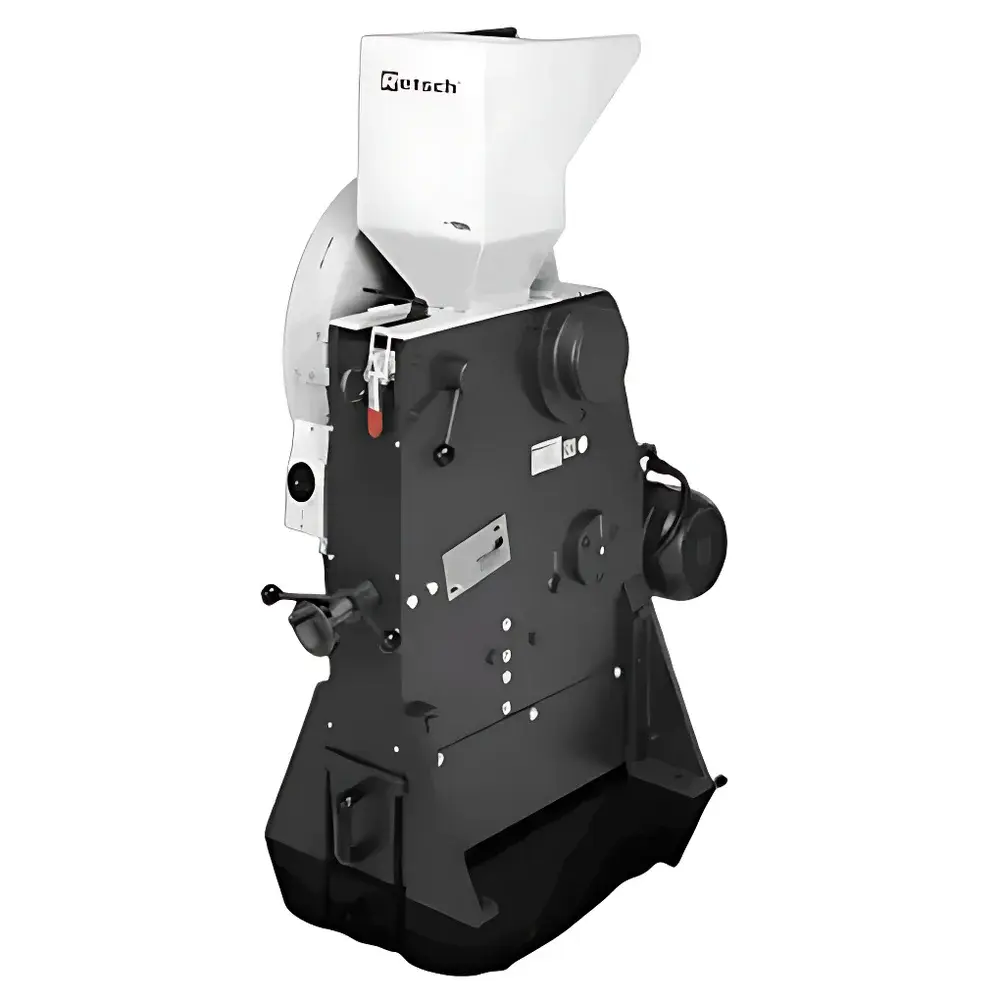
RETSCH BB 200 Jaw Crusher
| Brand | RETSCH |
|---|---|
| Origin | Germany |
| Model | BB 200 |
| Instrument Type | Jaw Crusher |
| Sample Applicability | Hard and Brittle Materials |
| Maximum Feed Size | < 90 mm |
| Final Particle Size | < 2 mm |
| Drive | Belt-driven Eccentric Shaft with Brake Motor |
| Lubrication | Lifetime Greased |
| Safety | Interlocked Feed Hopper with Splash Guard, Emergency Stop via Safety Switch |
| Compliance | CE, ISO 9001 Design Principles |
| Optional Configurations | Heavy-Metal-Free Version (Tungsten Carbide + Polymer-Lined Hopper), Semiconductor-Grade Variant |
Overview
The RETSCH BB 200 Jaw Crusher is an industrial-grade primary size reduction instrument engineered for reproducible, controlled comminution of hard, brittle, and tough materials. Operating on the principle of compressive crushing—where material is fed between two opposing jaws (one fixed, one movable) and subjected to high mechanical pressure—the BB 200 delivers consistent pre-grinding performance essential for downstream analytical workflows. Designed and manufactured in Haan, Germany, the unit complies with stringent CE marking requirements and adheres to ISO 9001 quality management standards throughout its engineering lifecycle. Its robust cast-iron frame, precision-machined jaw geometry, and dynamically balanced flywheel-equipped pulley system ensure stable operation at rated speed (typically 300–500 rpm), minimizing vibration and acoustic emissions during extended batch or continuous duty cycles.
Key Features
- Adjustable jaw gap with real-time zero-point recalibration: Integrated Belleville spring washers in the eccentric shaft assembly provide mechanical overload protection while enabling continuous gap compensation during operation to counteract jaw plate wear.
- Lifetime-lubricated drive system: Sealed-for-life bearings and permanently greased transmission components eliminate routine lubrication intervals, reducing maintenance downtime and contamination risk.
- Modular, tool-free access to grinding chamber: The hinged feed hopper detaches in under 60 seconds, allowing rapid visual inspection and residue-free cleaning—critical for cross-sample integrity in QA/QC laboratories.
- Interlocked safety architecture: A splash-guarded feed hopper prevents operator contact with moving parts; integrated safety switches cut power instantly upon hopper disengagement or unauthorized access.
- Material-flexible crushing surfaces: Five jaw plate and cheek plate material options—including manganese steel, stainless steel, tungsten carbide, heavy-metal-free steel, and polymer-lined configurations—support application-specific purity requirements (e.g., semiconductor-grade Si, trace-metal analysis of geological samples).
Sample Compatibility & Compliance
The BB 200 is validated for comminution of heterogeneous, high-hardness matrices including cement clinker (Mohs 5–6), quartz (Mohs 7), tungsten alloys (Vickers hardness >600 HV), coal (ASTM D3174 ash determination), granitic rock, ceramic oxides, and recycled construction aggregates. It meets sample preparation prerequisites defined in ASTM C110 (limestone and hydraulic cement), ISO 679 (cement testing), and USP <1174> (particle size reduction for pharmaceutical raw materials). For GLP/GMP-regulated environments, optional audit-trail-capable digital control modules (not standard) support 21 CFR Part 11-compliant operation when integrated with RETSCH’s software ecosystem.
Software & Data Management
While the BB 200 operates as a standalone electromechanical unit without embedded microprocessor controls, it is fully compatible with RETSCH’s optional SmartControl interface module (sold separately), which enables remote start/stop, runtime logging, cycle counting, and integration into LIMS via RS-232 or Ethernet. All mechanical settings—including jaw gap position, motor run time, and cumulative operating hours—are manually recorded per batch in accordance with laboratory SOPs. Calibration documentation, wear-part replacement logs, and preventive maintenance schedules align with ISO/IEC 17025 clause 6.4.10 for equipment traceability.
Applications
The BB 200 serves as a primary crusher in geochemical assay labs processing drill core fragments prior to XRF or ICP-MS digestion; in cement manufacturing QA labs reducing clinker nodules to ≤2 mm for Blaine fineness testing (EN 196-6); in recycling facilities preparing WEEE fractions for heavy metal leaching studies (EN 12457); and in R&D centers developing novel refractory ceramics requiring homogenized starting powders. Its continuous-feed capability—when paired with conveyor-linked discharge systems—enables integration into pilot-scale mineral beneficiation lines for real-time process monitoring.
FAQ
What is the maximum feed size the BB 200 can accept?
The BB 200 accepts feed particles up to 90 mm in largest dimension, provided they are free-flowing and non-fibrous.
Can the BB 200 be used for moisture-sensitive samples?
Yes—provided ambient humidity is controlled and hygroscopic samples are processed under inert gas purge (optional accessory hood available).
Is the BB 200 suitable for food-grade applications?
Only when configured with FDA-compliant stainless steel jaw plates and operated under validated cleaning protocols (e.g., ATP swab verification post-cleaning).
How often should jaw plates be replaced?
Replacement frequency depends on throughput and material abrasivity; typical service life ranges from 500–2,000 kg of granite-equivalent feed under standard operating conditions.
Does RETSCH provide validation documentation for GMP use?
Yes—IQ/OQ documentation packages, including dimensional verification reports, torque calibration certificates, and mechanical safety test records, are available upon request for regulated environments.



