
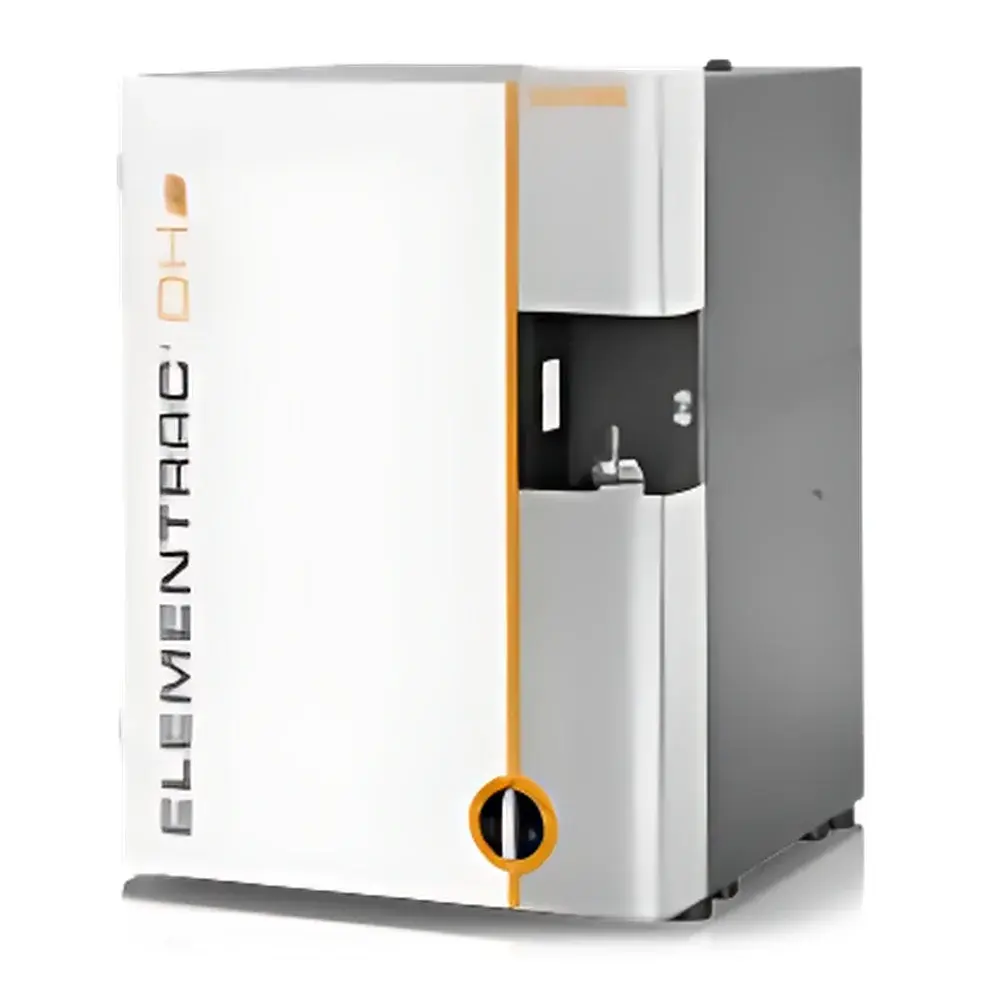
ELTRA ELEMENTRAC ONH-p 2 Oxygen/Nitrogen/Hydrogen Analyzer
| Brand | ELTRA |
|---|---|
| Origin | Germany |
| Model | ELEMENTRAC ONH-p 2 |
| Analysis Time | 120–180 s |
| Carrier Gas Options | Helium (standard), Argon (optional) |
| Detection Principle | IR absorption for O (as CO₂), TCD for N₂ and H₂ |
| Sample Mass Range | 1 mg to 2,000 mg |
| Maximum Furnace Power | 8.5 kW |
| Compliance | Designed for GLP/GMP environments |
Overview
The ELTRA ELEMENTRAC ONH-p 2 is a high-precision inert gas fusion elemental analyzer engineered for the quantitative determination of oxygen (O), nitrogen (N), and hydrogen (H) in solid inorganic materials. It operates on the principle of high-temperature inert gas fusion (up to 3,000 °C), where the sample is thermally decomposed in a graphite crucible under a controlled helium or argon atmosphere. Released gaseous species—CO (from oxygen), N₂, and H₂—are swept through a closed-loop gas circuit and quantified using dual infrared (IR) detectors for oxygen (after catalytic oxidation of CO to CO₂) and a high-sensitivity thermal conductivity detector (TCD) for nitrogen and hydrogen. The fully sealed gas path ensures quantitative transfer of evolved gases to detectors, delivering exceptional sensitivity (sub-ppm detection limits), high reproducibility (<0.5% RSD for certified reference materials), and minimal carrier gas consumption—critical for laboratories operating under cost and sustainability constraints.
Key Features
- Integrated high-power induction furnace (up to 8.5 kW) enabling rapid, uniform heating up to 3,000 °C for complete decomposition of refractory metals, ceramics, and carbides.
- Pulse-degassing sample inlet: Removes ambient air from the sample chamber prior to drop, eliminating atmospheric O/N/H contamination and improving baseline stability—especially critical for low-level hydrogen analysis.
- Modular gas detection architecture: Dual IR cells for oxygen (measured as CO₂ post-catalysis); variable-length TCD cells optimized separately for N₂ and H₂, enhancing selectivity and dynamic range.
- Front-access consumables panel: All chemical reagents (e.g., CuO catalyst, desiccants, CO-to-CO₂ oxidant) and filters are housed behind a removable door—reducing maintenance downtime and supporting routine service without system disassembly.
- Graphite crucible-based analysis with integrated CuO catalyst: Ensures complete oxidation of CO to CO₂ for accurate oxygen quantification—even in oxide-rich or complex matrices such as slag, ferroalloys, and sintered ceramics.
- No nickel capsule sealing required for powder analysis: Direct introduction of unsealed Ni capsules enables rapid throughput and eliminates operator error associated with crimping or welding steps.
Sample Compatibility & Compliance
The ELEMENTRAC ONH-p 2 accommodates diverse physical forms—including rods, chips, granules, and powders—with a maximum sample mass of 2,000 mg. It delivers reliable results across metallurgical, geological, and advanced ceramic applications: stainless steels, titanium alloys, silicon carbide, tungsten heavy alloys, iron ores, furnace slags, and high-purity silicon. The system is designed to meet international standards for elemental analysis workflows, including ASTM E1019 (Standard Test Methods for Determination of Carbon, Sulfur, Nitrogen, and Oxygen in Steel, Iron, Nickel, and Cobalt Alloys), ISO 14284 (Steel—Sampling and preparation of samples for determination of chemical composition), and USP (Elemental Impurities—Procedures). When operated with ELEMENTS software v4.0 or later and configured with user access controls, audit trail logging, and electronic signature capability, the system complies with FDA 21 CFR Part 11 requirements for regulated pharmaceutical and medical device manufacturing environments.
Software & Data Management
ELEMENTS is a Windows-based, modular analytical software platform developed exclusively for ELTRA analyzers. Its intuitive interface centers on a unified analysis workspace, where users initiate runs, group samples by batch or project, and export results directly to LIMS via ASTM E1382-compliant ASCII or XML formats. Calibration management includes multi-point linear and quadratic regression with residual error reporting, drift correction, and bracketing options. Diagnostic tools monitor furnace temperature stability, gas flow integrity, detector signal-to-noise ratios, and catalyst activity—providing real-time feedback for preventive maintenance. All analytical events—including method changes, calibration updates, user logins, and result modifications—are time-stamped and logged with immutable audit trails. Optional integration with laboratory information systems supports automated report generation, statistical process control (SPC) charting, and compliance-ready documentation packages.
Applications
The ELEMENTRAC ONH-p 2 serves as a core instrument in quality control laboratories for primary metal producers, foundries, aerospace material suppliers, and R&D centers developing next-generation alloys and functional ceramics. Typical use cases include: verification of interstitial gas content in vacuum-melted superalloys; monitoring hydrogen embrittlement risk in titanium and high-strength steels; quantifying residual oxygen in electronic-grade silicon wafers; certifying nitrogen levels in nitrided tool steels; and assessing nitrogen pickup during powder metallurgy sintering. Its ability to analyze O, N, and H individually—or simultaneously in ON, OH, NH, or full ONH configurations—enables flexible method development aligned with material specification requirements (e.g., AMS 2301, DIN EN 10260, JIS G 0321).
FAQ
What carrier gases are supported, and how do they affect detection sensitivity?
Helium is the standard carrier gas for optimal TCD response and fast gas exchange. Argon is available as an economical alternative for ON analysis but reduces H₂ sensitivity due to lower thermal conductivity contrast—making helium preferred for sub-10 ppm hydrogen measurements.
Can the instrument be used for single-element analysis only?
Yes. The system can be configured to measure oxygen only, nitrogen only, hydrogen only, or any two-element combination (ON, OH, NH) without hardware modification—software-selectable methods define detector activation and calibration curves.
Is the automatic cleaner compatible with all sample types?
The optional auto-cleaner is recommended for high-throughput labs analyzing >20 samples/day of carbon-rich materials (e.g., cast iron, ferrochromium), where electrode and furnace sooting compromises long-term reproducibility. It performs in situ carbon removal between runs without interrupting workflow.
How does the pulse-degassing inlet improve measurement accuracy?
By evacuating ambient air from the sample chamber immediately before drop-in, the inlet minimizes dilution of evolved gases and prevents false high readings—particularly essential for hydrogen analysis where atmospheric moisture interference is a known source of bias.
What maintenance intervals are recommended for the CuO catalyst and IR cell windows?
Under typical usage (50–100 analyses/week), the CuO catalyst requires replacement every 6–12 months; IR cell windows should be inspected quarterly and cleaned with spectroscopic-grade methanol if signal attenuation exceeds 5% over baseline—both procedures are guided step-by-step in the ELEMENTS diagnostics module.




