
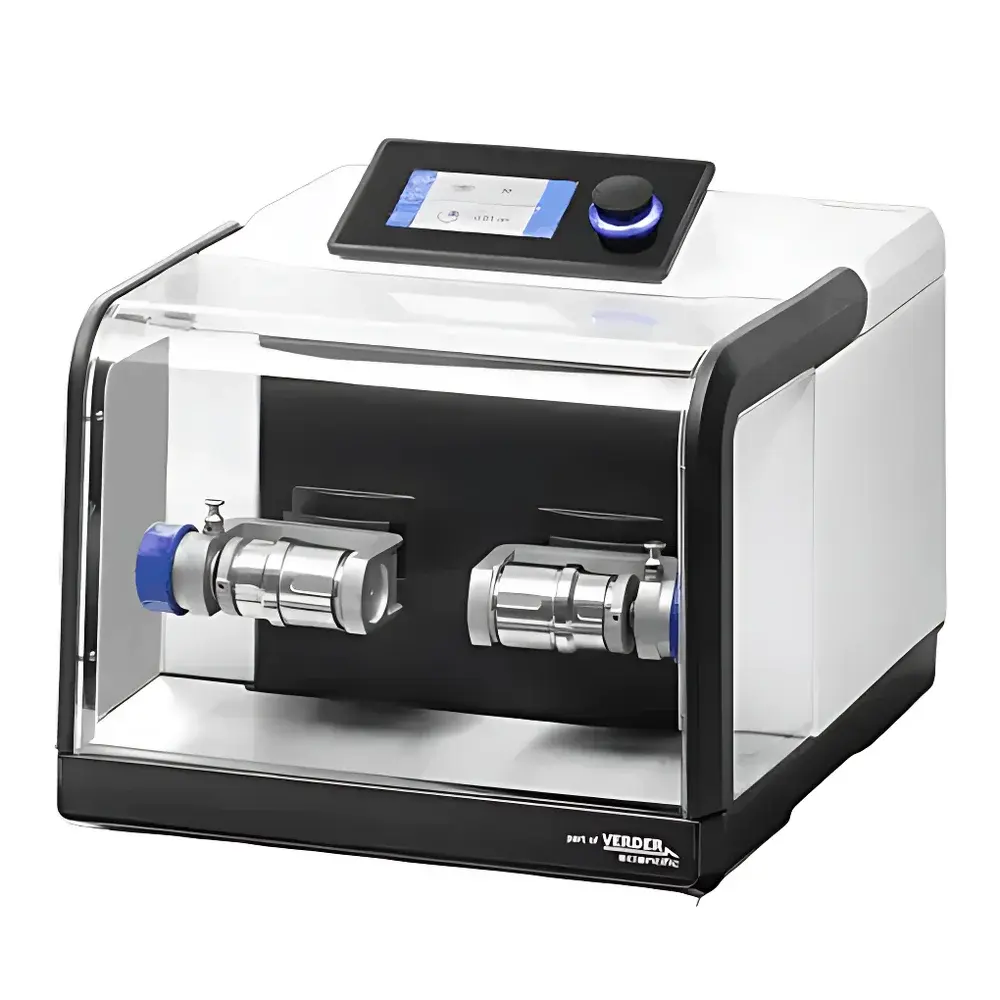
RETSCH MM 400 Cryo-Mixing Mill
| Brand | RETSCH |
|---|---|
| Origin | Germany |
| Model | MM 400 |
| Grinding Principle | High-Energy Vibratory Milling |
| Sample Type | Soft to Medium-Hard Materials |
| Feed Size | ≤ 8 mm |
| Final Particle Size | ~5 µm |
| Batch Capacity | max. 2 × 20 mL |
| Operating Frequency | 30 Hz |
| Processing Time Range | 0.01–99 h |
| Cooling Compatibility | Liquid Nitrogen Cryo-Grinding Enabled |
| Compliance | CE, ISO 9001,符合GLP-ready laboratory workflows |
Overview
The RETSCH MM 400 Cryo-Mixing Mill is a high-performance vibratory ball mill engineered for rapid, reproducible size reduction and homogenization of small-volume samples under controlled thermal conditions. Utilizing high-frequency oscillatory motion (30 Hz), the instrument subjects grinding jars to intense inertial forces that accelerate grinding media—typically stainless steel or tungsten carbide balls—against the sample material. This mechanism enables efficient comminution via impact, friction, and shear, making it especially effective for soft, fibrous, or temperature-sensitive materials including biological tissues, polymers, pharmaceutical excipients, and organic compounds. Unlike rotary or planetary mills, the MM 400’s single-axis vertical vibration architecture minimizes mechanical complexity while maximizing energy transfer efficiency per cycle. Its cryogenic capability—enabled by liquid nitrogen-cooled grinding jars—preserves thermolabile analytes (e.g., enzymes, nucleic acids, metabolites) during processing, supporting applications in molecular biology, mechanochemistry, and pre-analytical sample preparation for HPLC, XRD, or SEM.
Key Features
- High-energy vibratory drive delivering consistent 30 Hz oscillation with programmable amplitude control
- Cryo-compatible design supporting liquid nitrogen cooling for sub-zero grinding (−196 °C) without condensation or jar fracture
- Dual-jar configuration enabling parallel processing of two independent 20 mL samples with identical parameters
- Precision digital timer with resolution down to 0.01 seconds and maximum duration up to 99 hours for extended mechanochemical reactions
- Interchangeable grinding jars (stainless steel, hardened steel, tungsten carbide, agate, PTFE-lined) optimized for contamination control and chemical resistance
- Integrated safety interlock system preventing operation when lid is unlatched or jars are improperly seated
- Low-noise housing with vibration-dampening feet compliant with ISO 5349-1 for laboratory ergonomic standards
Sample Compatibility & Compliance
The MM 400 accommodates a broad spectrum of sample types—including plant tissue, microbial pellets, freeze-dried proteins, soft metals, and polymer blends—with feed sizes up to 8 mm and final particle distributions centered at approximately 5 µm (D50). It meets CE marking requirements and adheres to ISO 9001 quality management protocols. For regulated environments, its repeatable process parameters, non-volatile memory retention, and operator-accessible audit logs support GLP/GMP-aligned workflows. While not intrinsically 21 CFR Part 11 compliant, the instrument’s deterministic timing, fixed parameter sets, and manual logbook integration facilitate traceability required for FDA-submitted analytical method validation packages.
Software & Data Management
The MM 400 operates via an intuitive front-panel interface with tactile buttons and LCD display; no external PC or proprietary software is required for routine operation. All settings—including frequency, time, pause intervals, and start/stop sequences—are stored in non-volatile memory and recalled across power cycles. Optional data export (via RS-232 or USB-to-serial adapter) allows timestamped logging of run parameters into LIMS or Excel-based QA records. The absence of embedded operating systems eliminates cybersecurity vulnerabilities associated with networked instruments, aligning with IT security policies common in academic core facilities and contract research organizations.
Applications
- Mechanochemical synthesis of metal–organic frameworks (MOFs) and co-crystals without solvents
- Preparation of homogeneous powder blends for tablet formulation development
- Rapid lysis of mammalian cells and bacterial cultures for RNA/DNA extraction protocols
- Particle size reduction of pharmaceutical APIs prior to dissolution testing (USP <711>)
- Homogenization of heterogeneous geological or environmental samples prior to XRF or ICP-MS analysis
- Cryogenic milling of rubber or elastomers for TEM sample thinning and dispersion stability studies
FAQ
Can the MM 400 grind hard or abrasive materials such as ceramics or silicon carbide?
No—the MM 400 is optimized for soft to medium-hard samples (Mohs hardness ≤ 6). Harder materials require planetary ball mills (e.g., RETSCH PM 100) or jaw crushers for primary size reduction.
Is it possible to achieve sub-micron particle size with the MM 400?
While typical D50 values range around 5 µm, extended processing times (>60 min) combined with cryogenic conditions and high-density grinding media may yield distributions approaching 1–2 µm for select organics; however, true nanoscale comminution (<100 nm) is outside its design envelope.
Does the instrument support automated sample feeding or unloading?
No—it is a batch-operated manual loader. Sample introduction and retrieval must be performed manually between runs, consistent with ISO 13320 laser diffraction sample handling conventions.
What maintenance is required for long-term reliability?
Annual inspection of spring suspension mounts and drive shaft alignment is recommended; grinding jars and balls should be cleaned ultrasonically after each use to prevent cross-contamination and wear-induced dimensional drift.



