
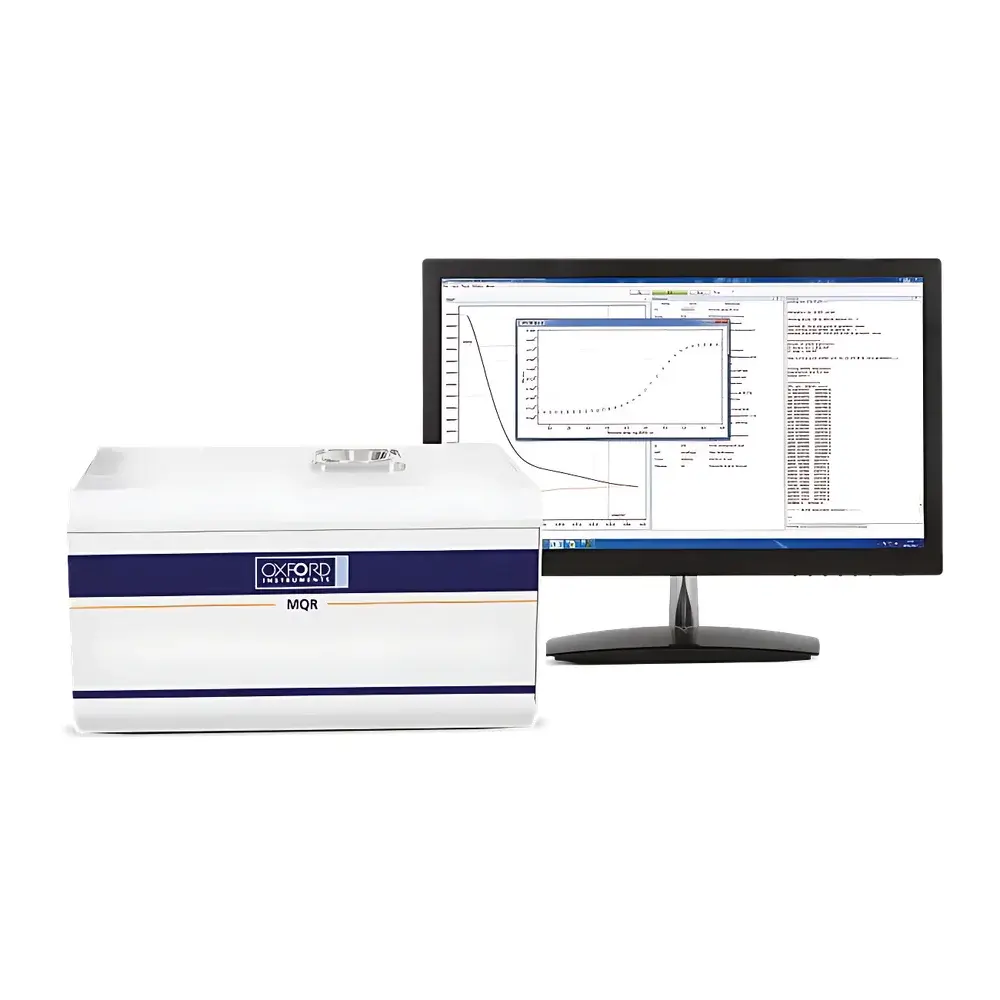
Oxford Instruments MQR Time-Domain Nuclear Magnetic Resonance Spectrometer
| Brand | Oxford Instruments |
|---|---|
| Origin | United Kingdom |
| Model | MQR |
| Field Strength | 0.54 T (23 MHz ¹H) |
| Operating Frequency | 23 MHz (¹H) |
| Probe Options | 10 mm, 18 mm, 26 mm diameter |
| Sample Compatibility | Solid and liquid samples (dual-phase) |
| Pulse Sequence Capability | User-programmable via Application Developer software |
| Gradient Options | Bipolar PFG (1D), 3-axis PFG (MRI-capable) |
| Temperature Control | Optional VT probe |
| Data Analysis | 1D/2D inverse Laplace transform, T₁/T₂/D diffusion correlation, phase-resolved component analysis |
| Software Environment | Open-data architecture with Python-compatible API |
| Compliance | Designed for GLP/GMP-aligned workflows |
Overview
The Oxford Instruments MQR is a benchtop time-domain nuclear magnetic resonance (TD-NMR) spectrometer engineered for quantitative, non-destructive characterization of molecular dynamics in heterogeneous materials. Operating at a fixed Larmor frequency of 23 MHz (corresponding to a 0.54 T static magnetic field), the system employs pulsed NMR techniques—including spin-echo (CPMG), inversion-recovery, and stimulated-echo sequences—to extract fundamental relaxation parameters (T₁, T₂, T₁ρ) and translational diffusion coefficients (D). Unlike high-field NMR systems optimized for chemical shift resolution, the MQR prioritizes robustness, reproducibility, and accessibility in industrial QC, polymer science, food quality control, pharmaceutical solid-state analysis, and petrophysics. Its permanent magnet architecture ensures stable field homogeneity without cryogens or active shimming, while its digital spectrometer core delivers sub-microsecond timing precision and low dead-time acquisition—critical for resolving short-T₂ components (<100 µs) in rigid polymers, hydrated soils, or porous catalysts.
Key Features
- Integrated 0.54 T permanent magnet with passive shimming—zero helium consumption, minimal infrastructure requirements
- Digital spectrometer with 23 MHz ¹H channel, <100 ns RF pulse width resolution, and <500 ns dead time for accurate short-T₂ quantification
- Modular probe selection: 10 mm (high-SNR for small-volume liquids), 18 mm (general-purpose), and 26 mm (bulk solids, emulsions, or packaged goods)
- Application Developer software suite—a fully integrated, scriptable environment supporting Python-based pulse sequence design, real-time parameter tuning, and on-the-fly visualization
- Expandable gradient capability: optional bipolar 1D PFG for diffusion-ordered spectroscopy (DOSY)-equivalent analysis; 3-axis PFG module enabling basic MRI reconstruction (e.g., spatial mapping of moisture distribution)
- Optional variable-temperature (VT) probe with ±10 °C to +80 °C range, calibrated for thermal stability during T₁ρ or activation-energy studies
- Open data architecture: raw FID and processed datasets exported in HDF5 or ASCII formats; compatible with third-party analysis tools (MATLAB, Origin, custom Python pipelines)
Sample Compatibility & Compliance
The MQR accommodates diverse sample geometries and physical states without destructive preparation: intact tablets, sealed vials, packed powders, gels, emulsions, and even small-format packaged foods. Its low-field design minimizes susceptibility artifacts at phase boundaries—enabling reliable T₂ distribution analysis across solid–liquid interfaces (e.g., bound vs. free water in starch gels or hydrate phases in cement paste). The system complies with ISO/IEC 17025 documentation standards for method validation and supports audit-ready operation under GLP and GMP frameworks. All pulse sequence parameters, calibration logs, and user actions are timestamped and exportable—meeting traceability requirements outlined in FDA 21 CFR Part 11 for regulated environments.
Software & Data Management
Data acquisition and processing occur within a dual-layer software ecosystem. The core MQR Console provides intuitive, real-time monitoring of signal decay, echo trains, and preliminary T₂ spectra—with immediate feedback during parameter optimization. The Application Developer package extends functionality through a Python API, allowing users to implement custom excitation schemes (e.g., adiabatic pulses, composite 90°–180°–90° blocks), embed real-time calculations (e.g., iterative T₂ inversion within acquisition loops), and generate reusable sequence libraries. Built-in analysis modules include mono- and multi-exponential curve fitting, 1D inverse Laplace transformation (non-negative least-squares algorithm), and 2D T₂–D correlation mapping. Advanced add-ons support phase-resolved decomposition (e.g., separating oil/water signals in emulsions) and constrained 2D inversion with regularization constraints for ill-conditioned datasets.
Applications
- Pharmaceuticals: Quantifying amorphous content in lyophilized formulations, monitoring hydration state changes during stability testing, and assessing excipient–API miscibility via T₁ρ dispersion profiles
- Food Science: Measuring fat crystallinity kinetics in chocolate, determining moisture mobility in cereal matrices, and evaluating emulsion stability through diffusion–relaxation correlation maps
- Polymers & Composites: Characterizing crosslink density in rubbers (via T₂ distribution width), tracking solvent diffusion in membranes, and detecting microvoid formation during thermal cycling
- Petrophysics: Estimating porosity, permeability, and fluid saturation in rock core plugs using T₂ cutoff models validated against mercury intrusion porosimetry
- Materials R&D: In situ monitoring of curing reactions in thermosets, analyzing pore-size distributions in MOFs and aerogels, and distinguishing surface-bound vs. bulk-phase species in functionalized nanoparticles
FAQ
What is the minimum detectable T₂ value with the MQR system?
The system achieves effective T₂ detection down to ~20–50 µs depending on probe selection, RF power, and signal averaging—enabled by its low dead time and high dynamic range digitizer.
Can the MQR be used for quantitative moisture analysis in hygroscopic powders?
Yes. Its T₂-weighted signal intensity correlates linearly with proton density when calibrated against gravimetric standards, and the 26 mm probe accommodates standard 10–20 g powder samples in sealed containers.
Is method transfer possible from high-field NMR to the MQR platform?
While chemical shift information is not resolved, relaxation- and diffusion-based methods (e.g., CPMG-based moisture mapping or PFG-based self-diffusion assays) demonstrate strong inter-platform reproducibility when standardized per ASTM D8143 or ISO 17892-12 protocols.
Does the system support automated batch analysis for QC labs?
Yes—via scripting in Application Developer, users can define sequence templates, auto-load calibration files, trigger external peripherals (e.g., autosamplers), and generate PDF reports compliant with internal SOPs.
What maintenance is required for long-term operational stability?
Annual field homogeneity verification and RF calibration are recommended; no cryogen refills, vacuum pumps, or superconducting magnet quench management are involved due to the permanent magnet design.



