
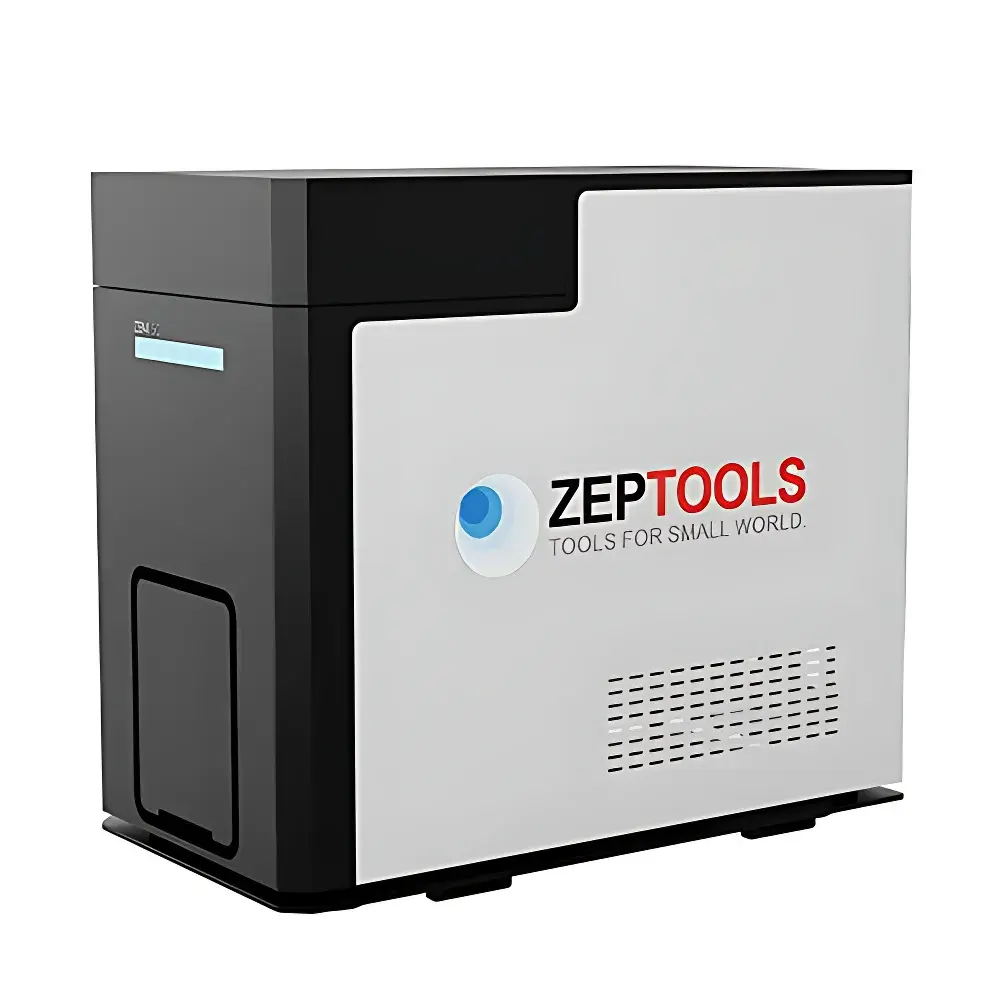
ZEPTOOLS ZEM15C Desktop Scanning Electron Microscope
| Brand | ZEPTOOLS |
|---|---|
| Origin | Anhui, China |
| Model | ZEM15C |
| Instrument Type | Desktop SEM |
| Electron Source | Pre-aligned Tungsten Filament |
| Maximum Accelerating Voltage | 15 kV |
| Backscattered Electron (BSE) Resolution | <10 nm |
| Standard Detectors | BSE, SE |
| Magnification | Up to 150,000× |
| Sample Exchange Time | 90 s |
| Vacuum Mode | High Vacuum |
| Stage Movement | 2-axis Manual |
| Integrated Optical Navigation Camera | Yes |
| Detector Configuration | Dual-detector (Secondary Electron + Backscattered Electron) |
Overview
The ZEPTOOLS ZEM15C is a compact, high-performance desktop scanning electron microscope (SEM) engineered for precision nanoscale imaging in resource-constrained or space-limited laboratory environments. Utilizing a thermionic tungsten filament electron source with factory pre-alignment, the ZEM15C delivers stable beam current and consistent signal-to-noise performance without requiring routine filament alignment by the user. Its operation is based on raster-scanning a focused electron beam across conductive or coated non-conductive samples under high vacuum conditions (typically <1 × 10⁻³ Pa), with secondary electron (SE) and backscattered electron (BSE) signals collected simultaneously to generate topographic and compositional contrast images. Designed for accessibility without compromise, the ZEM15C achieves a verified BSE resolution of <10 nm at 15 kV — meeting the imaging requirements of academic teaching labs, quality control facilities, and early-stage R&D teams working in materials science, battery electrode characterization, polymer morphology analysis, and semiconductor packaging inspection.
Key Features
- Pre-aligned tungsten filament architecture: Eliminates the need for periodic filament centering; reduces operational downtime and extends filament lifetime under standard operating conditions.
- Integrated optical navigation camera: Provides real-time macro-scale sample positioning, enabling rapid region-of-interest selection prior to SEM imaging — significantly reducing time-to-data.
- Two-axis manual stage with mechanical feedback: Offers precise, tactile-controlled movement over defined X/Y ranges; optimized for repeatable positioning during multi-site analysis workflows.
- High-vacuum system with automated pump-down sequence: Achieves operational vacuum in ≤90 seconds post-chamber closure, supporting rapid sample turnover without external turbomolecular pump dependency.
- Dual-detector acquisition: Simultaneous capture of SE (surface topology) and BSE (atomic number contrast) signals enables immediate comparative analysis — critical for phase identification in heterogeneous composites or failure analysis of solder joints.
- Space-efficient footprint: Dimensions compatible with standard 750 mm-wide laboratory benches; no dedicated vibration-isolation table required due to built-in passive damping design.
Sample Compatibility & Compliance
The ZEM15C accommodates specimens up to 50 mm in diameter and 30 mm in height, including bulk metals, ceramics, polymers, geological sections, and biological tissues (after appropriate conductive coating). Non-conductive samples are routinely imaged using sputter-coated Au/Pd or carbon layers (5–15 nm thickness). The instrument complies with IEC 61000-6-3 (EMC emission standards) and IEC 61010-1 (safety requirements for electrical equipment for measurement, control, and laboratory use). While not certified to ISO/IEC 17025 for accredited testing, its hardware stability and software audit trail functionality support GLP-compliant documentation practices when integrated into validated lab workflows.
Software & Data Management
The proprietary ZEMControl software suite provides full instrument control via intuitive graphical interface — fully localized in English and Chinese. It supports parameter scripting, batch acquisition protocols, image annotation with scale bar embedding, and direct export of TIFF/RAW files for third-party quantitative analysis (e.g., ImageJ, MATLAB, or commercial EDS integration modules). All session metadata — including kV, probe current, dwell time, detector gain, and stage coordinates — are automatically logged with each acquired image. Audit-trail features record user login, parameter changes, and acquisition timestamps, facilitating traceability in regulated environments aligned with FDA 21 CFR Part 11 principles (when deployed with network authentication and electronic signature modules).
Applications
- Characterization of cathode/anode microstructures in lithium-ion battery research
- Morphological assessment of electrospun nanofibers and porous membrane scaffolds
- Failure analysis of microelectronic interconnects and PCB solder joints
- Particle size distribution and agglomeration behavior in catalyst powders
- Fractography of composite laminates and additive-manufactured metal parts
- Educational demonstration of electron-sample interaction mechanisms (e.g., SE/BSE yield dependence on tilt angle and atomic number)
FAQ
What vacuum level does the ZEM15C achieve, and how is it maintained?
The system reaches high vacuum (<1 × 10⁻³ Pa) using a dual-stage rotary vane pump coupled with a cold trap; no liquid nitrogen or turbo pump is required.
Can the ZEM15C be used for energy-dispersive X-ray spectroscopy (EDS)?
Yes — the chamber includes standardized ports and electrical feedthroughs compatible with third-party EDS detectors; integration requires separate detector purchase and software synchronization.
Is training provided for new users?
ZEPTOOLS offers remote and on-site operator certification programs covering vacuum safety, basic imaging optimization, detector selection, and report generation — typically completed within one business day.
How often must the tungsten filament be replaced?
Under typical usage (4–6 hours/day at 15 kV), filament lifetime averages 120–180 hours; replacement is user-performed in <5 minutes using supplied tools and alignment jig.
Does the ZEM15C support motorized stage or automated mapping?
The base ZEM15C configuration includes manual stage control; optional motorized XY stage and stage auto-calibration module are available as field-upgradable accessories.





