
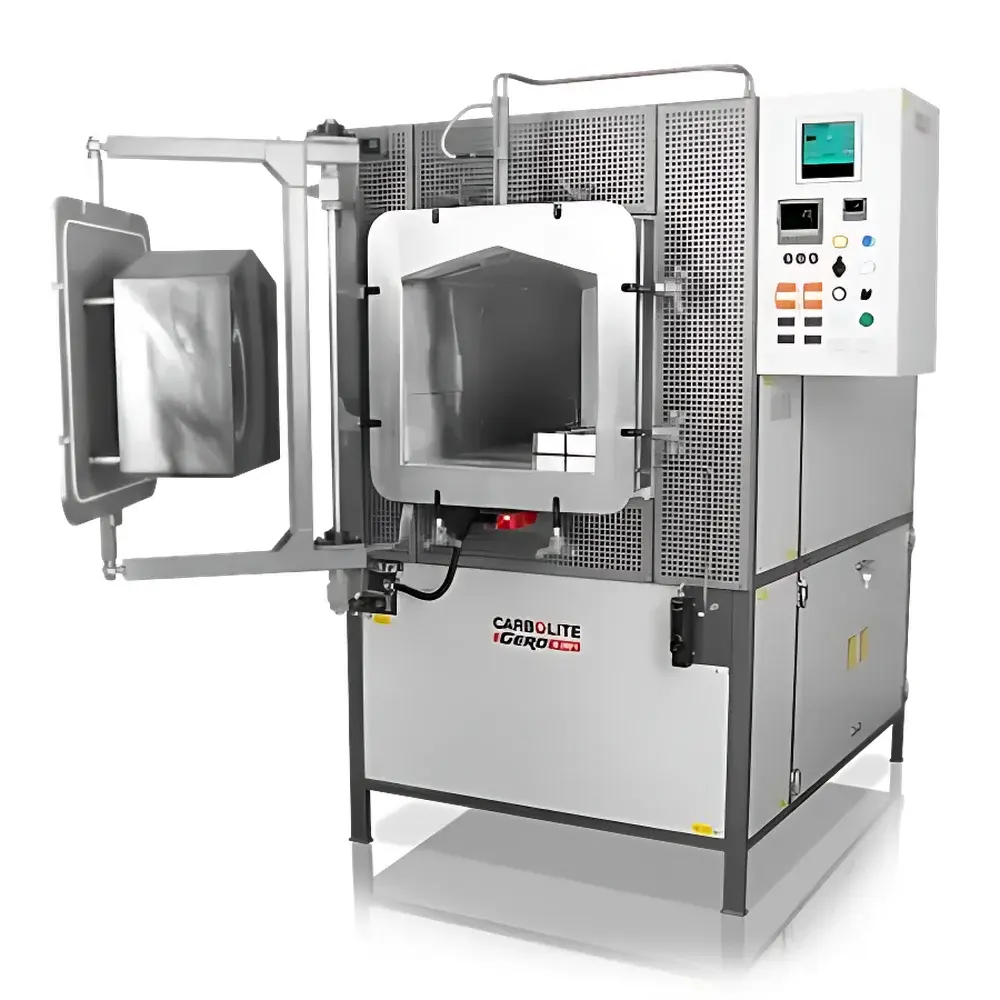
Carbolite Gero GPCMA Controlled-Atmosphere Box Furnace
| Brand | Carbolite Gero |
|---|---|
| Origin | Germany |
| Model | GPCMA |
| Furnace Type | Horizontal Box Furnace |
| Maximum Operating Temperature (dependent on chamber material) | 1000 °C (310 stainless steel), 1050 °C (314 stainless steel), 1100 °C (Inconel 601), 1150 °C (Haynes 230) |
| Chamber Volume Options | 37, 56, 117, 174, 208, 245 L |
| Control System | 3508P1 Programmable Controller with Dual-Zone Cascade Regulation |
| Over-Temperature Protection | Independent Safety Circuit |
| Atmosphere Compatibility | N₂, Ar (semi-automatic analog mass flow control) |
| Heating Configuration | Triple-sided (side + top + bottom) radiant heating elements (37 L variant: side + bottom only) |
| Insulation | Low-density, high-efficiency ceramic fiber modules |
| Door Design | Dual-axis counterbalanced hinge with water-cooled silicone gasket and mechanical safety lock |
| Thermocouples | R-type (control), K-type (process chamber monitoring) |
Overview
The Carbolite Gero GPCMA is a precision-engineered controlled-atmosphere box furnace designed for repeatable thermal processing under inert or reducing gas environments. Built upon Carbolite Gero’s legacy of German engineering excellence, the GPCMA employs a robust horizontal chamber architecture optimized for uniform temperature distribution, rapid thermal response, and long-term stability in demanding laboratory and pilot-scale applications. Its core operating principle relies on resistive radiant heating via high-grade Kanthal® or similar alloy heating elements strategically distributed across multiple furnace surfaces—ensuring minimal thermal gradients and high spatial homogeneity (±2 °C at setpoint across working volume per ASTM E220). The furnace supports programmable multi-step thermal profiles under continuous gas purging, making it suitable for sintering, annealing, calcination, ashing, and heat treatment processes where oxygen exclusion or precise partial pressure control is critical.
Key Features
- Triple-zone heating configuration (side, top, and bottom elements) — standard on all volumes ≥56 L; 37 L variant features side + bottom heating to maintain compact footprint without compromising uniformity
- Dual-zone cascade temperature control via the 3508P1 programmable controller, enabling independent regulation of main chamber and door/transition zone temperatures to minimize thermal lag and improve ramp fidelity
- Independent over-temperature protection circuit with redundant R-type thermocouple input, compliant with EN 60519-1 safety requirements for industrial heating equipment
- Water-cooled silicone elastomer door seal integrated into a dual-axis counterbalanced hinge mechanism — maintains integrity up to 1150 °C while positioning the hot face >300 mm from operator access plane
- Lightweight, low-conductivity ceramic fiber insulation (density <200 kg/m³) achieving surface temperatures <55 °C at ambient conditions — certified per ISO 22007-2 for thermal conductivity performance
- Semi-automatic inert gas management system with analog mass flow meters for N₂ and Ar, supporting purge rate adjustment from 0.5 to 20 L/min with visual flow indication and leak-tested manifold connections
Sample Compatibility & Compliance
The GPCMA accommodates a wide range of sample geometries and crucible types—including alumina, quartz, graphite, and molybdenum—within its six standard internal volume configurations (37–245 L). Chamber linings are interchangeable based on maximum process temperature requirements: 310 stainless steel (≤1000 °C), 314 stainless steel (≤1050 °C), Inconel 601 (≤1100 °C), and Haynes 230 (≤1150 °C), each selected for oxidation resistance and creep strength under sustained thermal load. All variants conform to IEC 61000-6-3 (EMC emissions) and IEC 61000-6-2 (immunity), and are CE-marked per the EU Machinery Directive 2006/42/EC. Optional upgrades include integrated data logging compliant with FDA 21 CFR Part 11 (electronic records/signatures) and GLP/GMP audit trail functionality.
Software & Data Management
The 3508P1 controller provides 16-segment programmable ramp-soak profiles with real-time deviation alarms, event-triggered outputs (e.g., gas valve actuation, cooling fan start), and USB export of time-stamped temperature logs (CSV format). Optional Carbolite Gero FurnaceLink™ software enables remote monitoring, profile synchronization across multiple furnaces, and automated report generation aligned with ISO/IEC 17025 documentation standards. Audit trails record all parameter changes, user logins, and alarm acknowledgments with immutable timestamps — essential for quality systems requiring traceability in regulated environments.
Applications
- Controlled-atmosphere sintering of advanced ceramics and metal powders (e.g., TiAl, SiC, WC-Co)
- Oxidation-sensitive annealing of thin-film photovoltaic substrates and battery electrode materials
- Thermal gravimetric analysis (TGA) pre-conditioning and post-test stabilization under inert purge
- High-purity ashing of pharmaceutical excipients per USP and EP 2.2.35 protocols
- Calibration reference furnace operation for secondary thermocouple validation (in accordance with ISO/IEC 17025 Clause 6.4.10)
- Pilot-scale pyrolysis and carburization studies requiring precise dwell-time and atmosphere control
FAQ
What inert gases are supported, and how is flow accuracy ensured?
The GPCMA is configured for nitrogen (N₂) and argon (Ar) using calibrated analog mass flow meters. Flow rates are adjustable between 0.5 and 20 L/min with ±2% full-scale repeatability. Optional digital mass flow controllers (MFCs) with RS485 Modbus output are available for closed-loop integration.
Is the furnace compatible with vacuum operation?
No — the GPCMA is designed exclusively for positive-pressure inert gas environments. Vacuum capability requires a separate Carbolite Gero VF series furnace with reinforced chamber and vacuum-rated seals.
Can the 3508P1 controller be upgraded to support Ethernet or Profibus communication?
Yes — firmware revision 3.2+ supports optional communication modules for Ethernet/IP, Profibus DP, or Modbus TCP, enabling integration into centralized SCADA or MES platforms.
What maintenance intervals are recommended for the heating elements and insulation?
Under normal use at ≤1100 °C, heating elements require inspection every 1,000 operating hours; ceramic fiber insulation retains structural integrity beyond 5,000 hours when operated within specified temperature limits and protected from mechanical impact or moisture ingress.
Does the furnace meet requirements for GLP-compliant laboratories?
With optional FurnaceLink™ software and 21 CFR Part 11 add-on module, the system supports electronic signatures, role-based access control, and tamper-evident audit logs — satisfying core GLP data integrity criteria outlined in OECD Principles of GLP (Section 2.1.10).



