
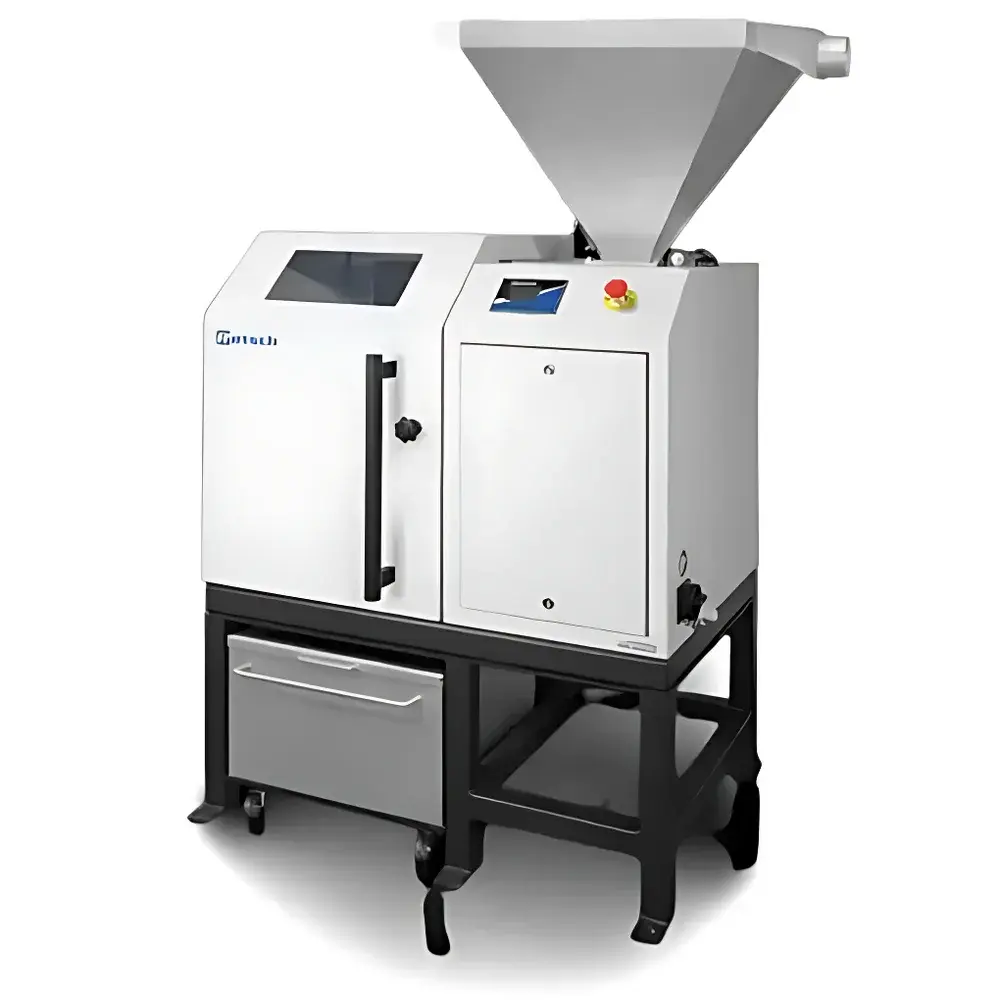
Retsch PT 600 Rotary Sample Divider
| Brand | Retsch |
|---|---|
| Origin | Germany |
| Model | PT 600 |
| Rotational Speed Range | 18–53 rpm |
| Number of Subsamples per Cycle | 4–10 |
| Feed Mechanism | Vibratory Hopper with Push-in Loading Tray |
| Sample Port Configuration | Gravity-fed, Bottom-discharge Funnel System |
| Viewing Window | Integrated Illuminated Observation Port |
| Compliance | Designed in accordance with ISO 13320, ISO 14887, and ASTM D6938 for representative sampling of dry granular and powdered materials |
Overview
The Retsch PT 600 Rotary Sample Divider is an engineered solution for the precise, reproducible subdivision of bulk dry particulate materials in laboratory and quality control environments. Based on the principle of rotary riffling—where a rotating sample chamber equipped with equally spaced radial dividers distributes material by gravity into multiple receiving compartments—the PT 600 ensures statistically representative subsampling without bias from particle segregation or flow channeling. Its design adheres to fundamental sampling theory as defined in Gy’s sampling equation and aligns with international standards governing heterogeneity management in powders and granules. Unlike static splitter designs, the PT 600’s controlled rotational motion combined with vibratory feed promotes uniform mass distribution across all outlet channels, minimizing systematic error associated with particle size, shape, and density differentials. It is not intended for wet, sticky, fibrous, or cohesive materials; its operational envelope is strictly limited to free-flowing, dry solids within typical industrial particle size ranges (approx. 10 µm to 25 mm).
Key Features
- Modular architecture enables rapid reconfiguration for varying throughput and subsample count requirements (4–10 fractions per rotation cycle)
- Stepless rotational speed control (18–53 rpm) allows optimization for material flow behavior—slower speeds for coarse, abrasive feeds; higher speeds for fine, aerated powders
- Vibratory hopper with push-in loading tray ensures consistent feed rate and minimizes operator-induced variability during sample introduction
- Illuminated observation window permits real-time visual verification of material flow dynamics, divider alignment, and funnel fill status—critical for method validation and troubleshooting
- Gravity-fed discharge funnels are constructed from corrosion-resistant stainless steel and feature quick-release clamps for tool-free cleaning and cross-contamination prevention
- Height-adjustable support frame accommodates ergonomic operation across diverse lab bench configurations and user anthropometrics
- All contact surfaces comply with FDA-compliant materials specifications; no lubricants or polymers contact the sample path
Sample Compatibility & Compliance
The PT 600 is validated for use with free-flowing, non-cohesive solid matrices including but not limited to cement clinker, blast furnace slag, mineral ores, agricultural seeds, ground cereals, metal powders, pharmaceutical excipients, detergent granules, and construction aggregates. It meets functional requirements outlined in ISO 13320 (laser diffraction particle size analysis—sampling guidance), ISO 14887 (suspension preparation for particle characterization), and ASTM D6938 (standard practice for sampling soils and aggregate). While the instrument itself does not carry CE marking as a standalone measurement device, its mechanical design conforms to EN 61000-6-2 (immunity) and EN 61000-6-3 (emissions) for laboratory equipment. Routine performance verification is recommended using certified reference materials traceable to NIST or BAM standards.
Software & Data Management
The PT 600 operates as a stand-alone electromechanical system with no embedded microprocessor or digital interface. All operational parameters—including rotational speed, cycle count, and elapsed run time—are manually set and monitored via analog dials and mechanical counters. This architecture eliminates software validation burdens under FDA 21 CFR Part 11 or EU Annex 11, making it suitable for GLP- and GMP-regulated laboratories where auditability of manual process records is prioritized over automated data capture. Users maintain sampling logs per ISO/IEC 17025 clause 7.5.2, documenting batch ID, operator, date/time, speed setting, number of fractions, and visual inspection notes. Optional integration with external timing or weight-data acquisition systems (e.g., balance + PLC) is supported via dry-contact relay outputs.
Applications
- Preparation of analytically representative subsamples prior to laser diffraction, sieve analysis, or SEM-EDS characterization
- Homogenization and division of QA/QC batches in cement, mining, and agrochemical production facilities
- Reduction of large field-collected soil or sediment samples to laboratory-submittal size while preserving spatial heterogeneity
- Splitting of metal powder lots for subsequent Hall flow rate or apparent density testing per MPIF Standard 35
- Division of pharmaceutical blend batches for content uniformity assay—conducted under ISO 8573-7 cleanroom-compatible conditions when paired with appropriate enclosures
- Method development for ASTM E1900-compliant sampling plans in bulk solids handling operations
FAQ
Is the PT 600 suitable for moisture-sensitive or hygroscopic powders?
Yes—provided ambient humidity is controlled and residence time in the feed hopper is minimized. No internal heating or drying elements are present.
Can the PT 600 be cleaned between samples without disassembly?
Yes—stainless steel funnels and the rotor chamber are accessible via front-panel release mechanisms; compressed air or soft brushes suffice for routine decontamination.
Does Retsch provide calibration certificates for the PT 600?
No—calibration is not applicable to this mechanical divider. Performance verification is conducted via repeatability testing using certified mass standards and documented procedural adherence.
What maintenance intervals are recommended?
Lubrication-free operation requires only quarterly inspection of belt tension, vibration motor mounting integrity, and funnel alignment—no scheduled part replacement is specified in the technical manual.
Is the PT 600 compatible with robotic sample handling systems?
Yes—its 0–10 V analog speed input and TTL-compatible cycle trigger signal allow synchronization with third-party automation platforms via optional interface modules.
Related Products



