
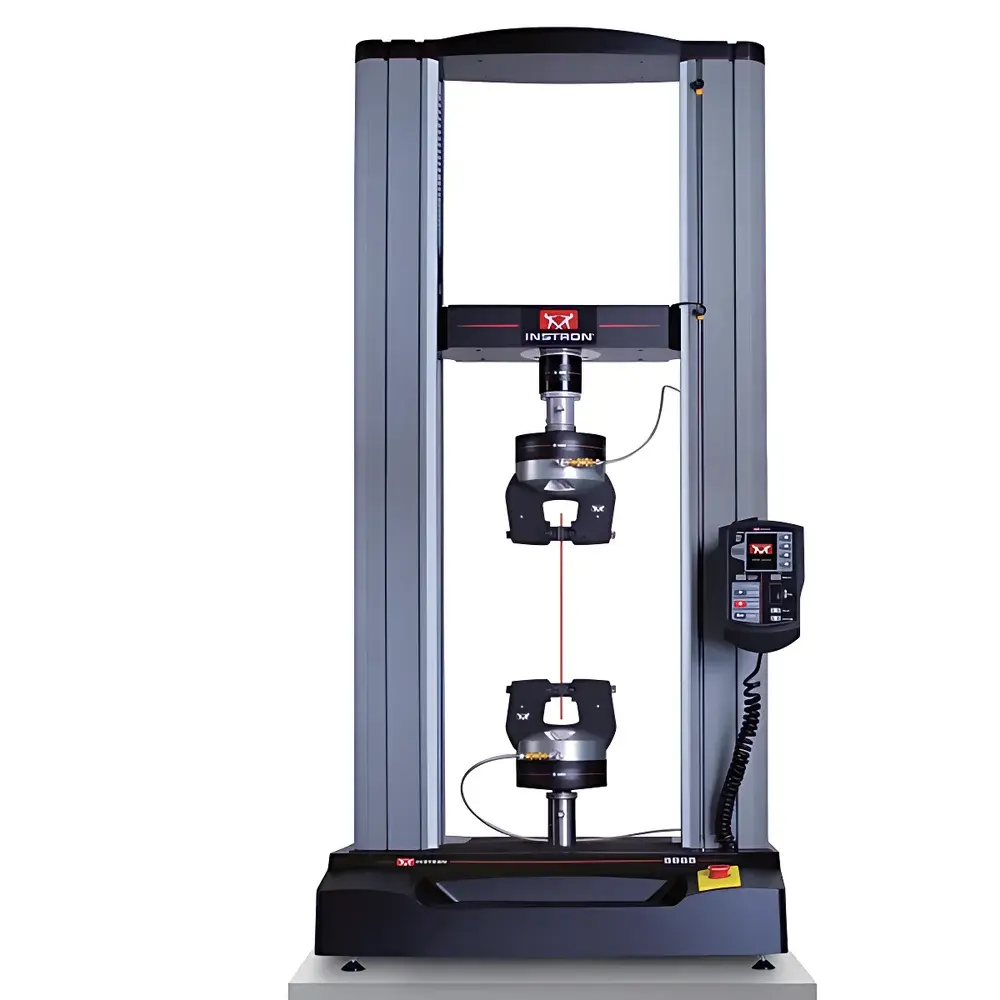
Instron 5960 Series Dual-Column Desktop Universal Testing System
| Brand | Instron |
|---|---|
| Origin | USA |
| Model | 5960 Series |
| Load Capacity Range | 5 kN to 50 kN (5965–5969 models) |
| Type | Electromechanical Universal Testing Machine |
| Compliance | ASTM E4, E8, E9, E21, ISO 6892-1, ISO 527, ISO 178, USP <1041>, FDA 21 CFR Part 11 (with Bluehill software configuration) |
| Control Interface | Integrated Ethernet (10/100/1000BASE-T) |
| Data Acquisition Rate | Up to 5 kHz (standard), configurable higher with optional modules |
| Speed Range | 0.001–2500 mm/min (model-dependent) |
| Return Speed | Up to 2500 mm/min |
| Sensor Channels | Up to 4 built-in analog input channels for load, strain, displacement, and environmental sensors |
| Software Platform | Bluehill Universal v4.x or later |
Overview
The Instron 5960 Series Dual-Column Desktop Universal Testing System is an electromechanical materials testing platform engineered for precision mechanical characterization across research, quality control, and regulatory-compliant environments. Based on servo-controlled ball-screw actuation and high-fidelity closed-loop digital control architecture, the system applies controlled uniaxial tensile, compressive, flexural, peel, shear, and cyclic loading to specimens according to standardized test methods. Its dual-column rigid frame—constructed from high-strength aluminum alloy and reinforced steel crossheads—ensures minimal deflection (<0.01 mm under full load), enabling accurate force alignment and repeatable measurement of modulus, yield strength, elongation at break, and fracture energy. Designed for laboratories where footprint, reliability, and traceability are critical, the 5960 Series supports both ambient and conditioned testing (when integrated with environmental chambers), and meets structural and metrological requirements defined in ASTM E4 (force verification), ISO 7500-1 (static calibration), and ISO 13384-1 (system verification).
Key Features
- Rigid dual-column frame with T-slot tabletop for modular fixture mounting and accessory integration
- High-precision load cells calibrated to ±0.5% of reading (full scale), traceable to NIST standards; available capacities: 5 kN (5965), 10 kN (5966), 30 kN (5967), and 50 kN (5969)
- Advanced motion control delivering speed accuracy of ±0.2% of setpoint across the full range (0.001–2500 mm/min), including rapid return at up to 2500 mm/min to reduce cycle time
- Integrated Ethernet interface (10/100/1000BASE-T) enabling deterministic communication with host PCs, remote diagnostics, and networked instrument management
- Digital controller with four programmable analog input channels supporting simultaneous acquisition from load, extensometer, LVDT, thermocouple, or pressure transducers
- Front-panel touchscreen interface with soft-key navigation, real-time parameter display, and specimen protection logic (e.g., auto-stop on overload or over-travel)
- Preloaded bearing guides and precision-ground lead screws ensure axial alignment within ±0.02°, minimizing bending moments and improving data fidelity for thin films, fibers, and brittle specimens
- Optional automatic pneumatic clamp control module with programmable pressure sequencing and dwell timing
- Integrated LED task lighting within the test zone for improved visibility during small-specimen setup and failure observation
Sample Compatibility & Compliance
The 5960 Series accommodates specimens ranging from sub-millimeter polymer fibers and biomedical sutures to structural composite coupons and automotive fasteners. Standard fixtures include wedge-action grips, pneumatic side-action clamps, compression platens, and bend fixtures compliant with ASTM D790, ISO 178, and ISO 14125. Optional accessories include video extensometers (for non-contact strain measurement), environmental chambers (−70 °C to +350 °C), humidity control enclosures, and high-temperature furnaces. All systems are supplied with factory calibration certificates and support GLP/GMP workflows via Bluehill Universal’s audit trail, electronic signatures, and 21 CFR Part 11 compliance packages. Test method libraries include preconfigured routines for ISO 527 (plastics), ASTM D638 (tensile plastics), ASTM E8/E21 (metals), and ASTM D3039 (composites), ensuring direct alignment with international reporting requirements.
Software & Data Management
Bluehill Universal software serves as the central interface for test definition, execution, real-time monitoring, and post-processing. It provides intuitive workflow-based test creation, customizable pass/fail criteria, and automated report generation in PDF, Excel, or XML formats. The software supports multi-channel synchronized data acquisition at up to 5 kHz sampling rate, with optional oversampling modules extending resolution for dynamic or low-force applications. Built-in statistical tools enable batch analysis across multiple specimens, while raw data export preserves full fidelity for third-party analysis (e.g., MATLAB, Python). Audit trails log all user actions—including method edits, calibration events, and result approvals—with timestamps and operator IDs. Data integrity is further ensured through role-based access control, encrypted database storage, and configurable backup policies aligned with ISO/IEC 17025 laboratory accreditation standards.
Applications
The 5960 Series delivers reproducible mechanical property data for diverse material classes and industries. In polymer R&D labs, it quantifies tensile modulus, yield behavior, and creep compliance per ISO 527 and ASTM D638. For metal component validation, it performs tensile-to-fracture tests per ASTM E8 and fatigue pre-cracking per ASTM E647. Automotive suppliers use it for seatbelt webbing elongation, gasket compression set, and adhesive lap-shear strength (ASTM D1002). Biomedical device manufacturers rely on its sub-newton resolution and micro-grip compatibility for suture tensile testing (ISO 10993-12) and hydrogel compression. Academic researchers apply it in multiscale mechanics studies—pairing with digital image correlation (DIC) systems or in situ microscopy—to correlate macroscopic stress–strain response with microstructural evolution.
FAQ
What load capacities are available in the 5960 Series?
The series includes five standard models: 5965 (5 kN), 5966 (10 kN), 5967 (30 kN), and 5969 (50 kN). Custom configurations beyond 50 kN are available upon request.
Can the system be used for high-temperature testing?
Yes—when paired with Instron’s 3119-600 series environmental chambers or high-temperature furnaces (up to 1200 °C), the 5960 supports thermal-mechanical testing under ISO 6892-2 and ASTM E21 protocols.
Is Bluehill Universal software included with the system?
Yes—each 5960 system ships with a perpetual license for Bluehill Universal v4.x or later, including method templates, reporting modules, and firmware update entitlements for the first 12 months.
How is force calibration verified and maintained?
Load cells are factory-calibrated per ISO 7500-1 and supplied with NIST-traceable certificates. Users can perform routine verifications using Instron’s 2530 series calibration kits or third-party deadweight standards; automated calibration workflows are embedded in Bluehill Universal.
Does the system support automated testing sequences?
Yes—Bluehill Universal supports script-driven multi-step tests, including conditional branching (e.g., “if yield detected, proceed to creep hold”), cyclic loading profiles, and pass/fail logic for unattended operation across shifts.



