
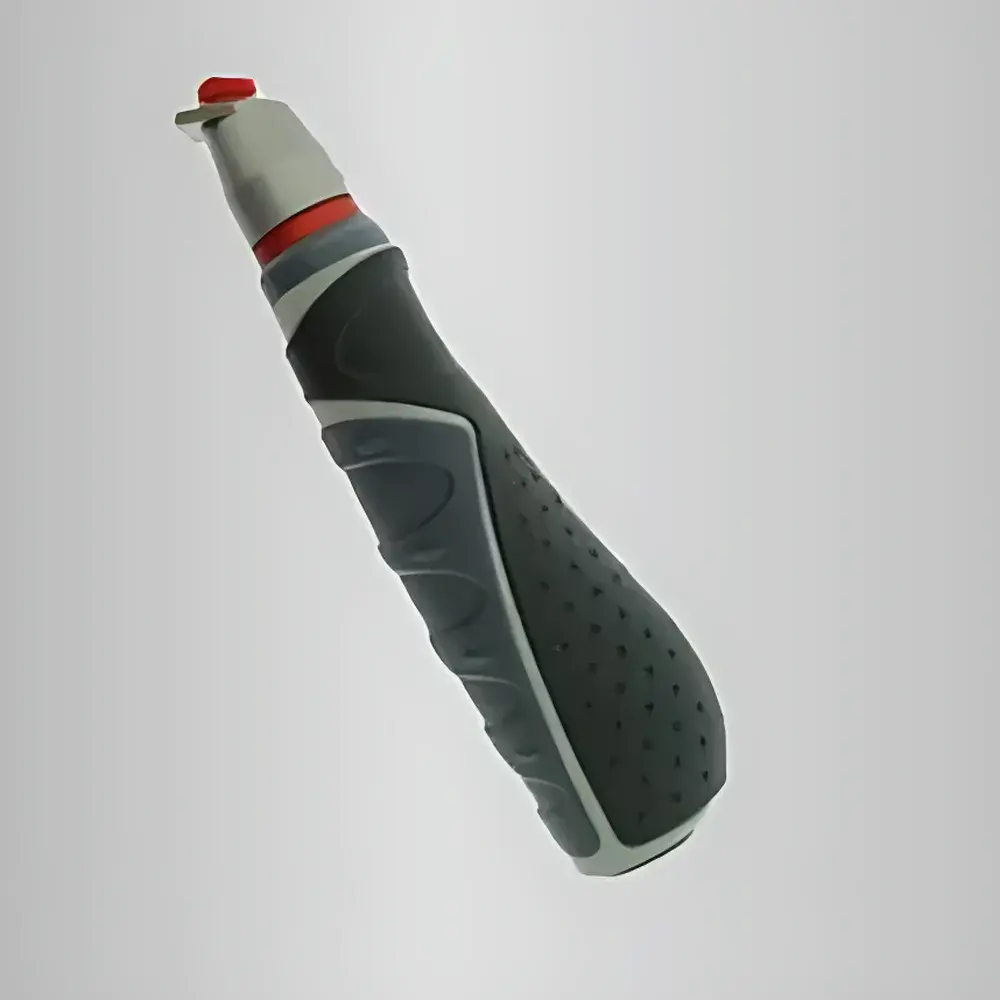
TQC CC2000 Single-Blade Cross-Cut Adhesion Tester
| Brand | TQC |
|---|---|
| Origin | Netherlands |
| Model | CC2000 |
| Standard Compliance | ISO 2409, ASTM D3359 |
| Blade Spacing Options | 1 mm, 2 mm, 3 mm (DIN/ISO) |
| Blade Count | 6 (DIN/ISO), 11 (ASTM) |
| Included Accessories | Ergonomic handle, hardened steel cutting blade, nylon brush (SP1710), illuminated 2.5× magnifier (SP9700), pressure-sensitive tape (4.3 N/cm adhesion) |
| Tape Adhesion Options | 4.3 N/cm (SP3007/SP3010), 7.6 N/cm (SP3020) |
| Replaceable Blade System | Tool-free |
| Handle Design | Ergonomic, non-slip grip |
Overview
The TQC CC2000 Single-Blade Cross-Cut Adhesion Tester is a precision-engineered manual instrument designed for standardized assessment of coating adhesion to rigid and semi-rigid substrates using the cross-cut method. It operates on the principle of controlled mechanical incision: a hardened steel blade—mounted in a spring-loaded, pressure-regulated holder—scores a uniform grid of parallel cuts into the cured coating film. Two perpendicular sets of cuts form either 25 or 100 nominally square cells (depending on blade spacing and standard requirements). Subsequent evaluation involves mechanical removal of detached fragments via standardized tape application (per ISO 2409 or ASTM D3359) or dry brushing, followed by visual classification under magnification against defined rating scales. This method quantifies interfacial cohesion and coating-substrate bonding integrity—not absolute bond strength, but comparative performance under defined mechanical stress. The CC2000 is widely deployed in quality control laboratories, R&D facilities, and production environments where regulatory compliance, batch-to-batch consistency, and failure mode analysis are critical.
Key Features
- Spring-loaded blade holder with automatic pressure regulation ensures consistent normal force across all cuts—eliminating operator-dependent variability and improving inter-laboratory reproducibility.
- Ergonomically contoured handle with textured, non-slip surface minimizes hand fatigue during repetitive testing and enhances control over cut alignment and stroke stability.
- Tool-free blade exchange system enables rapid switching between DIN/ISO (6-blade) and ASTM (11-blade) configurations, as well as between spacing variants (1 mm, 2 mm, 3 mm for ISO; 1 mm, 1.5 mm for ASTM).
- Modular blade compatibility extends utility across diverse coating thickness ranges: 1 mm spacing for films ≤50–60 µm (ISO/ASTM), 2 mm for 61–120 µm (ISO) or 50–125 µm (ASTM), and 3 mm for 121–250 µm (ISO only).
- Integrated calibration reference geometry ensures blade perpendicularity and parallelism within ±0.1° tolerance—critical for avoiding skewed cell formation and misclassification.
Sample Compatibility & Compliance
The CC2000 is validated for use on flat, stable substrates including cold-rolled steel, aluminum, glass, plastic panels, and wood composites—provided surface roughness (Ra) remains below 3.2 µm and substrate rigidity prevents flexure during cutting. It complies fully with ISO 2409:2013 (“Paints and varnishes — Cross-cut test”) and ASTM D3359–22 (“Standard Test Methods for Measuring Adhesion by Tape Test”). Each blade variant carries traceable certification to these standards, and the complete kit—including supplied tape (4.3 N/cm nominal peel adhesion, per ASTM D3330), nylon brush (SP1710), and 2.5× illuminated magnifier (SP9700)—meets the accessory specifications outlined in both methods. For GLP/GMP-regulated environments, documentation packages support audit readiness, including certificate of conformance, traceable blade lot numbers, and tape adhesion verification reports.
Software & Data Management
As a manual, non-electronic test instrument, the CC2000 does not incorporate embedded firmware or digital output. However, its design supports full integration into structured quality management systems. Test records—including substrate ID, coating type/thickness, blade type/spacing, tape lot number, observer name, lighting conditions, and final rating (0–5 per ISO or 5A–0A per ASTM)—are documented using standardized paper-based or LIMS-compatible electronic forms. Optional accessories such as calibrated tape dispensers (SP3007/SP3010) include batch-specific peel adhesion certificates compliant with ISO 10360-5 metrological requirements. All components are compatible with FDA 21 CFR Part 11-compliant electronic record workflows when paired with validated data entry platforms.
Applications
The CC2000 serves as a primary adhesion screening tool across industries requiring rigorous coating validation: automotive OEMs (e-coat, primer, topcoat systems), marine and protective coatings (zinc-rich primers, epoxy mastic), industrial wood finishes (UV-cured acrylics, waterborne polyurethanes), aerospace component suppliers (polyimide and polysulfone coatings on aluminum alloys), and ink manufacturers (flexographic and gravure inks on PET and BOPP films). It is routinely specified in internal QC protocols, supplier qualification audits, and third-party certification schemes (e.g., Qualicoat, AAMA 2605). Its portability and lack of power dependency also make it suitable for field inspections on large structures—such as bridge girders or offshore platform modules—when used in conjunction with portable lighting and environmental monitoring logs.
FAQ
What standards does the CC2000 support?
It is fully compliant with ISO 2409:2013 and ASTM D3359–22, including all referenced blade geometries, spacing tolerances, and evaluation criteria.
Can the same blade be used for both ISO and ASTM tests?
No—ISO 2409 requires a 6-blade cutter; ASTM D3359 requires an 11-blade cutter. Blades are physically distinct and not interchangeable.
How often should the cutting blade be replaced?
Blades must be replaced after each test series on abrasive substrates (e.g., sandblasted steel) or after 25–50 cuts on smooth surfaces, as edge wear compromises cut depth consistency and cell geometry fidelity.
Is tape adhesion verification required before each test?
Yes—per ASTM D3359 Section 7.2 and ISO 2409 Clause 6.3, tape peel adhesion must be confirmed within ±0.5 N/cm of nominal value (e.g., 4.3 ± 0.5 N/cm) using a certified tensile tester prior to qualification testing.
Does the CC2000 require calibration certification?
While no periodic recalibration is mandated (as it contains no adjustable measurement electronics), users must retain blade lot certificates, tape adhesion reports, and magnifier verification records as part of their equipment qualification dossier per ISO/IEC 17025.
Related Products






