
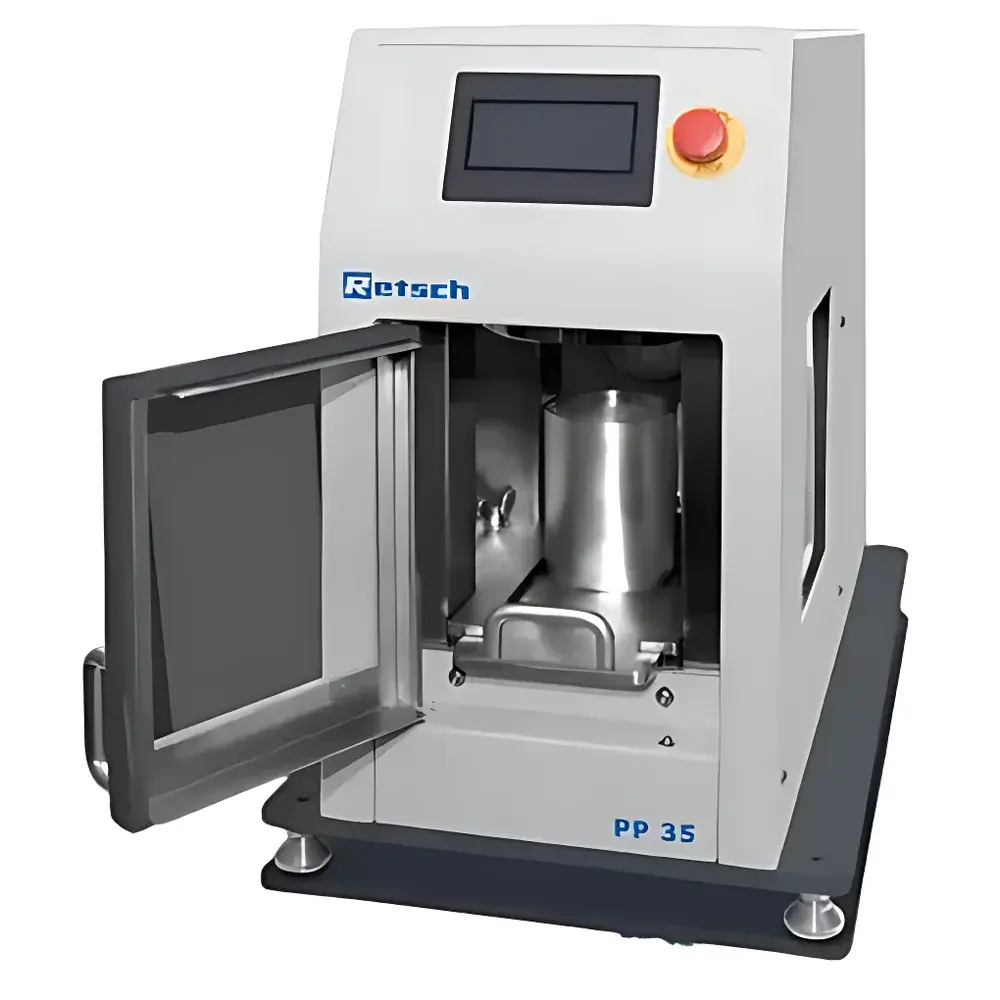
RETSCH PP 35 Automated Pellet Press
| Brand | Retsch |
|---|---|
| Origin | Germany |
| Model | PP 35 |
| Type | Fully Automatic Pellet Press |
| Maximum Force | 0–35 Ton (343 kN) |
| Dimensions (W × D × H) | 335 × 495 × 570 mm |
| Application | Spectroscopic Sample Preparation (XRF, IR, NIR) |
| Control Interface | Integrated Touchscreen with SOP Storage (up to 10 methods) |
| Tooling Compatibility | Interchangeable Punch & Die Sets (multiple diameters), Aluminum Cups Included |
| Compliance | Designed for GLP/GMP-aligned laboratory environments |
Overview
The RETSCH PP 35 Automated Pellet Press is an engineered solution for reproducible, high-integrity sample compaction in analytical laboratories. It operates on the principle of uniaxial cold compression—applying precisely controlled hydraulic force to powdered or granular specimens within standardized die cavities—to produce homogeneous, binder-free pellets suitable for quantitative X-ray fluorescence (XRF), Fourier-transform infrared (FTIR), and near-infrared (NIR) spectroscopy. Unlike manual or semi-automated presses, the PP 35 integrates closed-loop pressure feedback and real-time force monitoring to ensure consistent densification across variable material densities and flow characteristics. Its compact benchtop footprint (335 × 495 × 570 mm) enables deployment in space-constrained analytical labs without compromising mechanical rigidity or thermal stability during extended operation.
Key Features
- Fully automated hydraulic press system with digital pressure regulation from 0 to 35 metric tons (0–343 kN), adjustable in 0.1-ton increments for method-sensitive applications.
- Integrated touchscreen interface supporting storage and recall of up to 10 Standard Operating Procedures (SOPs), each defining target force, dwell time, decompression rate, and cycle count.
- Modular tooling platform compatible with standard punch-and-die sets (e.g., 10 mm, 13 mm, 20 mm, 32 mm, and 40 mm diameters) and disposable aluminum sample cups for contamination-sensitive matrices.
- Real-time force and displacement monitoring with automatic hold-and-relax sequencing to minimize elastic rebound and improve pellet cohesion.
- Robust cast-iron frame with precision-machined guide columns ensures parallelism between upper and lower platens within ±2 µm, critical for uniform thickness and minimal edge cracking.
- No external air or vacuum supply required—self-contained electro-hydraulic actuation eliminates dependency on facility infrastructure.
Sample Compatibility & Compliance
The PP 35 accommodates a broad range of inorganic and organic powders, including but not limited to cement clinker, blast furnace slag, geological ores, metallurgical slags, ceramic precursors, pharmaceutical excipients, and polymer blends. Its pressure calibration traceability aligns with ISO 7500-1 (static load verification of testing machines), and operational logs—including force curves, cycle timestamps, and user IDs—are exportable in CSV format for audit readiness. When configured with optional electronic signature and audit trail modules, the system supports compliance with FDA 21 CFR Part 11 requirements for regulated environments. Routine verification procedures follow ASTM E384 (microhardness) and ISO 16014 (powder compaction behavior) guidelines to validate inter-batch repeatability.
Software & Data Management
The embedded control firmware provides full parameterization of compression profiles: pre-load ramp rate, main compression force ramp, dwell duration (0.1–999.9 s), and controlled decompression velocity. All process data—including actual applied force vs. time, final pellet thickness (via integrated displacement sensor), and cycle status flags—are logged locally and exportable via USB or Ethernet. No proprietary software installation is required; exported datasets are natively compatible with common laboratory informatics systems (LIMS) and statistical process control (SPC) platforms. Firmware updates are delivered via signed binary packages to maintain integrity and version traceability.
Applications
- XRF analysis of cement raw meals and finished products per ASTM C114 and EN 196-2.
- Quantitative mineralogical assessment of iron ore fines using fused bead or pressed pellet methodologies (ISO 29581-2).
- Preparation of reference materials for calibration of handheld XRF analyzers in mining QA/QC workflows.
- Standardized pellet formation for FTIR quantification of functional groups in catalyst supports or battery electrode materials.
- High-reproducibility compaction of hygroscopic or low-cohesion samples (e.g., fly ash, limestone, gypsum) where binder addition is undesirable.
FAQ
What is the maximum achievable green density for typical silicate powders?
Green densities exceeding 85% of theoretical density are routinely achieved for well-deaerated mineral powders at 30–35 ton force, depending on particle size distribution and specific surface area.
Can the PP 35 be integrated into an automated sample preparation line?
Yes—RS-232 and Ethernet interfaces support external PLC-triggered start/stop commands and status polling, enabling synchronization with robotic sample handling or upstream milling stations.
Is calibration certification included with delivery?
Each unit ships with a factory-issued calibration certificate referencing national metrology institute standards (DAkkS-accredited lab), valid for 12 months under normal operating conditions.
How often does the hydraulic system require maintenance?
The sealed electro-hydraulic drive requires no scheduled fluid changes; annual inspection of seal integrity and pressure transducer linearity is recommended per RETSCH Service Bulletin PP-35-REV2023.
Are custom die geometries supported?
Yes—RETSCH offers OEM die manufacturing services for non-standard cavity shapes (e.g., toroidal, segmented, or multi-cavity dies) upon submission of dimensional specifications and material compatibility data.



