
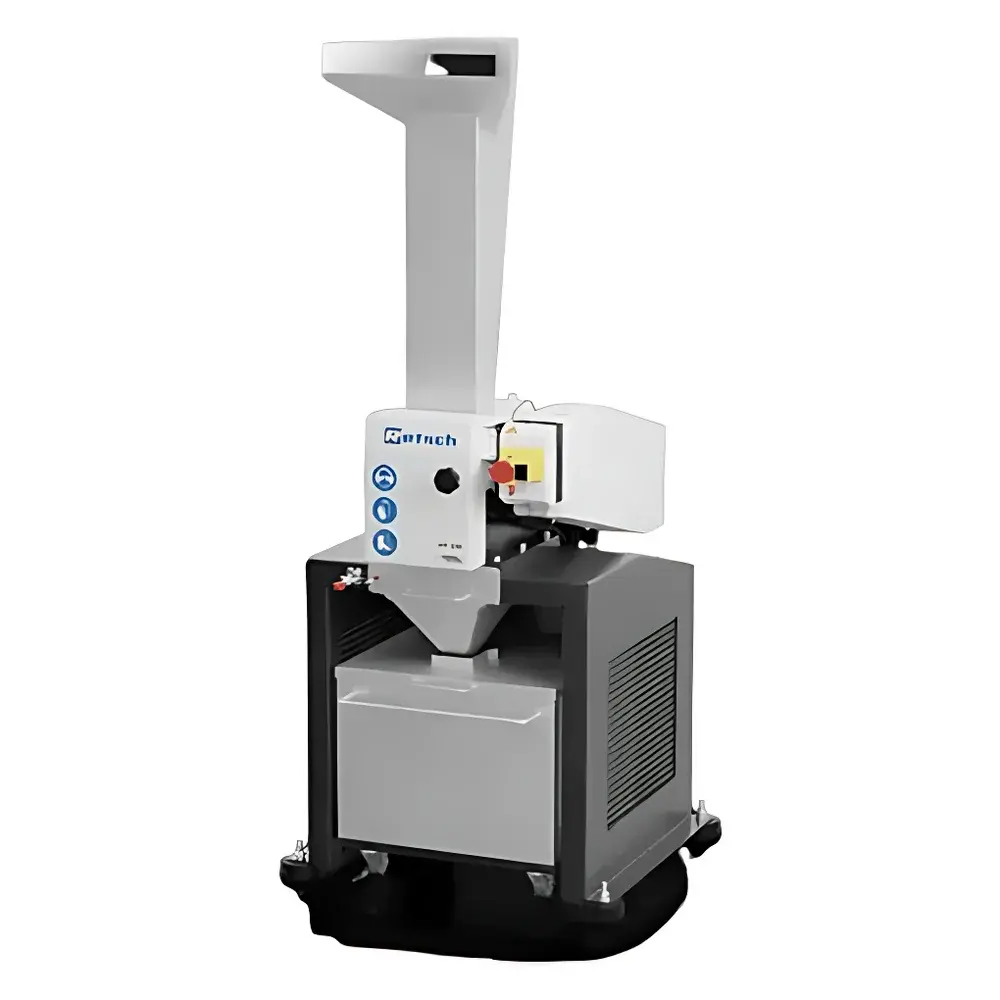
RETSCH HM 200 Hammer Mill
| Brand | RETSCH |
|---|---|
| Origin | Germany |
| Model | HM 200 |
| Instrument Type | Hammer Crusher |
| Sample Suitability | Hard and Brittle Materials |
| Maximum Feed Size | < 100 mm |
| Final Particle Size | < 0.8 mm |
| Rotor Speed | 3000 rpm |
| Throughput Capacity | up to 1500 kg/h |
| Bottom Sieve Aperture Range | 2–40 mm |
Overview
The RETSCH HM 200 Hammer Mill is a high-capacity, industrial-grade laboratory crusher engineered for robust primary and intermediate size reduction of hard, brittle, and moderately fibrous materials. Operating on the principle of impact crushing—where rapidly rotating hammers strike feed material against fixed breaker plates and sieve surfaces—the HM 200 delivers consistent particle size distribution with minimal heat generation and low operational noise relative to its throughput class. Designed for demanding routine use in geochemical, mining, cement, environmental, and agricultural laboratories, it bridges the gap between benchtop grinders and pilot-scale comminution systems. Its fixed-speed 3000 rpm rotor ensures mechanical stability and repeatability across batches, while the modular sieve system enables precise control over final particle geometry and size cutoff without requiring recalibration or software intervention.
Key Features
- High-throughput processing: Rated for up to 1500 kg/h under continuous operation with appropriate feed control and sieve selection
- Large feed opening: Accommodates particles up to 100 mm in maximum dimension—significantly exceeding the 25 mm limit of rotary disc mills (e.g., SR 300, SK 300)
- Adjustable final fineness: Achieves nominal output < 0.8 mm using standard 2 mm bottom sieve; coarser fractions (up to 40 mm aperture) support efficient size reduction of fibrous, damp, or elastic materials including wood chips, wet coal, and plastic fragments
- Tool-free access design: Forward-folding hopper provides top-down access to the grinding chamber; centrally hinged base panel allows full underside exposure of rotor assembly and hammer set for rapid inspection and cleaning
- Wear-resistant construction: Replaceable wear liners inside the crushing chamber and hardened steel hammers extend service life during abrasive applications such as slag, quartz, or cement clinker processing
- Integrated safety architecture: Electromechanical safety switch de-energizes the motor within < 1 s if the front door is opened during operation; dynamic braking ensures immediate rotor stoppage
- Flexible feeding & collection: Compatible with batch hopper (≈600 mL), standard gravity-fed hopper, and continuous discharge configurations; supports 10 L and 30 L collection vessels or customer-defined downstream transfer systems
Sample Compatibility & Compliance
The HM 200 is validated for comminution of inorganic and organic solids exhibiting hardness (Mohs 3–7), low to moderate toughness, and limited ductility. Typical compliant sample categories include geological aggregates (granite, basalt, slag), ceramics, glass cullet, coal (dry and moderately moist), soil composites, cementitious materials, dried botanicals (herbs, feed pellets), and rigid polymers. It is not recommended for highly elastic, sticky, oily, or temperature-sensitive substances. While the instrument itself carries CE marking per EU Machinery Directive 2006/42/EC and conforms to EN 61000-6-2 (EMC immunity) and EN 61000-6-4 (EMC emission) standards, users are responsible for validating method-specific performance against application-relevant norms—including ASTM D2974 (coal and coke analysis), ISO 13320 (laser diffraction particle sizing pre-treatment), and USP & Ph. Eur. general chapters on sample homogenization for pharmaceutical raw material testing.
Software & Data Management
The HM 200 operates as a stand-alone electromechanical system with no embedded firmware, touchscreen interface, or digital data logging capability. All operational parameters—including feed rate, sieve selection, and run duration—are manually controlled and documented externally by the user. This analog architecture eliminates cybersecurity risks, ensures long-term serviceability without proprietary software dependencies, and facilitates seamless integration into GLP-compliant workflows where audit trails are maintained via laboratory notebooks or LIMS-integrated SOP records. For regulated environments requiring electronic records, optional third-party vibration sensors or load-cell–equipped feed hoppers may be deployed upstream to capture time-stamped throughput metrics traceable to 21 CFR Part 11–compliant data acquisition platforms.
Applications
The HM 200 serves as a critical preprocessing tool in analytical laboratories requiring representative sub-sampling prior to XRF, ICP-OES, XRD, or elemental combustion analysis. It is routinely employed in: mineral exploration labs for homogenizing drill core rejects; cement quality control for reducing clinker and limestone to < 0.8 mm prior to Blaine surface area measurement; environmental testing facilities preparing soil and sediment composites for heavy metal leaching studies (TCLP, SPLP); feed and food safety labs generating uniform ground animal feed or herbal powder batches for mycotoxin screening; and recycling R&D centers fragmenting end-of-life electronics housings or automotive plastics for polymer identification and additive analysis. Its ability to process heterogeneous, oversized feed without pre-crushing significantly reduces manual labor and cross-contamination risk compared to multi-stage jaw-roll-disk mill sequences.
FAQ
What materials are unsuitable for processing in the HM 200?
Materials with high elasticity (e.g., rubber, silicone), strong adhesion (e.g., wet clay, molasses-coated grains), or thermal sensitivity (e.g., waxes, certain pharmaceutical actives) may cause clogging, incomplete size reduction, or unintended thermal degradation.
Can the HM 200 be used for cryogenic grinding?
No—it lacks provisions for liquid nitrogen cooling or low-temperature housing; operation below ambient temperature is not supported.
Is the bottom sieve interchangeable during operation?
No—sieve replacement requires full shutdown, rotor lockout, and mechanical disassembly per the maintenance manual; it is not a hot-swap component.
Does RETSCH provide calibration certificates for the HM 200?
As a mechanical size reduction device—not a metrological instrument—no factory calibration certificate is issued; users perform performance verification using reference sieves and standardized test feeds per internal SOPs.
How often should hammers and wear liners be replaced?
Replacement intervals depend on cumulative operating hours and feed abrasivity; typical service life ranges from 200–800 hours for hammers and 500–1500 hours for liners when processing medium-hard rock or coal.



