
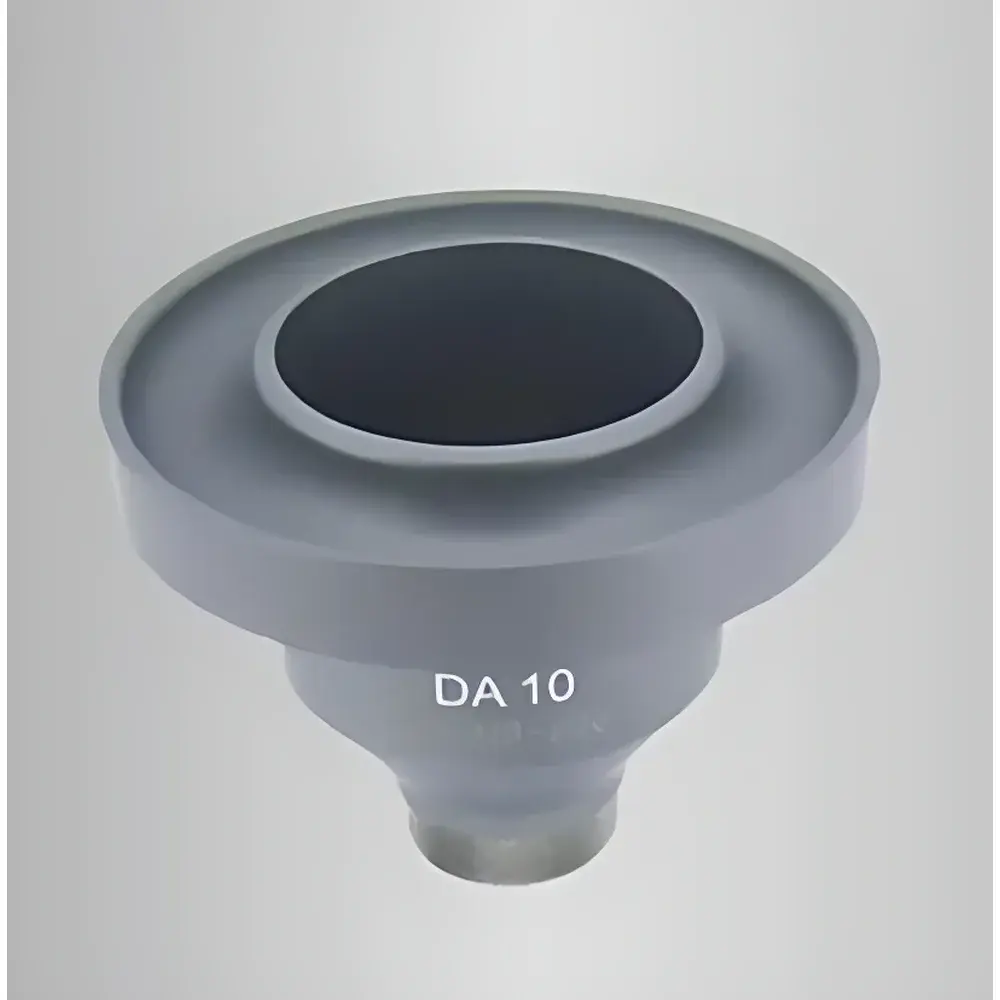
TQC VF2020 DIN 53211 Efflux Viscometer Cup
| Brand | TQC |
|---|---|
| Origin | Netherlands |
| Model | DIN 53211 |
| Material | Anodized Aluminum Body with Stainless Steel Orifice Holder |
| Orifice Diameter Options | 1–8 mm (VF2181 to VF2027) |
| Compliance | DIN 53211 (ISO 2431, ASTM D1200 referenced) |
Overview
The TQC VF2020 DIN 53211 Efflux Viscometer Cup is a precision gravity-driven flow viscometer designed for routine viscosity assessment of low- to medium-viscosity Newtonian and near-Newtonian liquids—primarily coatings, varnishes, lacquers, thin resins, and solvent-based formulations. It operates on the principle of efflux time measurement: the time required for a fixed volume of liquid to drain through a standardized orifice under gravity at controlled temperature. This method is defined in DIN 53211 and harmonized with ISO 2431 and ASTM D1200, making it a widely accepted standard for quality control in paint, ink, and surface treatment laboratories. The VF2020 cup features an anodized aluminum body for dimensional stability and corrosion resistance, paired with a precision-machined stainless steel orifice holder that ensures repeatable alignment and thermal consistency. Its geometry—including the annular overflow groove, calibrated internal volume, and defined orifice-to-receiver distance (>100 mm)—is engineered to minimize meniscus error and streamline flow initiation, directly supporting reproducibility per GLP-aligned testing protocols.
Key Features
- Anodized aluminum construction ensures long-term dimensional integrity, thermal uniformity, and resistance to chemical exposure from common solvents and thinners.
- Interchangeable stainless steel orifices (1–8 mm diameter) allow precise range selection; each orifice is individually machined to DIN 53211 tolerances and marked with traceable part numbers (e.g., VF2024 for 4 mm).
- Integrated annular overflow groove captures excess sample during filling, eliminating meniscus-dependent volume errors and enabling consistent 100 mL fill level per standard procedure.
- Flat-bottomed, low-profile design ensures compatibility with TQC’s certified leveling stands—including the VF2061 S40B stainless steel tripod stand with built-in spirit level—and facilitates stable placement on temperature-controlled surfaces.
- Smooth interior walls and absence of recessed features simplify cleaning; no blind holes or crevices trap residue, reducing cross-contamination risk between samples.
- Each unit is laser-engraved with a unique serial number for traceability, supporting audit-ready documentation in ISO/IEC 17025-accredited labs.
Sample Compatibility & Compliance
The VF2020 is validated for use with homogeneous, particle-free liquids exhibiting kinematic viscosities typically between 10–300 mm²/s (cSt) at 23 °C—corresponding to efflux times of ~20–120 seconds across available orifice sizes. It is not suitable for non-Newtonian, thixotropic, or highly volatile systems without procedural adaptation. Compliance is maintained when used within strict environmental controls: test temperature must be stabilized at 23.0 ± 0.2 °C (per DIN 53211 Clause 5.1), and ambient humidity should remain below 65% RH to prevent condensation on the cup exterior. When paired with optional accessories such as the VF1982 or VF2067 temperature regulators (DIN/ASTM-compliant), the system supports full adherence to ISO/IEC 17025 clause 5.4.2 for environmental monitoring. All orifice inserts are manufactured to DIN 53211 Annex A dimensional specifications and may be verified using NIST-traceable standard oils (e.g., Cannon–Fenske reference fluids).
Software & Data Management
As a manual efflux device, the VF2020 does not incorporate embedded electronics or firmware. However, its operational workflow integrates seamlessly into regulated digital environments. Efflux time data—recorded via compatible timing devices such as the DI0076 C510 LCD stopwatch (resolution: 0.01 s, max duration: 9 h 59 min 59.99 s)—can be logged directly into LIMS or ELN platforms supporting ASTM E2500-17 structured data entry. For FDA 21 CFR Part 11 compliance, users may pair the stopwatch with validated timestamping software that enforces electronic signatures, audit trails, and data immutability. Annual recalibration services include certificate issuance with uncertainty budgets referenced to ISO/IEC 17025-accredited metrology labs, ensuring traceability to SI units.
Applications
- Batch release testing of architectural and industrial coatings prior to packaging or application.
- In-process viscosity checks during resin synthesis or pigment dispersion stages.
- Supplier qualification and incoming raw material verification per OEM technical data sheets.
- Method transfer between R&D, QC, and contract manufacturing sites operating under harmonized DIN/ISO/ASTM frameworks.
- Educational demonstrations of Newtonian fluid behavior and temperature–viscosity relationships in polymer science curricula.
FAQ
What is the recommended calibration frequency for the VF2020 DIN cup?
Annual calibration is recommended by TQC and aligned with ISO/IEC 17025 Clause 6.4. Calibration should be performed using certified standard oils traceable to national metrology institutes.
Can I use solvents like acetone or xylene to clean the orifice?
Yes—provided the solvent is compatible with anodized aluminum and stainless steel. Avoid prolonged immersion or abrasive tools; rinse thoroughly with deionized water and dry with lint-free cloth after cleaning.
Why must the orifice-to-receiver distance exceed 100 mm?
This requirement prevents air entrainment and jet contraction effects, ensuring laminar outflow and minimizing turbulence-induced timing variability per DIN 53211 Section 6.2.
Is the VF2024 (4 mm orifice) the only cup certified to full DIN 53211 specification?
Yes—the VF2024 orifice meets all dimensional and tolerance criteria specified in DIN 53211 Table 1 and is supplied with validation data for use with standard reference oils.
Do I need a separate stand to achieve level positioning?
While not mandatory, use of the VF2061 S40B tripod stand (with integrated bubble level) is strongly advised to meet DIN 53211 Section 6.1 requirements for horizontal alignment and reduce operator-induced tilt error.



