
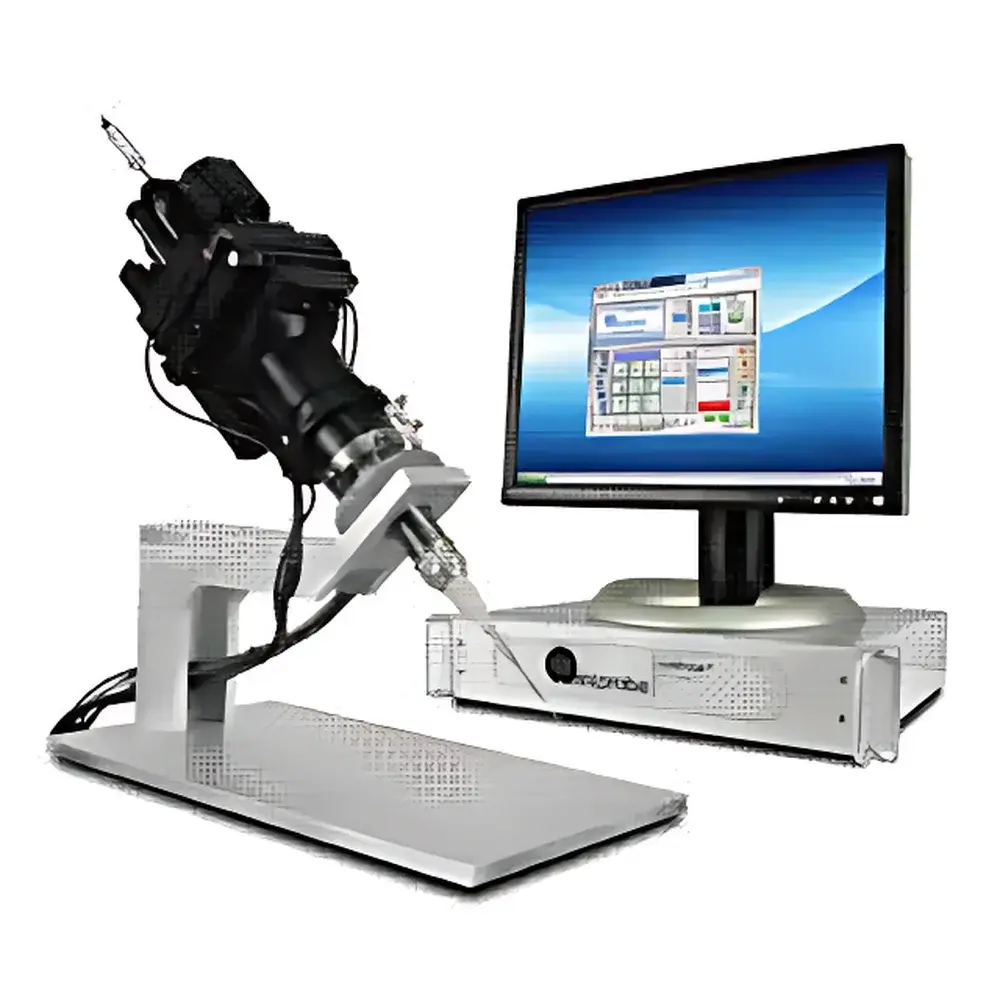
Oxford Instruments OmniProbe Nanomanipulator for FIB-SEM Systems
| Brand | Oxford Instruments |
|---|---|
| Origin | United Kingdom |
| Model | OmniProbe (OP350, OP400, Cryo) |
| Drive Technology | Piezoelectric actuation |
| Positioning Resolution | Sub-nanometer |
| Operating Temperature Range (Cryo) | –180 °C to room temperature |
| Port Compatibility | Standard SEM/FIB vacuum feedthroughs (e.g., 60 mm, 80 mm) |
| Control Interface | Digital USB/Ethernet with real-time image-synchronized calibration |
| Compliance | Designed for GLP/GMP-aligned workflows |
Overview
The Oxford Instruments OmniProbe is a high-precision nanomanipulator engineered exclusively for integration with focused ion beam–scanning electron microscope (FIB-SEM) platforms. Since its commercial introduction in 1995, the OmniProbe has become an industry-standard tool for in situ nanoscale manipulation, lift-out, and electrical probing within ultra-high vacuum (UHV) environments. Its operational principle relies on closed-loop piezoelectric actuation coupled with real-time image-based coordinate calibration—ensuring that all probe movements are spatially referenced directly to the SEM/FIB field of view. This eliminates cumulative mechanical drift and enables reproducible sub-nanometer positioning accuracy over extended acquisition periods. The system’s modular architecture supports three distinct configurations: the OP350 for general-purpose nanomanipulation, the OP400 for high-speed, high-stability tasks requiring enhanced dynamic range, and the Cryo variant—specifically engineered for cryogenic sample handling down to –180 °C. Each variant maintains full compatibility with standard FIB-SEM column geometries and detector layouts, minimizing interference with EDS, EBSD, or secondary electron detectors.
Key Features
- Sub-nanometer closed-loop positioning resolution enabled by low-drift, low-vibration piezoelectric actuators
- Image-synchronized motion control: probe trajectory calibrated dynamically against live SEM/FIB imaging coordinates
- Compact port-mounted design (60 mm and 80 mm flange options) preserving detector access and chamber clearance
- Dual-axis tilt capability (±15°) on OP400 and Cryo models for angled lift-out and cross-sectional preparation
- Cryo variant integrates with third-party cryo-transfer systems and maintains thermal stability during FIB milling at –180 °C
- Digital control interface via USB or Ethernet, supporting synchronization with Oxford Instruments AZtec or third-party acquisition software
- Robust mechanical architecture compliant with UHV (<1×10⁻⁷ mbar) and vibration-isolation requirements for long-duration nanofabrication
Sample Compatibility & Compliance
The OmniProbe accommodates a broad spectrum of specimen types—including TEM lamellae, MEMS devices, battery electrode cross-sections, geological thin sections, and cryo-preserved biological tissues. The Cryo model extends compatibility to vitrified samples prepared by high-pressure freezing (HPF), enabling site-specific extraction without ice-crystal damage. All variants conform to ISO 14644-1 Class 5 cleanroom assembly protocols and are manufactured under ISO 9001-certified quality management systems. For regulated environments, the OmniProbe control firmware supports audit-trail logging and user-access controls aligned with FDA 21 CFR Part 11 requirements when deployed with validated software stacks. It is routinely used in laboratories operating under GLP and GMP frameworks for materials qualification and failure analysis.
Software & Data Management
Control is delivered through Oxford Instruments’ proprietary OmniProbe Control Suite—a platform-independent application supporting Windows and Linux. The suite provides real-time coordinate mapping between stage movement and pixel coordinates in the SEM/FIB image frame, enabling “click-to-move” functionality with automatic drift compensation. All motion sequences, calibration logs, and user actions are timestamped and exportable as CSV or XML for traceability. Integration with AZtec Live allows synchronized EDS mapping during manipulation, while API support enables custom scripting for automated lift-out workflows. Data integrity safeguards include checksum validation, encrypted session logs, and role-based permission settings—essential for multi-user core facilities and regulated QA/QC labs.
Applications
- In situ TEM lamella preparation via FIB lift-out from bulk specimens or device wafers
- Nanoscale electrical characterization using four-point probe configurations on semiconductors and 2D materials
- Cryo-FIB milling and extraction of frozen-hydrated cellular structures for subsequent cryo-TEM analysis
- Micro-machining of photonic crystals, plasmonic arrays, and metamaterial test structures
- Failure analysis of solder joints, interconnects, and packaging interfaces in advanced ICs
- Extraction and relocation of nanoparticles, nanowires, or quantum dots for correlative microscopy
FAQ
What vacuum level is required for stable OmniProbe operation?
The OmniProbe is rated for continuous operation at pressures ≤1×10⁻⁷ mbar, consistent with standard FIB-SEM chamber base vacuum specifications.
Can the OP350 be upgraded to OP400 functionality?
No—OP350 and OP400 differ in actuator design, mechanical rigidity, and tilt mechanism; upgrades require full hardware replacement.
Is the Cryo model compatible with non-Oxford cryo-transfer systems?
Yes—Cryo OmniProbe uses standardized CF-63/CF-100 flanges and communicates via RS-232/USB, enabling interoperability with Gatan Alto, Leica EM VCT, and other major cryo-platforms.
Does OmniProbe support automated scripting for repetitive lift-out protocols?
Yes—Python and MATLAB APIs are provided, along with example scripts for lamella rough milling, polishing, and final thinning sequences.
What maintenance intervals are recommended for piezoelectric modules?
Under normal usage (≤8 hrs/day), no scheduled maintenance is required; lifetime expectancy exceeds 10⁹ actuation cycles per axis, verified per IEC 61000-4-2 standards.




