
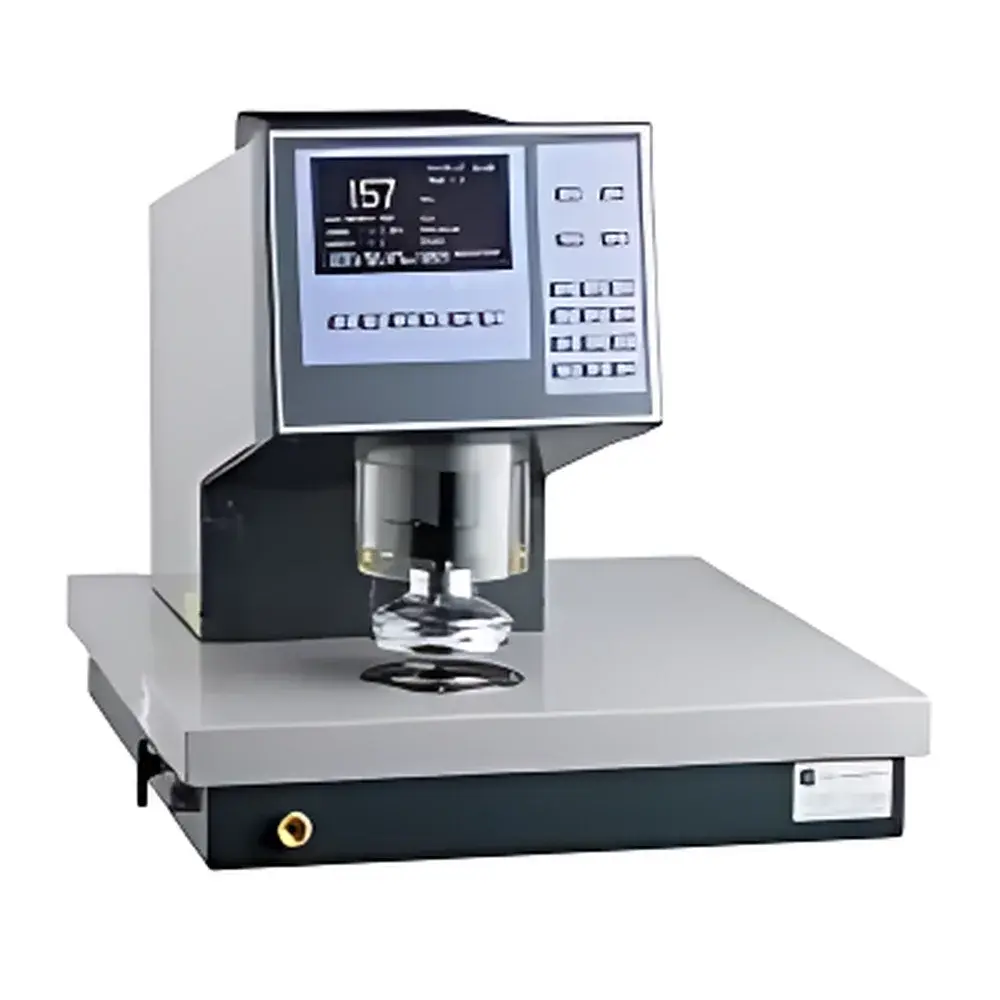
TMI 13-6X Burst Strength Tester
| Origin | Guangdong, China |
|---|---|
| Manufacturer Type | Authorized Distributor |
| Origin Category | Domestic (China) |
| Model | 13-6X |
| Pricing | Upon Request |
| Pressure Range | 0–100 bar |
| Accuracy | ±1% of reading or ±0.1 bar |
| Resolution | 2 mbar (50,000 data points) |
| Compliance Standards | ISO 2960, ASTM D3786, BS 4768, TAPPI T403, TAPPI T807, TAPPI T810 |
| Optional Software | TMI GraphMaster™ |
Overview
The TMI 13-6X Burst Strength Tester is a precision-engineered mechanical testing instrument designed to quantify the burst resistance of planar, flexible materials under controlled hydraulic or pneumatic pressure. It operates on the principle of uniform, radially symmetric pressure application via an expanding diaphragm (typically rubber or elastomeric), forcing the test specimen—clamped in a fixed annular ring—to rupture at its weakest point. The peak pressure required to induce failure is recorded as the burst strength, expressed in bar or kPa. This measurement directly correlates with the material’s internal fiber network integrity, tensile cohesion, and resistance to multidirectional stress—critical parameters for quality assurance in paper, nonwovens, textiles, coated fabrics, leather substitutes, and industrial belting. Unlike uniaxial tensile testers, the 13-6X evaluates isotropic structural robustness, making it indispensable for applications where delamination, seam failure, or puncture resistance govern functional performance.
Key Features
- High-stability integrated pressure transducer calibrated over 0–100 bar range, delivering traceable accuracy of ±1% of reading or ±0.1 bar—whichever is greater.
- Digital resolution of 2 mbar (equivalent to 50,000 discrete measurement points), enabling detection of subtle pressure differentials during ramped loading profiles.
- Robust clamping system with standardized annular test head (compliant with ISO 2960 and TAPPI T403 geometry), ensuring repeatable specimen positioning and edge-load minimization.
- Programmable test protocols supporting pre-defined pressure ramp rates, dwell times, and auto-hold functions—essential for method standardization across laboratories.
- Onboard memory for calibration coefficients, user-defined test methods, and up to 1,000 test records—including burst pressure, time-to-failure, and diaphragm displacement metadata.
- Modular interface compatible with optional TMI GraphMaster™ software for real-time data acquisition, statistical analysis (mean, SD, CV%), curve overlay, and export to CSV or PDF for audit-ready reporting.
Sample Compatibility & Compliance
The 13-6X accommodates specimens up to 175 mm in diameter, suitable for standard sheet formats used in paperboard, filter media, geotextiles, and technical textiles. Its mechanical architecture supports both dry and conditioned samples per ASTM D685 and ISO 187 environmental preconditioning requirements. The instrument meets the geometric, procedural, and metrological criteria defined in ISO 2960 (paper and board), ASTM D3786 (fabric burst resistance), BS 4768 (textile strength), and multiple TAPPI standards including T403 (paper), T807 (corrugated board), and T810 (nonwovens). All pressure measurements are NIST-traceable; routine verification follows ISO/IEC 17025 guidelines for testing laboratories. The system supports GLP-compliant operation when paired with GraphMaster™’s 21 CFR Part 11–enabled audit trail, electronic signatures, and secure user access levels.
Software & Data Management
TMI GraphMaster™ is a Windows-based analytical platform that transforms raw pressure-time datasets into actionable quality intelligence. It enables synchronized multi-channel logging (pressure, time, diaphragm displacement if equipped), automated pass/fail evaluation against user-set specification limits, and generation of Gage R&R reports per MSA v4. Calibration history, operator ID, environmental logs (temperature/humidity), and instrument firmware version are embedded in every exported report. Data files are stored in encrypted SQLite format with immutable timestamps, satisfying FDA and EU Annex 11 requirements for electronic records integrity. Batch-level summary dashboards support SPC charting (X-bar/R, Cpk), facilitating continuous process monitoring in manufacturing QA environments.
Applications
- Quality control of packaging board and linerboard in corrugated converting facilities.
- Evaluation of wet/dry strength retention in tissue and towel products post-chemical treatment.
- Validation of hydroentangled nonwoven integrity for medical gowns and filtration membranes.
- Comparative assessment of coating adhesion and substrate cohesion in laminated technical textiles.
- Regulatory submission support for ASTM D3786-compliant burst testing in textile PPE certification (e.g., EN 14126).
- R&D screening of fiber blends, recycled content impact, and biopolymer reinforcement efficacy.
FAQ
What sample thickness ranges does the 13-6X accommodate?
The standard test head accepts specimens from 0.05 mm to 6.0 mm thick. For ultra-thin films (3 mm), optional auxiliary clamping fixtures are available upon request.
Is third-party calibration certification included with purchase?
Yes—each unit ships with a NIST-traceable calibration certificate valid for 12 months, accompanied by as-found/as-left data and uncertainty budgets per ISO/IEC 17025.
Can the 13-6X perform sequential burst tests on the same specimen?
No—the test is destructive by design. However, GraphMaster™ supports statistical grouping of replicate specimens (n ≥ 5) with automatic outlier detection using Grubbs’ test.
Does the system meet FDA 21 CFR Part 11 requirements?
When configured with GraphMaster™ v5.2 or later and deployed on a validated Windows domain environment, full Part 11 compliance—including audit trails, role-based access, and electronic signatures—is achievable.
How often should the diaphragm be replaced?
Under typical usage (≤20 tests/day), the elastomeric diaphragm maintains dimensional stability for ≥10,000 cycles. Visual inspection for microcracks or permanent deformation is recommended every 2,000 cycles.



