
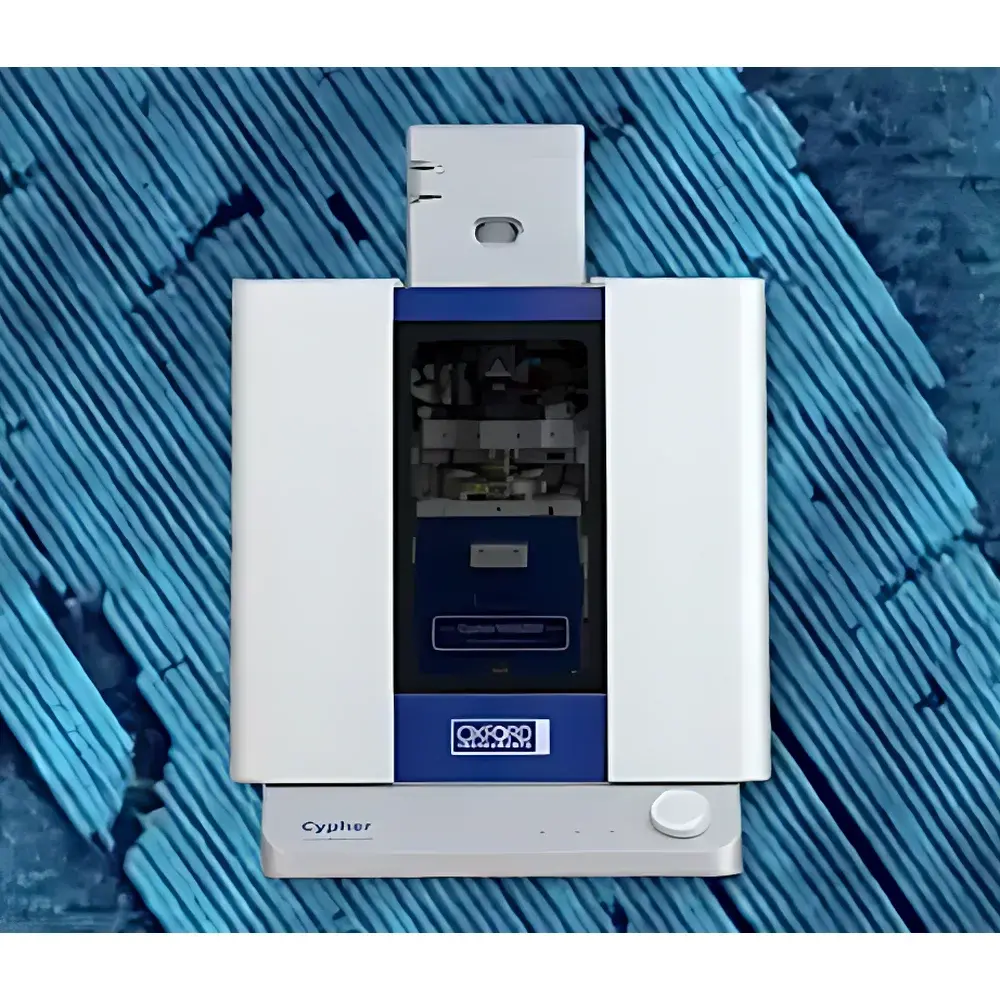
Oxford Instruments Cypher VRS1250 High-Speed Atomic Force Microscope
| Brand | Oxford Instruments |
|---|---|
| Origin | United Kingdom |
| Manufacturer Type | Authorized Distributor |
| Product Origin | Imported |
| Model | Cypher VRS1250 |
| Instrument Type | Materials-Focused Atomic Force Microscope |
| Position Detection Noise | X&Y < 60 pm |
| Sample Dimensions | Ø ≤ 15 mm, Thickness ≤ 7 mm |
| Stage Travel Range | 180 mm × 180 mm |
| Software | SmartScan |
| Environmental Compatibility | Fully compatible with Cypher ES environmental control system (temperature-controlled sample stage: –30 °C to +250 °C) |
| Excitation Method | blueDrive™ photothermal excitation |
Overview
The Oxford Instruments Cypher VRS1250 is a high-speed, closed-environment atomic force microscope engineered for quantitative nanoscale imaging and dynamic property mapping across materials science, soft matter, and life science applications. Utilizing a true closed-loop piezoelectric scanner architecture combined with low-noise position detection (<60 pm lateral, <15 pm vertical), the system delivers sub-angstrom resolution while maintaining exceptional thermal and mechanical stability. Its core measurement principle relies on detecting cantilever deflection via optical beam bounce—enhanced by blueDrive™ photothermal excitation—which eliminates acoustic coupling and enables stable, long-duration operation under ambient, liquid, or controlled-gas conditions. The integrated sealed sample chamber ensures minimal thermal drift and vibration isolation, making it suitable for time-lapse studies of biological macromolecules, polymer dynamics, and electrochemical interfaces without structural perturbation.
Key Features
- Video-rate imaging capability up to 45 frames per second at full spatial resolution, enabled by high-bandwidth electronics and optimized scan algorithms.
- blueDrive™ photothermal excitation provides consistent cantilever resonance actuation independent of laser alignment drift or environmental fluctuations—critical for multi-hour experiments.
- Thermally compensated mechanical design minimizes thermal drift to <0.5 nm/min in Z and <1 nm/min in XY over 30-minute intervals, verified per ISO 18975-2 guidelines.
- Large-area motorized sample stage (180 mm × 180 mm travel) supports automated multi-region acquisition and correlative workflows with optical microscopy.
- Modular vacuum-tight enclosure accommodates optional environmental modules including Cypher ES for precise temperature control (–30 °C to +250 °C) and gas/liquid cell integration.
- Automated laser alignment and motorized detector positioning reduce setup time and operator dependency—fully compliant with GLP-aligned laboratory documentation practices.
Sample Compatibility & Compliance
The Cypher VRS1250 accepts standard AFM substrates (e.g., mica, silicon wafers, glass coverslips) and custom samples up to 15 mm in diameter and 7 mm in thickness. Its sealed chamber supports in situ liquid imaging using commercial fluid cells and electrochemical flow cells. All hardware and firmware comply with CE marking requirements and meet electromagnetic compatibility standards per EN 61326-1. Data acquisition adheres to audit-trail principles required under FDA 21 CFR Part 11 when used with SmartScan’s optional electronic signature and user access control modules. The system is routinely validated against ASTM E2531–21 (Standard Guide for AFM Performance Verification) and ISO/IEC 17025-accredited calibration protocols.
Software & Data Management
SmartScan software provides a unified interface for instrument control, real-time data visualization, and post-processing—including FFT-based noise analysis, cross-section profiling, and force-distance curve fitting. All raw data are stored in HDF5 format with embedded metadata (timestamp, scanner calibration, environmental parameters), ensuring FAIR (Findable, Accessible, Interoperable, Reusable) compliance. Batch processing pipelines support automated report generation in PDF or LaTeX-ready formats, directly exportable for publication figures or regulatory submissions. SmartScan integrates with third-party platforms such as MATLAB, Python (via PyAFM), and LabVIEW through documented APIs—enabling custom algorithm deployment and AI-assisted feature extraction.
Applications
- Dynamic nanomechanical mapping of viscoelastic polymers during thermal cycling or solvent exposure.
- In situ observation of protein folding/unfolding kinetics and lipid bilayer reorganization in physiological buffers.
- High-resolution topography and phase imaging of battery electrode interfaces during electrochemical cycling.
- Quantitative adhesion and modulus mapping of thin-film semiconductor heterostructures.
- Time-resolved characterization of catalytic surface restructuring under reactive gas environments.
- Correlative AFM-optical microscopy of live-cell membrane dynamics using integrated inverted optical access ports.
FAQ
What environmental controls are supported beyond temperature regulation?
The Cypher VRS1250, when paired with the Cypher ES module, supports humidity control (5–95% RH), inert gas purging (N₂, Ar), and partial pressure regulation for catalysis or corrosion studies.
Is SmartScan compatible with automated workflow scripting?
Yes—SmartScan includes a Python-based scripting engine (SmartScan Scripter) that supports scheduled acquisitions, conditional triggers based on signal thresholds, and integration with robotic sample loaders.
Can the system be upgraded to include electrical or magnetic property mapping modes?
Yes—the platform supports optional add-ons including Conductive AFM (CAFM), Kelvin Probe Force Microscopy (KPFM), and Magnetic Force Microscopy (MFM) modules, all sharing the same mechanical and software infrastructure.
How is traceability ensured for regulatory submissions?
SmartScan logs all user actions, parameter changes, and hardware states with cryptographic timestamping; audit trails are exportable as encrypted CSV or XML files meeting ISO/IEC 17025 and 21 CFR Part 11 requirements.
What maintenance intervals are recommended for sustained metrological performance?
Oxford Instruments recommends quarterly calibration verification using NIST-traceable reference gratings and annual factory recalibration of position sensors and electronics—documented in accordance with ISO/IEC 17025 clause 6.5.





