
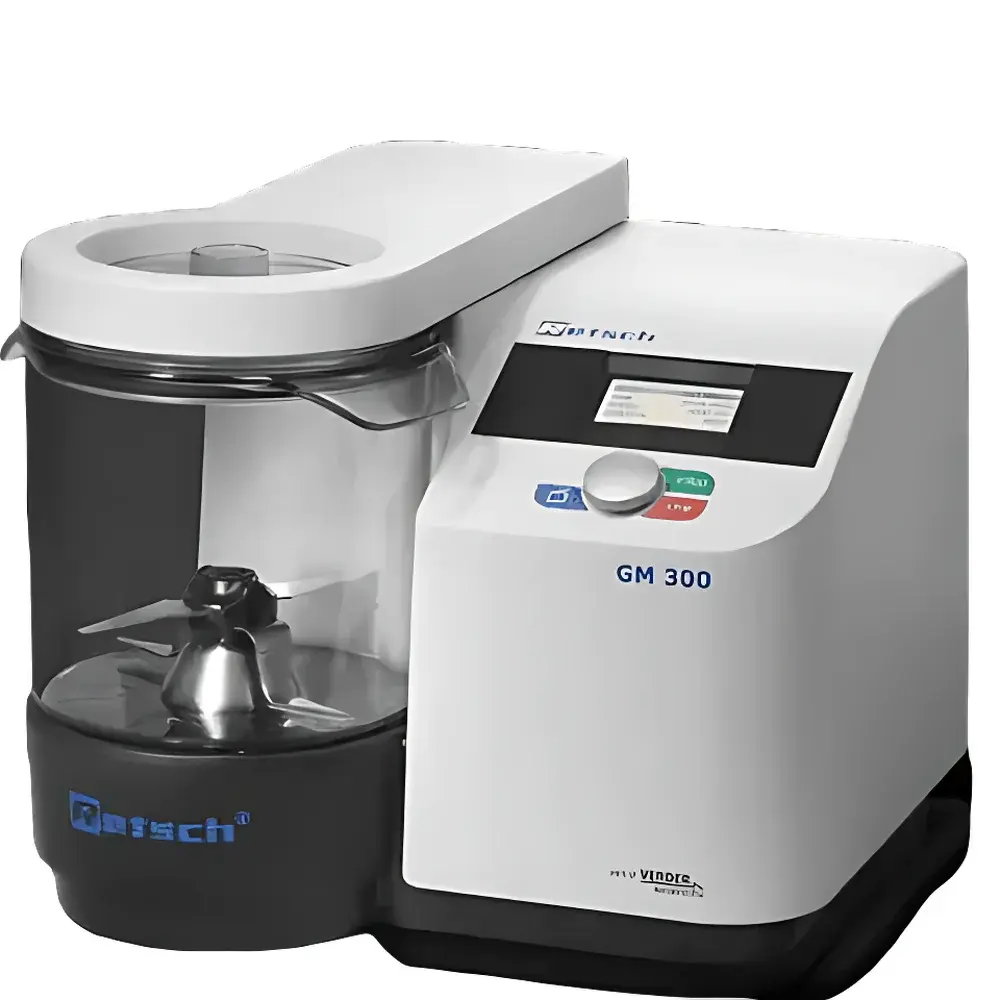
RETSCH GM 300 High-Performance Knife Mill
| Brand | RETSCH |
|---|---|
| Origin | Germany |
| Model | GM 300 |
| Motor Power | 1.1 kW (peak input > 3 kW) |
| Feed Capacity | 4500 mL |
| Maximum Feed Size | ~130 mm |
| Final Particle Size | < 300 µm |
| Speed Range | 500–4000 rpm (in 100 rpm increments) |
| Sample Type | Soft to moderately tough materials, including elastic and fibrous samples |
| Sterilization Compatibility | All contact parts autoclavable |
| Optional Accessories | Gravity lid, cryo-lid with pressure relief port, stainless steel & polymer grinding vessels, four blade variants (stainless steel, serrated stainless steel, full-metal, TiNb-coated for heavy-metal-free grinding) |
Overview
The RETSCH GM 300 High-Performance Knife Mill is a robust, laboratory-scale cutting mill engineered for rapid, reproducible pre-crushing and fine grinding of soft, fibrous, elastic, and heterogeneous organic materials. Operating on the principle of high-speed rotational shearing and impact comminution, the GM 300 employs a dynamically balanced rotor-mounted knife assembly rotating within a precisely engineered grinding chamber. Unlike conventional blenders or homogenizers, the GM 300 delivers controlled mechanical energy transfer—minimizing thermal degradation while ensuring homogeneous particle size reduction across diverse biological and food matrices. Its design conforms to ISO 17025-compliant laboratory workflows and supports GLP/GMP-aligned sample preparation protocols where traceability, contamination control, and process repeatability are critical.
Key Features
- 1.1 kW industrial motor with peak power capability exceeding 3 kW—enabling efficient size reduction of bulky, high-moisture, or viscoelastic samples (e.g., fresh meat, cheese, leafy vegetables, frozen fish)
- Adjustable rotational speed from 500 to 4000 rpm in precise 100 rpm increments—allowing optimization of shear intensity versus thermal load for sensitive analytes
- Autoclavable all-contact components—including grinding vessel, lid, rotor shaft, and interchangeable blades—ensuring compliance with microbiological and pharmaceutical cleanliness requirements
- Gravity lid system that dynamically reduces effective grinding volume by descending under its own weight during operation—maintaining consistent sample compression against the rotating knife and eliminating wall adhesion or channeling
- Cryo-lid option with calibrated pressure-relief vent—designed specifically for dry ice-assisted grinding of thermolabile or highly elastic materials (e.g., rubbery tissues, frozen berries, gum-based confections), preventing chamber overpressure while preserving structural integrity of labile compounds
- Intuitive graphical display with one-button operation and digital parameter entry—supporting storage of up to 10 user-defined SOPs with time, speed, and pause settings
- Tool-free vessel mounting and dismounting—facilitating rapid cleaning, cross-contamination mitigation, and residue-free sample recovery using optional scrapers
Sample Compatibility & Compliance
The GM 300 accommodates feed particles up to ~130 mm and routinely achieves final particle sizes below 300 µm—ideal for downstream analytical techniques including HPLC, GC-MS, NIR spectroscopy, and elemental analysis. It is validated for use with food-grade, pharmaceutical, and botanical samples per FDA 21 CFR Part 11–compatible SOP execution (when integrated with compliant LIMS or ELN systems). All wetted surfaces comply with USP and EU Directive 2002/72/EC for food contact materials. Stainless steel grinding vessels meet ASTM A276 standards; TiNb-coated blades satisfy ICH Q5D requirements for metal leaching control in biopharmaceutical raw material processing.
Software & Data Management
While the GM 300 operates as a standalone instrument, its digital interface enables direct integration into automated lab environments via RS232 or optional Ethernet module. Each stored SOP includes timestamped execution logs (start/stop time, speed, duration), supporting audit-ready documentation for ISO/IEC 17025 accreditation. When used in regulated QC/QA laboratories, the device’s deterministic behavior—combined with autoclavable traceability of consumables—fulfills ALCOA+ data integrity principles (Attributable, Legible, Contemporaneous, Original, Accurate, Complete, Consistent, Enduring, Available).
Applications
The GM 300 serves as a primary sample homogenization tool across food safety testing (e.g., pesticide residue analysis in lettuce or cabbage), nutraceutical QA (grinding of dietary supplements, cocoa nibs, oilseeds), veterinary diagnostics (fish tissue, sausage, ham), and phytochemical extraction (fresh herbs, spices, plant roots). It is routinely employed in accredited reference labs preparing certified reference materials (CRMs) for proficiency testing schemes under ILAC G13 guidelines. Applications extend to forensic toxicology (wine gum, gelatin-based matrices) and environmental monitoring (feed pellets, composted organics).
FAQ
Can the GM 300 process frozen or cryogenically treated samples?
Yes—using the dedicated cryo-lid and stainless steel vessel, it safely grinds samples cooled with dry ice, enabling homogenization of otherwise intractable elastic or rubbery materials without thawing.
Is cross-contamination prevented between sequential runs?
Yes—the tool-free vessel removal, autoclavable components, and scraper-compatible design eliminate residual carryover; validation studies confirm ≤0.1% mass retention across consecutive heterogeneous batches.
What regulatory standards does the GM 300 support?
The instrument meets mechanical safety requirements per EN 61000-6-2/-4 and is designed to facilitate compliance with ISO/IEC 17025, USP , and FDA 21 CFR Part 11 when operated within documented SOP frameworks.
How is particle size distribution controlled?
Through speed selection, grinding time, gravity lid positioning, and blade geometry—users establish empirical correlations between operational parameters and D90 values measured via laser diffraction (e.g., Mastersizer 3000) or sieve analysis.
Are replacement blades and vessels supplied with lot-specific certification?
Yes—RETSCH provides CoA documentation for all autoclavable accessories, including material composition reports and dimensional verification certificates traceable to DAkkS-accredited metrology labs.



