
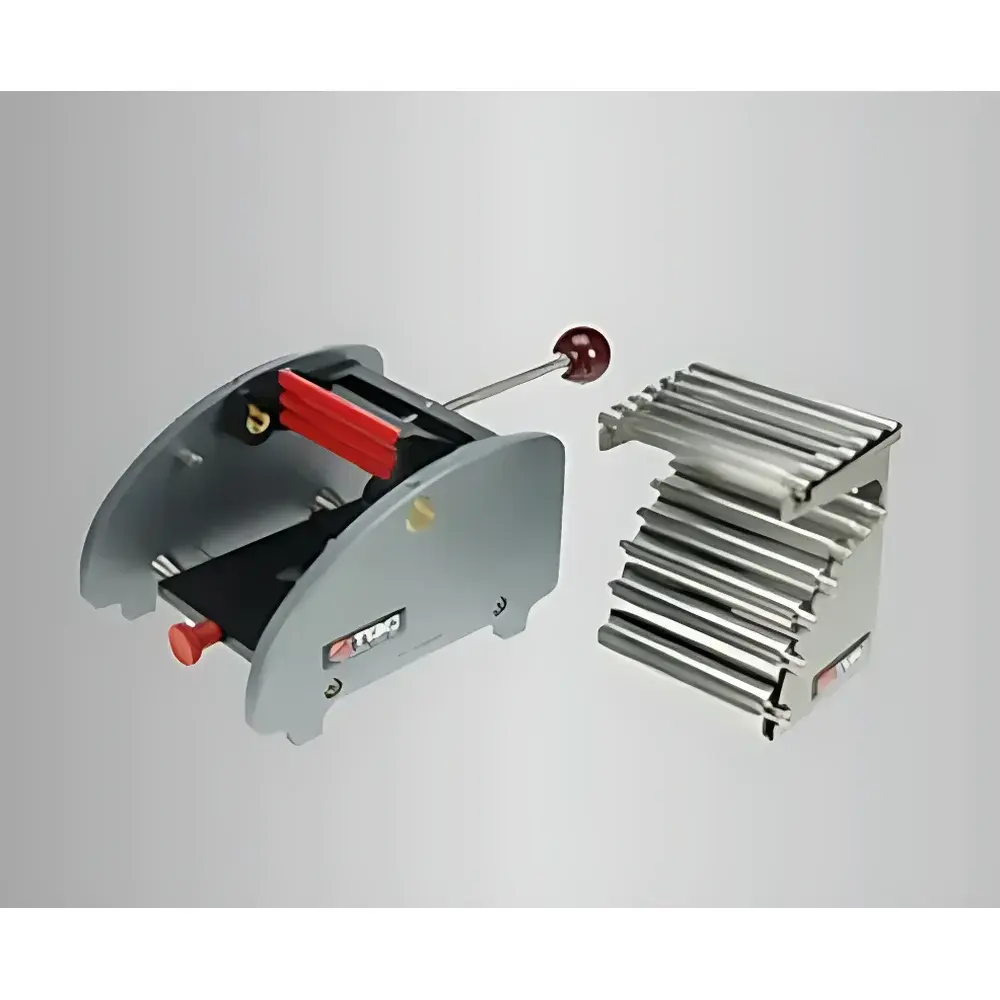
TQC Cylindrical Mandrel Bend Tester
| Brand | TQC |
|---|---|
| Origin | Netherlands |
| Manufacturer Type | Authorized Distributor |
| Origin Category | Imported |
| Model | Cylindrical Mandrel Bend Tester |
| Pricing | Available Upon Request |
Overview
The TQC Cylindrical Mandrel Bend Tester is a precision mechanical testing instrument engineered for the standardized evaluation of coating elasticity, ductility, and adhesion to metallic substrates under controlled bending stress. It operates on the fundamental principle of mandrel bending—where a coated metal panel (150 × 100 mm) is forcibly bent around a rigid cylindrical mandrel of defined diameter. As mandrel diameter decreases, the induced tensile strain on the coating surface increases proportionally, enabling systematic differentiation between coatings with high flexibility and those prone to cracking or delamination. This method directly correlates to real-world performance under thermal expansion, mechanical deformation, or forming processes encountered in coil coating, automotive body panels, and architectural cladding applications. The tester complies strictly with ISO 1519:2022 “Paints and varnishes — Determination of resistance to bending (mandrel test)”, ensuring metrological traceability and interlaboratory reproducibility.
Key Features
- Robust, benchtop-mounted design with optional wall-mounting capability via integrated bracket system—optimized for space-constrained QC laboratories and production line environments.
- Comprehensive mandrel set included: fourteen hardened steel cylindrical mandrels with diameters of 2, 3, 4, 5, 6, 8, 10, 12, 13, 16, 19, 20, 25, and 32 mm—covering the full range specified in ISO 1519 and aligned with QUALICOAT, QIB, and GSB International certification requirements.
- Mandrels manufactured to ISO 2768-mK general tolerances, with surface roughness ≤ Ra 0.8 µm to prevent unintended abrasion or micro-scratching during bending.
- Calibrated mechanical lever mechanism ensures consistent, repeatable force application—eliminating operator-dependent variability inherent in manual bending tools.
- Non-slip base plate and adjustable panel clamping fixture secure standard 150 × 100 mm test panels (steel or aluminum) during bending, minimizing lateral slippage and ensuring uniform strain distribution across the coated surface.
Sample Compatibility & Compliance
The tester accommodates standard test panels conforming to ISO 1514 and ASTM D609 specifications: cold-rolled steel (0.25–0.30 mm thick) or aluminum alloy (e.g., AA1050-H14, 0.3 mm), pre-coated with liquid paints, powder coatings, or conversion layers. Panel preparation—including degreasing, pretreatment, and curing—must follow relevant substrate-specific protocols (e.g., EN 13523-0 for coil-coated metals). Test results are interpreted per ISO 1519 Annex A, using standardized visual assessment under 2× magnification to classify cracking severity (e.g., “no cracking,” “cracking at edges only,” “cracking extending >2 mm from edge”). The instrument is formally recognized and validated by QUALICOAT (for architectural aluminum anodizing and powder coating), QIB (Quality Inspectie Bouw), and GSB International—supporting compliance documentation for auditable quality management systems (ISO 9001, ISO/IEC 17025).
Software & Data Management
This mechanical tester operates without embedded electronics or proprietary software. All test parameters—including mandrel diameter, substrate type, coating formulation, cure conditions, and pass/fail assessment—must be recorded manually in laboratory notebooks or electronic lab notebooks (ELNs) compliant with GLP/GMP requirements. For regulated environments (e.g., pharmaceutical packaging or aerospace coatings), users may integrate test records into LIMS platforms with audit-trail functionality per FDA 21 CFR Part 11. Calibration certificates for individual mandrels (traceable to NMI-VSL, the Dutch Metrology Institute) are supplied with each unit and must be retained as part of equipment qualification (IQ/OQ documentation).
Applications
- Evaluation of flexibilizers and plasticizers in automotive OEM and refinish coatings.
- Qualification of powder coatings for roll-forming applications in building envelope systems.
- Batch release testing of coil-coated steel used in HVAC ductwork and appliance housings.
- R&D screening of novel waterborne acrylics and hybrid silane-based coatings for improved low-temperature bend performance.
- Third-party verification for CE marking dossiers requiring ISO 1519 conformity evidence.
FAQ
What standards does the TQC Cylindrical Mandrel Bend Tester comply with?
It is fully compliant with ISO 1519:2022 and supports conformance testing referenced in EN 13523-8, ASTM D522 (for elongation-based variants), and QUALICOAT Technical Specification Section 4.3.
Can the tester be used for non-metallic substrates such as plastics or composites?
While ISO 1519 specifies metallic panels, the instrument may be adapted for rigid polymeric substrates (e.g., PVC, polycarbonate sheets ≥1 mm thickness) provided panel dimensions and clamping geometry remain consistent; however, interpretation of results requires correlation with substrate-specific failure modes and is not covered by ISO 1519 certification.
Is calibration required before first use?
Yes—each mandrel set includes a calibration certificate issued by TQC’s accredited metrology partner, verifying dimensional accuracy against national standards; annual recalibration is recommended for ISO/IEC 17025-accredited labs.
How is pass/fail determined after bending?
Assessment follows ISO 1519 Clause 6: visual inspection under daylight or D65 illumination at 2× magnification, with classification based on crack length, density, and location relative to the bend apex—no instrumental quantification is performed by the device itself.
Does the instrument require electrical power or compressed air?
No—it is a purely mechanical, hand-operated device requiring no external utilities, ensuring operational reliability in field laboratories or cleanroom environments where electromagnetic interference or pneumatic infrastructure is restricted.





